

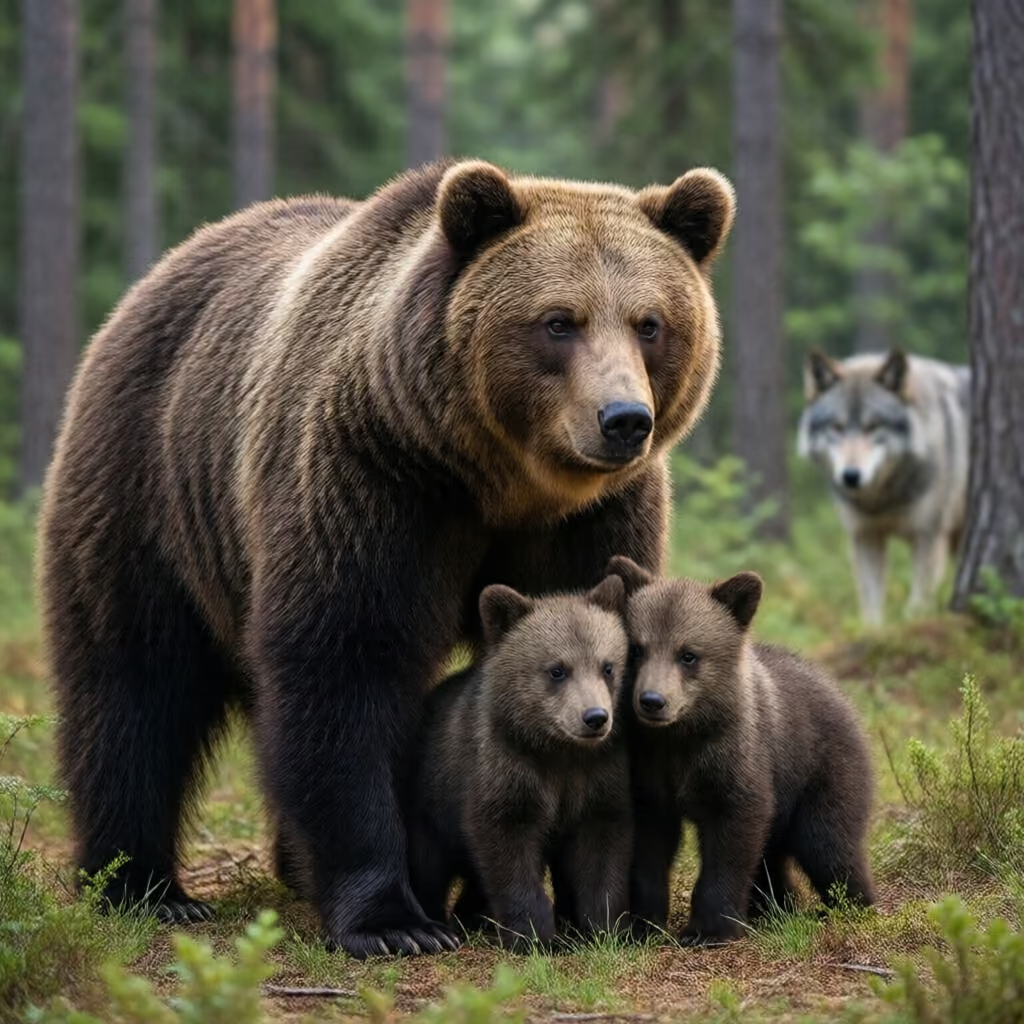
die Bärin
she-bear
A female animal from the bear family.
EXAMPLE
Die Bärin beschützt ihre Jungen vor dem Wolf.
The she-bear protects her cubs from the wolf.
she-bear
die Bärin, die Bärinnen
Loading your saved state.
she-bear
A female animal from the bear family.
Die Bärin beschützt ihre Jungen vor dem Wolf.
The she-bear protects her cubs from the wolf.
| gender | feminine die |
|---|---|
| plural | die Bärinnen |
| genitive | der Bärin |
| singular | plural | |
|---|---|---|
| nominative | die Bärin | die Bärinnen |
| accusative | die Bärin | die Bärinnen |
| dative | der Bärin | den Bärinnen |
| genitive | der Bärin | der Bärinnen |
The article changes with the case; it is shown in colour.
'Bärin' (she-bear) also appears at the end of animal names such as 'Eisbärin' (female polar bear) and 'Braunbärin' (female brown bear). These compounds also specify the bear species.
Die Bärin auf dem Foto ist eine Eisbärin.
The she-bear in the photo is a female polar bear.
When talking about offspring, 'Junge zur Welt bringen' (to give birth to cubs) and 'ihre Jungen säugen' (to nurse her cubs) are typical collocations with 'Bärin' (she-bear). 'Säugen' means that the mother feeds her young with milk.
Die Bärin liegt auf der Seite und säugt ihre Jungen.
The she-bear lies on her side and nurses her cubs.
In texts about brown bears, 'Winterruhe halten' (to enter a state of winter dormancy) is a typical collocation. In this context, 'Bärin' (she-bear) often appears together with a location such as 'in einer Höhle' (in a cave).
Die Bärin hält in einer geschützten Höhle Winterruhe.
The she-bear is spending the winter in a sheltered cave.