

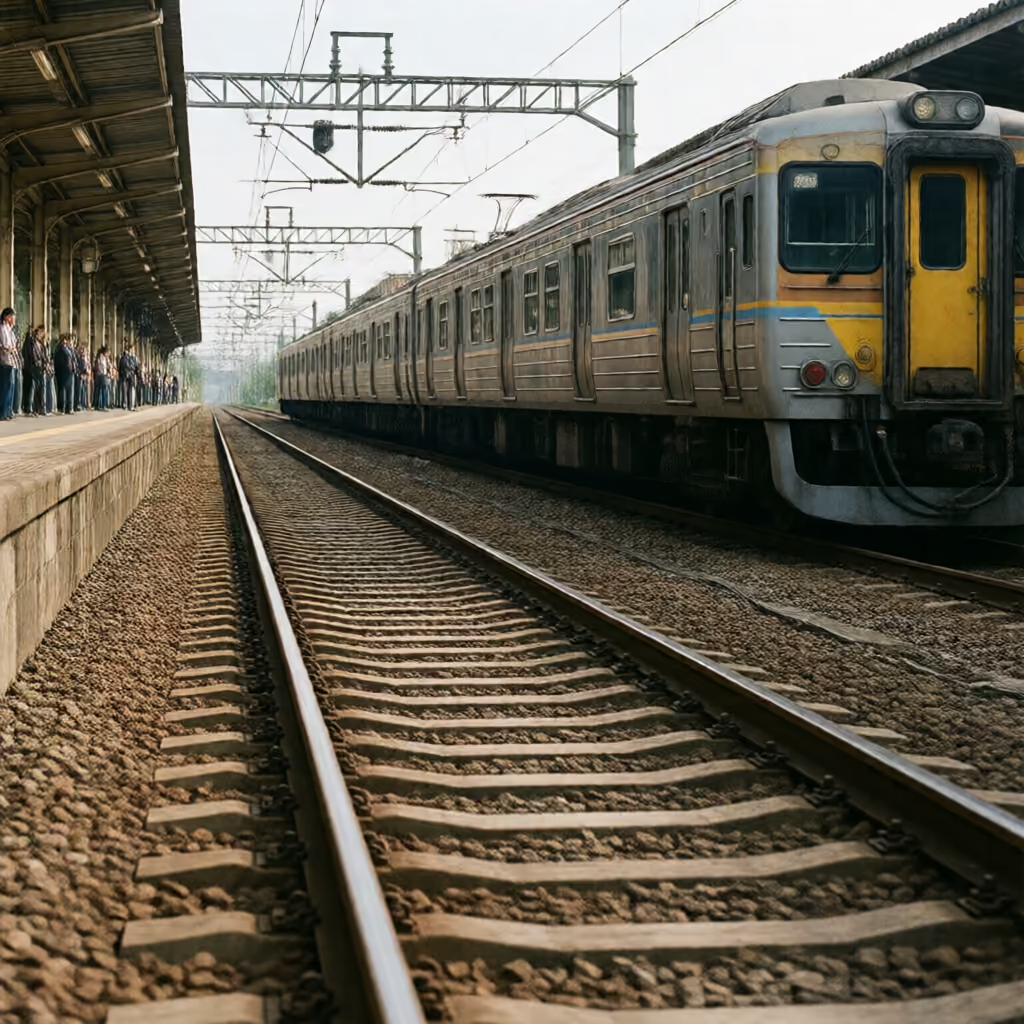
das Bahngleis
railway track
A track on which railway trains travel or stop at a station.
EXAMPLE
Der Zug steht auf dem Bahngleis neben dem Bahnsteig.
The train is standing on the railway track next to the platform.
railway track
das Bahngleis, die Bahngleise
Loading your saved state.
railway track
A track on which railway trains travel or stop at a station.
Der Zug steht auf dem Bahngleis neben dem Bahnsteig.
The train is standing on the railway track next to the platform.
| gender | neuter das |
|---|---|
| plural | die Bahngleise |
| genitive | des Bahngleises |
| singular | plural | |
|---|---|---|
| nominative | das Bahngleis | die Bahngleise |
| accusative | das Bahngleis | die Bahngleise |
| dative | dem Bahngleis | den Bahngleisen |
| genitive | des Bahngleises | der Bahngleise |
The article changes with the case; it is shown in colour.
'Bahngleis' (railway track) is made up of 'Bahn' (railway) and 'Gleis' (track). The base word 'Gleis' refers to the track; 'Bahn' indicates the connection with railway transport.
Das Bahngleis wird heute wegen Bauarbeiten gesperrt.
The railway track is being closed today because of construction work.
For a train that is located on a track, 'auf' (on) is often used with the dative. For movement onto a track, 'auf' (onto) can be used with the accusative.
Der Güterzug wartet auf dem Bahngleis hinter dem Bahnhof.
The freight train is waiting on the railway track behind the station.
Die Lok fährt langsam auf das freie Bahngleis.
The locomotive is slowly moving onto the empty railway track.
'Bahngleis' (railway track) is especially often used with verbs related to train traffic, such as 'einfahren' (to pull in), 'abfahren' (to depart), 'warten' (to wait), and 'ankommen' (to arrive). Place expressions such as 'am Bahnhof' (at the station) or 'neben dem Bahnsteig' (next to the platform) are also often used with it.
Der Regionalzug fährt gerade auf dem Bahngleis am Bahnhof ein.
The regional train is just pulling in on the track at the station.