

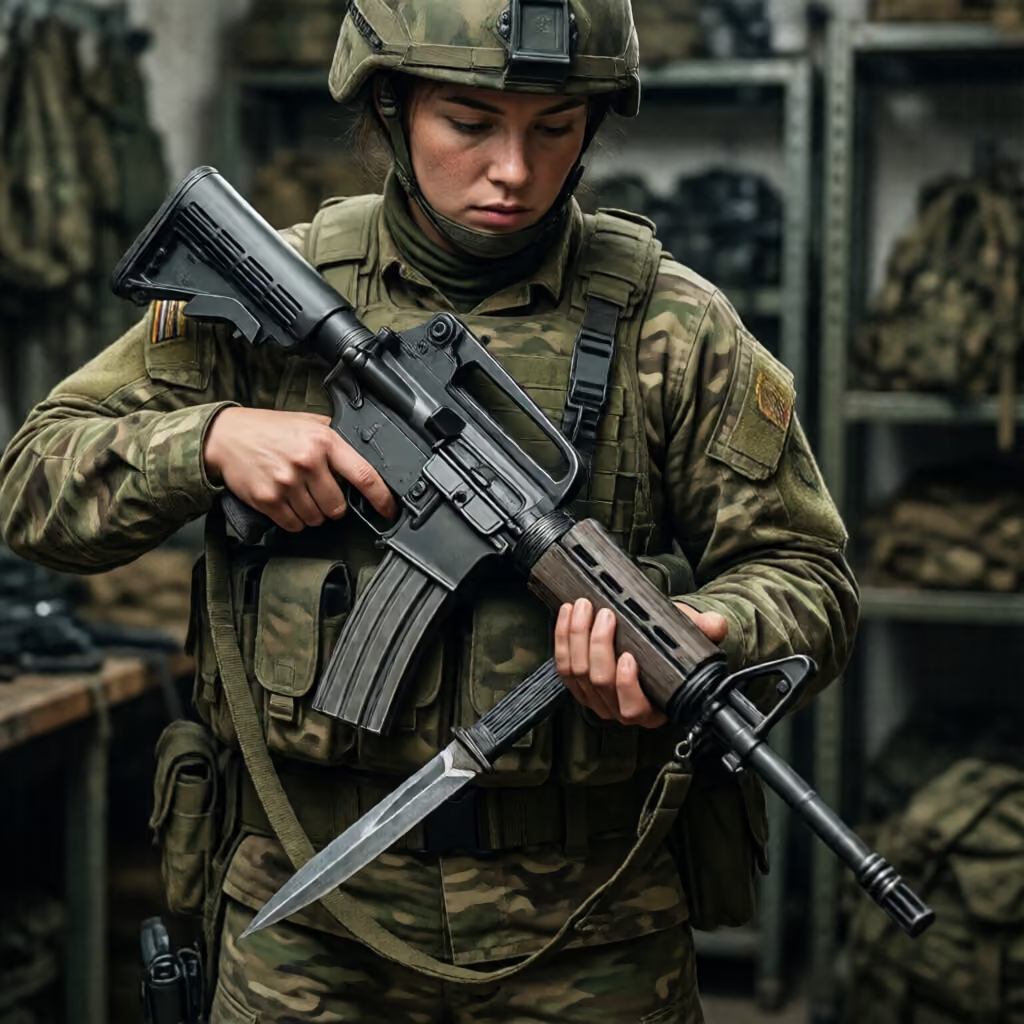
das Bajonett
bayonet
A thrusting weapon, usually shaped like a knife, that can be attached to a rifle.
EXAMPLE
Der Soldat befestigte das Bajonett am Gewehr.
The soldier attached the bayonet to the rifle.
bayonet
das Bajonett, die Bajonette
Loading your saved state.
bayonet
A thrusting weapon, usually shaped like a knife, that can be attached to a rifle.
Der Soldat befestigte das Bajonett am Gewehr.
The soldier attached the bayonet to the rifle.
| gender | neuter das |
|---|---|
| plural | die Bajonette |
| genitive | des Bajonetts |
| singular | plural | |
|---|---|---|
| nominative | das Bajonett | die Bajonette |
| accusative | das Bajonett | die Bajonette |
| dative | dem Bajonett | den Bajonetten |
| genitive | des Bajonetts des Bajonettes | der Bajonette |
The article changes with the case; it is shown in colour.
Common expressions include 'ein Bajonett aufpflanzen' (to fix a bayonet), 'mit aufgepflanztem Bajonett' (with a fixed bayonet), and 'ein Bajonettangriff' (a bayonet charge). The verb 'aufpflanzen' (to fix) is used here specifically for attaching a bayonet to a rifle.
Die Soldaten rückten mit aufgepflanztem Bajonett vor.
The soldiers advanced with fixed bayonets.
'Bajonett' (bayonet) often appears alongside words from military or historical contexts, such as 'Gewehr' (rifle), 'Angriff' (attack), 'Soldat' (soldier), or 'Infanterie' (infantry). These context clues make its meaning easy to recognize in a text.
Der historische Bericht beschreibt einen Angriff mit dem Bajonett.
The historical account describes a bayonet attack.
The word is primarily used in military language and frequently appears in historical accounts, novels, and descriptions of weapons. It is rarely used in modern everyday life.
Im Roman schildert der Autor den Kampf mit dem Bajonett besonders eindringlich.
In the novel, the author describes the bayonet fighting particularly vividly.