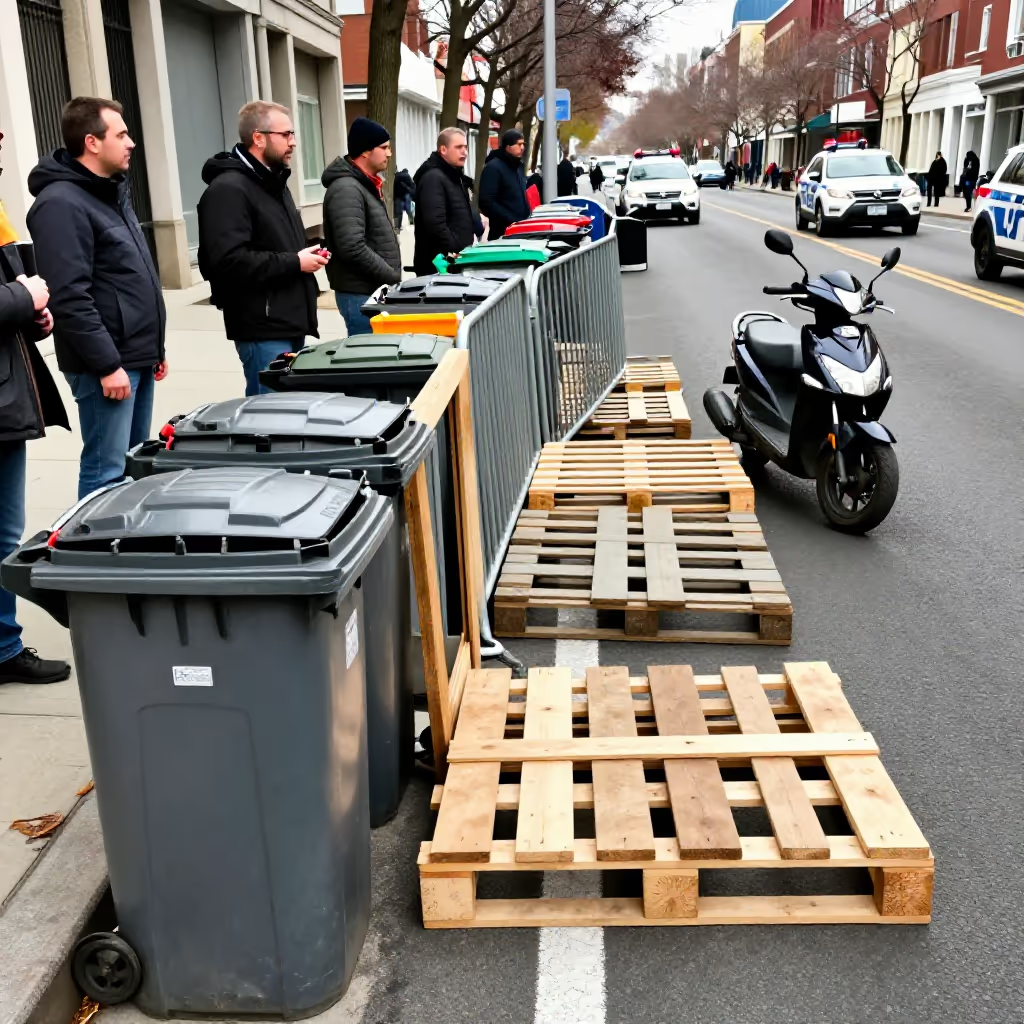
An improvised barrier built from various objects such as furniture, vehicles, or building materials in order to block a street or an entrance, often during protests or fighting.
example
Die Demonstranten errichteten eine Barrikade aus brennenden Reifen.
The demonstrators built a barricade out of burning tires.

Usage tips
Fixed expression
The idiom 'auf die Barrikaden gehen' means to protest loudly and angrily or to campaign energetically for or against something. It is often used in a figurative sense.
EXAMPLE
Als die Firma die Schließung des Werks bekannt gab, gingen die Mitarbeiter auf die Barrikaden.
When the company announced the closure of the plant, the employees went up in arms.
Context clue
The literal meaning can be recognized from words that describe physical objects or places (e.g., 'Straße' (street), 'Möbel' (furniture), 'blockieren' (to block)). The figurative meaning is used with abstract nouns such as 'Kommunikation' (communication), 'Verständigung' (understanding/agreement), or 'Ideologie' (ideology).
EXAMPLE
Die Polizei versuchte, die Barrikade aus Autowracks zu entfernen.
The police tried to remove the barricade made of car wrecks.
Typical verbs
In the literal sense, a 'Barrikade' (barricade) is typically 'errichtet' (erected/built) or 'gebaut' (built). The opposite is to 'durchbrechen' (break through), 'räumen' (clear), or 'entfernen' (remove) a barricade.
EXAMPLE
In der Nacht errichteten die Aktivisten eine neue Barrikade.
During the night, the activists built a new barricade.
Figurative use
In the figurative sense, people often talk about 'Barrikaden abzubauen' (breaking down barriers) in order to overcome obstacles in communication or cooperation. Here too, one can metaphorically 'Barrikaden errichten' (put up barriers).
EXAMPLE
Der neue Chef versucht, die Barrikaden zwischen den Abteilungen abzubauen.
The new boss is trying to break down the barriers between the departments.
Compare with
near_synonym · confusable
Barrikade vs Hürde
hurdle
'Hürde' and 'Barrikade' can both describe an obstacle in a figurative sense. 'Hürde' is more neutral and means a difficulty that you have to overcome in order to move forward. 'Barrikade' sounds stronger: it feels like a barrier that blocks something, for example a conversation, an agreement, or progress. Learners may confuse the words because both make the path to a goal more difficult. For normal problems, 'Hürde' usually fits better. 'Barrikade' fits when something clearly blocks things or when people resist something internally or externally.
Barrikade
Im Gespräch baute sie eine Barrikade auf, weil sie keine Kritik hören wollte.
In the conversation, she put up a barrier because she did not want to hear any criticism.
Hürde
Wegen der hohen Kosten bleibt die Wohnungssuche eine große Hürde für die Familie.
Because of the high costs, finding an apartment remains a major hurdle for the family.