

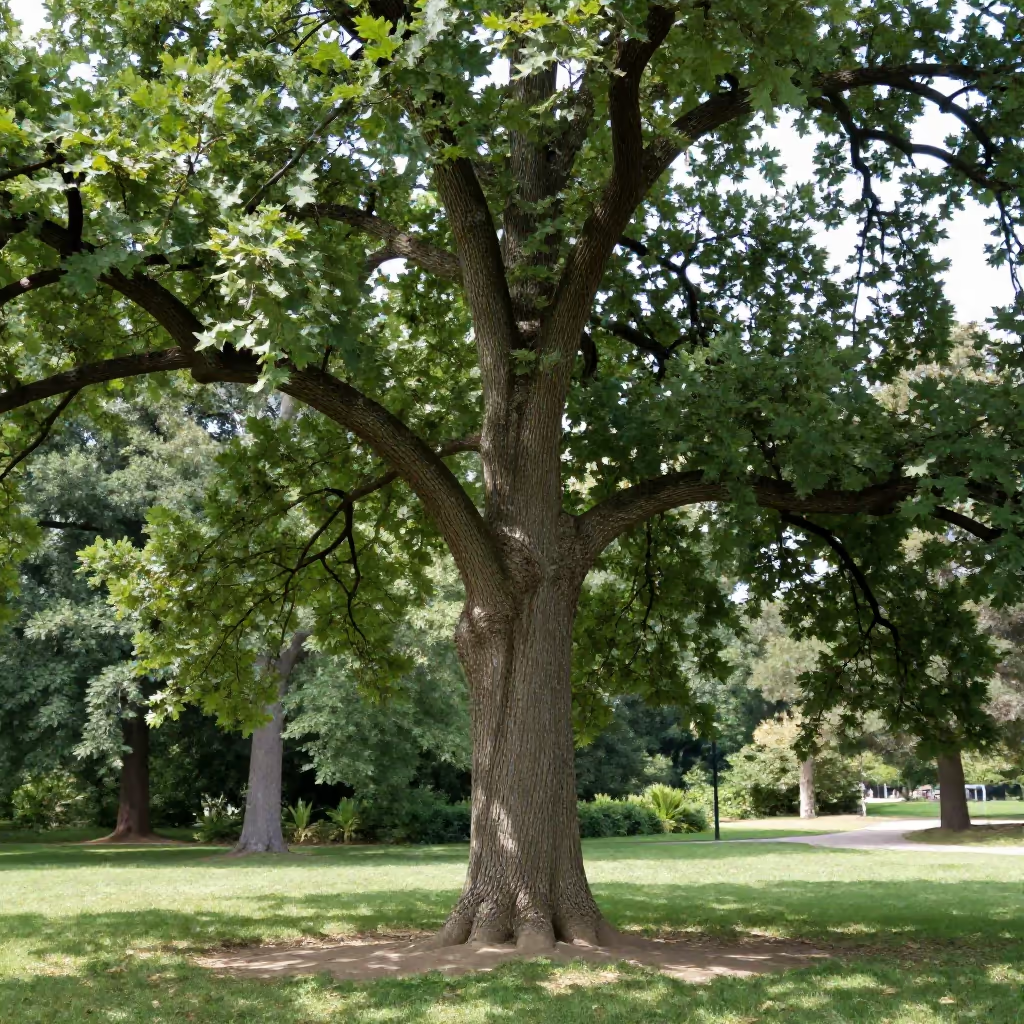
der Baum
tree
A large perennial plant with a woody trunk that divides into branches and twigs and bears leaves or needles.
EXAMPLE
Im Herbst verlieren die meisten Bäume ihre Blätter.
In autumn, most trees lose their leaves.
tree
Loading your saved state.
tree
A large perennial plant with a woody trunk that divides into branches and twigs and bears leaves or needles.
Im Herbst verlieren die meisten Bäume ihre Blätter.
In autumn, most trees lose their leaves.

tree
A graphic representation in the form of a branching structure that shows hierarchies or relationships, such as a family tree.
In der Informatik werden Daten oft in einer Baum-Struktur organisiert.
In computer science, data is often organized in a tree structure.

big strong guy
Colloquial and figurative for a very tall, strong man.
Der Türsteher war ein Baum von einem Kerl.
The bouncer was a giant of a guy.
With location expressions involving 'Baum' (tree), the distinction between dative and accusative is important. Movement toward a place requires the accusative, while being positioned at a place requires the dative.
Die Katze klettert auf den Baum.
The cat climbs up the tree.
The word 'Baum' (tree) is a very productive component of many compound nouns. If you see '-baum' at the end of a word, it is often a specific type of tree or something shaped like a tree.
Zu Weihnachten schmücken wir den Tannenbaum.
At Christmas, we decorate the fir tree.
In connection with the plant, 'Baum' (tree) is often combined with certain verbs. Typical actions are 'einen Baum pflanzen' (to plant a tree), 'einen Baum fällen' (to cut down a tree), or 'auf einen Baum klettern' (to climb a tree).
Die Stadtverwaltung will nächstes Jahr hundert neue Bäume pflanzen.
The city administration wants to plant one hundred new trees next year.
You can recognize the meaning of a graphic structure from words from the fields of computer science, science, or genealogy. Typical clues are 'Struktur' (structure), 'Daten' (data), 'Hierarchie' (hierarchy), or 'Stammbaum' (family tree).
Der Stammbaum der Familie reicht bis ins 17. Jahrhundert zurück.
The family tree goes back to the 17th century.
The colloquial expression for a tall, strong man follows a fixed pattern: 'ein Baum von einem Kerl' (a giant of a guy) or 'ein Baum von einem Mann' (a giant of a man). The word 'Kerl' (guy) is very common here.
Der neue Kollege ist ein Baum von einem Kerl und kann schwere Kisten allein tragen.
The new colleague is a giant of a guy and can carry heavy boxes by himself.