


behalten
to keep
To leave something in one's own possession and not give it away, sell it, or return it.
EXAMPLE
Den Rest des Geldes können Sie als Trinkgeld behalten.
You can keep the rest of the money as a tip.
to keep
Loading your saved state.
to keep
To leave something in one's own possession and not give it away, sell it, or return it.
Den Rest des Geldes können Sie als Trinkgeld behalten.
You can keep the rest of the money as a tip.
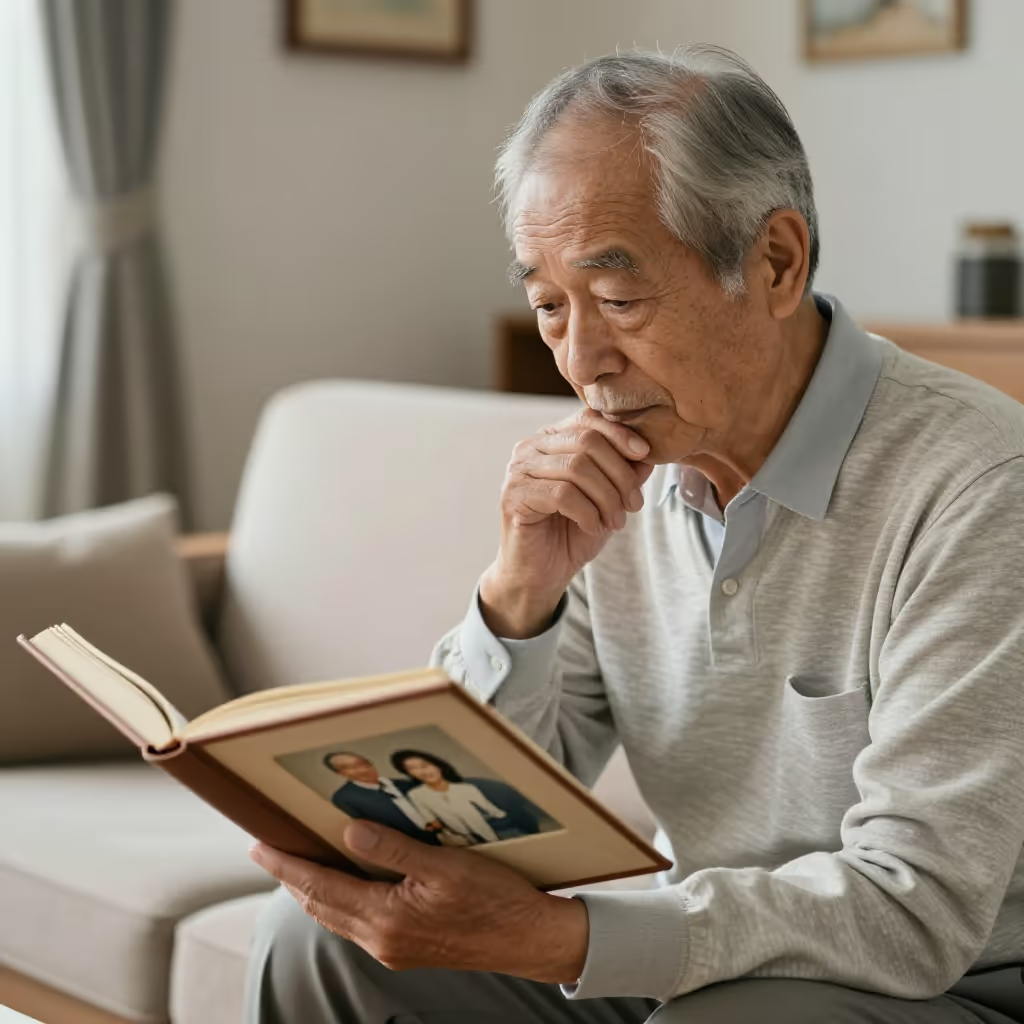
to remember
To remember something; to retain something in one's memory.
Ich kann mir Telefonnummern einfach nicht behalten.
I simply can't remember phone numbers.

to keep to oneself
Not to pass on information or a secret.
Das ist eine Überraschung, also behalte es bitte für dich.
This is a surprise, so please keep it to yourself.
to keep
To maintain or preserve a certain state, quality, or attitude.
Trotz der Hektik hat sie immer die Ruhe behalten.
Despite the hectic situation, she always kept calm.

to be proven right
To turn out in the end to have been right about something one predicted or claimed.
Sie wollte es nicht zugeben, aber am Ende habe ich doch Recht behalten.
She didn't want to admit it, but in the end I was proven right after all.
'Behalten' (to keep) is an inseparable verb. The prefix 'be-' remains firmly attached to the verb stem 'halten' in all tenses and sentence constructions.
Er behielt das Geheimnis für sich.
He kept the secret to himself.
The verb 'behalten' (to keep) almost always requires a direct object in the accusative. You always keep 'etwas' (something).
Darf ich diesen Stift behalten?
May I keep this pen?
In the meaning 'sich erinnern' (to remember), 'behalten' is used reflexively with a dative pronoun. The structure is: 'sich (dative) etwas (accusative) behalten'.
Ich kann mir neue Vokabeln nur schwer behalten.
I have a hard time remembering new vocabulary.
To express that someone does not pass on a secret, you use the fixed expression 'etwas für sich behalten' (to keep something to oneself). The reflexive pronoun changes according to the person.
Kannst du das bitte für dich behalten?
Can you please keep that to yourself?
When 'behalten' (to keep) describes maintaining a state, it is often combined with abstract nouns. Common expressions are 'die Ruhe bewahren' (to keep calm), 'die Nerven behalten' (to keep one's nerve), or 'einen kühlen Kopf behalten' (to keep a cool head).
Obwohl alle panisch waren, hat sie die Nerven behalten.
Although everyone was panicking, she kept her nerve.
The expression 'Recht behalten' (to be proven right) means that an earlier claim or assumption has turned out to be correct. It describes the result over a longer period of time.
Ich habe es dir doch gesagt! Am Ende habe ich wieder einmal Recht behalten.
I told you so! In the end, I was proven right once again.
to notice / remember
Behalten and sich etwas merken both relate to keeping information in your memory. Sich etwas merken emphasizes the process of memorizing something, while behalten describes more the resulting state in which the information is not forgotten. Use merken when learning or memorizing something, and behalten when remembering it later is important.

Nach dem Lernen konnte ich die neue Adresse auch ohne Notiz behalten.
After studying, I was able to remember the new address without a note.
Beim Lernen merke ich mir die neue Adresse, indem ich sie zweimal laut lese.
When studying, I memorize the new address by reading it aloud twice.