

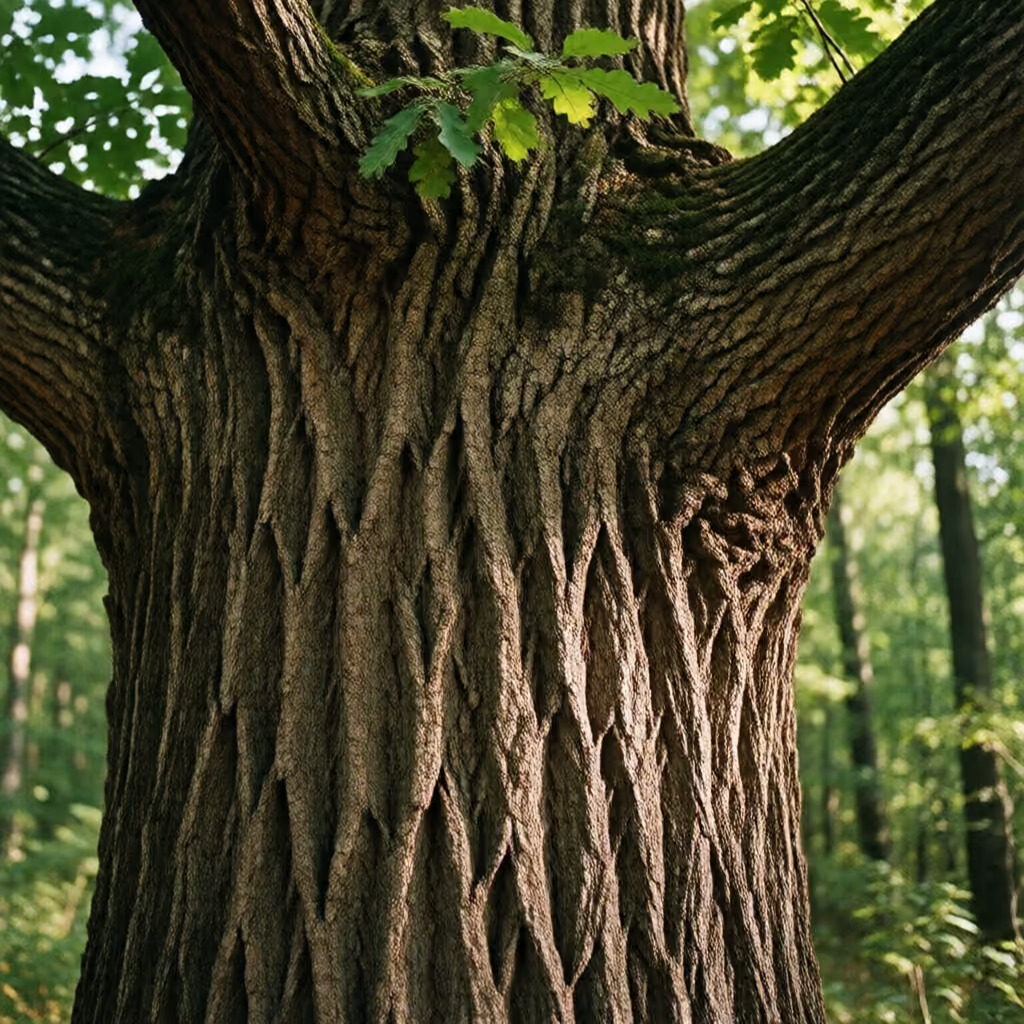
die Baumrinde
tree bark
The outer, protective layer of a tree or another woody plant.
EXAMPLE
Die Baumrinde schützt den Stamm vor Verletzungen und Austrocknung.
The tree bark protects the trunk from injuries and drying out.
tree bark
die Baumrinde, die Baumrinden
Loading your saved state.
tree bark
The outer, protective layer of a tree or another woody plant.
Die Baumrinde schützt den Stamm vor Verletzungen und Austrocknung.
The tree bark protects the trunk from injuries and drying out.
| gender | feminine die |
|---|---|
| plural | die Baumrinden |
| genitive | der Baumrinde |
| singular | plural | |
|---|---|---|
| nominative | die Baumrinde | die Baumrinden |
| accusative | die Baumrinde | die Baumrinden |
| dative | der Baumrinde | den Baumrinden |
| genitive | der Baumrinde | der Baumrinden |
The article changes with the case; it is shown in colour.
'Baumrinde' (tree bark) is made up of 'Baum' (tree) and 'Rinde' (bark). The base word 'Rinde' (bark) refers to the outer layer of a tree.
Die Baumrinde ist an dieser Stelle besonders dick.
The tree bark is especially thick in this spot.
Verbs such as 'beschädigen' (to damage), 'ritzen' (to scratch), 'abschälen' (to peel off), and 'untersuchen' (to examine) are often used with 'Baumrinde' (tree bark). These combinations describe typical actions or observations involving the bark.
Die Kinder sollen die Baumrinde nicht beschädigen.
The children must not damage the tree bark.
For a location on the bark, 'an der Baumrinde' (on the tree bark) is often used. After 'an' (at/on), the dative is used here because the phrase refers to a fixed location.
An der Baumrinde entdeckte die Försterin Spuren von Insekten.
On the tree bark, the forester discovered traces of insects.