

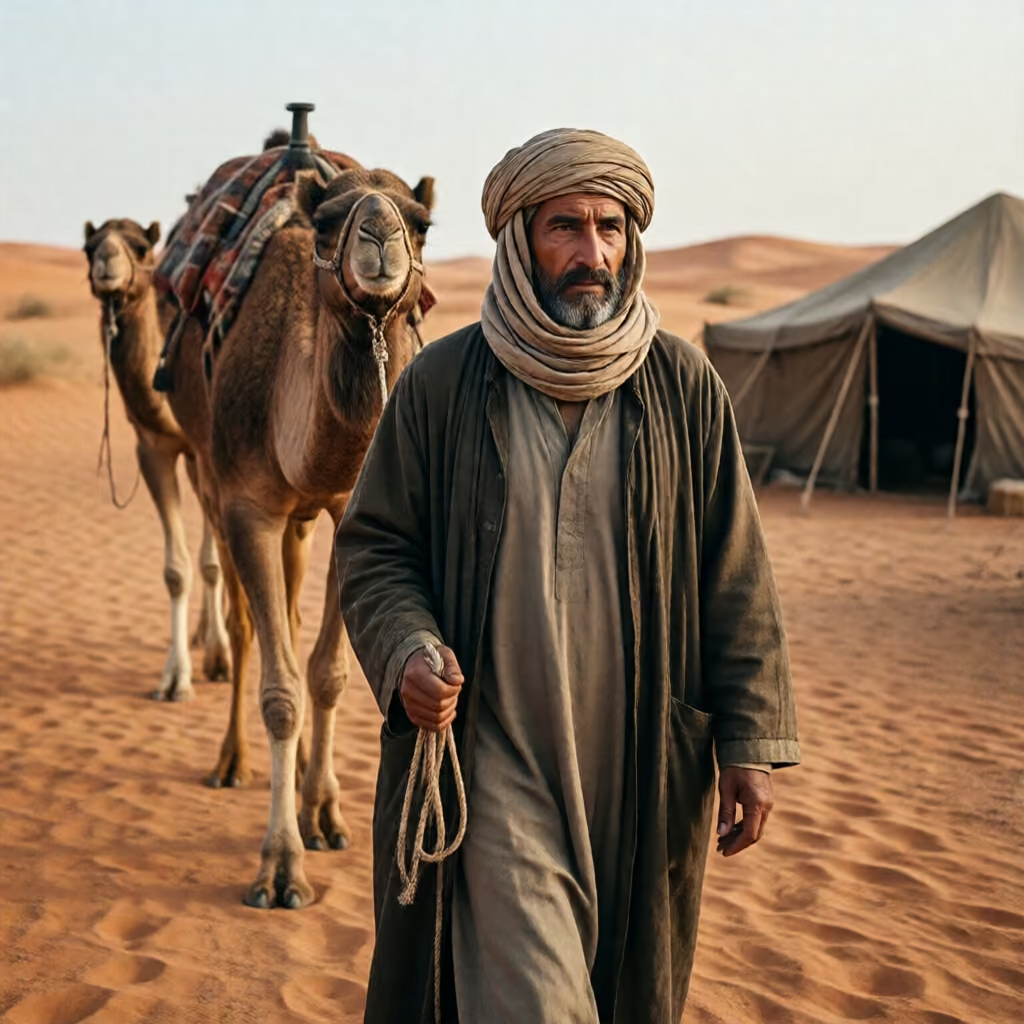
der Beduine
Bedouin
A member of an Arab desert people that traditionally lives as nomads.
EXAMPLE
Der Beduine führte die Reisegruppe sicher durch die Wüste.
The Bedouin guided the tour group safely through the desert.
Bedouin
der Beduine, die Beduinen
Loading your saved state.
Bedouin
A member of an Arab desert people that traditionally lives as nomads.
Der Beduine führte die Reisegruppe sicher durch die Wüste.
The Bedouin guided the tour group safely through the desert.
| gender | masculine der |
|---|---|
| plural | die Beduinen |
| genitive | des Beduinen |
| singular | plural | |
|---|---|---|
| nominative | der Beduine | die Beduinen |
| accusative | den Beduinen | die Beduinen |
| dative | dem Beduinen | den Beduinen |
| genitive | des Beduinen | der Beduinen |
The article changes with the case; it is shown in colour.
| gender | feminine die |
|---|---|
| plural | die Beduinen |
| genitive | der Beduine |
| singular | plural | |
|---|---|---|
| nominative | die Beduine | die Beduinen |
| accusative | die Beduine | die Beduinen |
| dative | der Beduine | den Beduinen |
| genitive | der Beduine | der Beduinen |
The article changes with the case; it is shown in colour.
In compound words, you can recognize „Beduine“ (Bedouin) by the element „Beduinen-“ (Bedouin), as in „Beduinenzelt“ (Bedouin tent) or „Beduinendorf“ (Bedouin village). This element indicates which population group the tent or village belongs to.
Der Beduine lud uns in sein Beduinenzelt ein.
The Bedouin invited us into his Bedouin tent.
When you are talking about a single Bedouin, the word takes the ending „-n“ in the accusative and dative. Learn the sentence patterns „einen Beduinen treffen“ (to meet a Bedouin) and „mit einem Beduinen sprechen“ (to speak with a Bedouin).
Auf unserer Reise trafen wir einen Beduinen, der uns den Weg erklärte.
On our journey, we met a Bedouin who explained the way to us.
Die Reporterin sprach mit einem Beduinen über das Leben seiner Familie.
The reporter spoke with a Bedouin about his family's life.
Common collocations are „nomadische Beduinen“ (nomadic Bedouins) and „sesshafte Beduinen“ (settled Bedouins). The adjectives provide information about the way of life: The term „Beduine“ (Bedouin) alone does not indicate whether someone still moves from place to place today.
In dem Dorf leben sesshafte Beduinen, deren Großeltern noch mit ihren Herden umherzogen.
Settled Bedouins live in the village, although their grandparents still moved from place to place with their herds.