

beerdigen
to bury
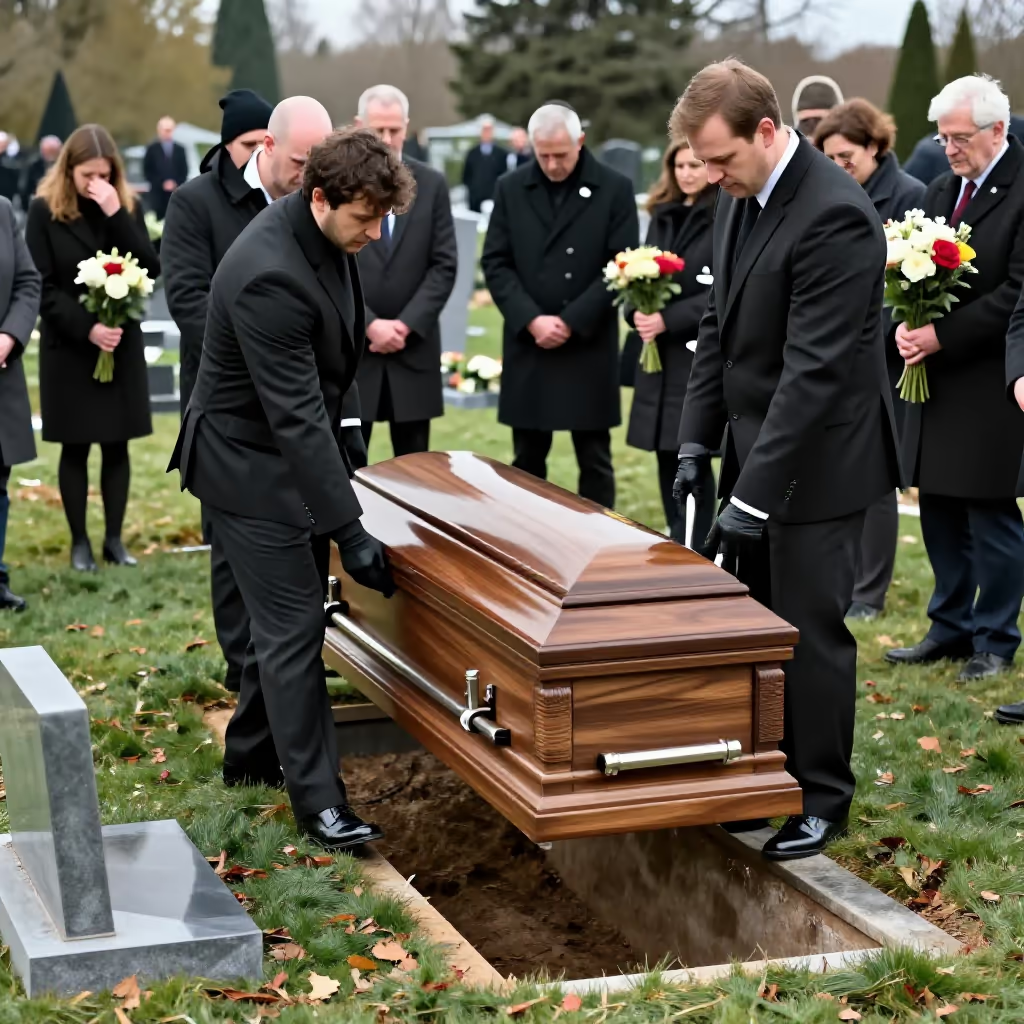
To bury the body of a deceased person in the ground, usually as part of a funeral service.
Er wurde im engsten Familienkreis auf dem Waldfriedhof beerdigt.
He was buried in the closest family circle at the forest cemetery.


to bury
Loading your saved state.
to bury
To bury the body of a deceased person in the ground, usually as part of a funeral service.
Er wurde im engsten Familienkreis auf dem Waldfriedhof beerdigt.
He was buried in the closest family circle at the forest cemetery.

The word is made up of the prefix 'be-', the noun 'Erde' (earth), and the ending '-igen'. So it literally means to bring someone or something 'into the earth'.
Die Schatztruhe wurde vor langer Zeit tief im Wald beerdigt.
The treasure chest was buried deep in the forest a long time ago.
The prefix 'be-' is inseparable. This means it stays firmly attached to the verb in all tenses and sentence constructions and is never placed at the end of the sentence.
Man beerdigte den berühmten Schriftsteller mit großen Ehren.
The famous writer was buried with great honors.
You can recognize the meaning from the object. If the object is a person, it is about a burial. If the object is something abstract like 'ein Plan' (a plan), 'eine Hoffnung' (a hope), or 'ein Projekt' (a project), the figurative meaning is intended.
Der Großvater wurde in seinem Heimatdorf beerdigt.
The grandfather was buried in his home village.
In its figurative meaning, 'beerdigen' (to bury) is often used with abstract nouns. Typical combinations are: 'einen Plan beerdigen' (to bury a plan), 'eine Hoffnung beerdigen' (to bury a hope), 'ein Projekt beerdigen' (to bury a project), or 'einen Traum beerdigen' (to bury a dream).
Nach der Absage des Investors mussten sie ihr Start-up-Projekt beerdigen.
After the investor's rejection, they had to bury their start-up project.
to give up / submit
'aufgeben' and 'beerdigen' can both mean that you stop pursuing a plan, hope, or idea. 'aufgeben' is the normal and neutral word for this. 'beerdigen' sounds more figurative and stronger: something is then truly and definitively over. 'beerdigen' is often used with plans or hopes when it is clear that they no longer have a future.

Nach der letzten Besprechung musste das Team die Idee für ein neues Büro beerdigen.
After the last meeting, the team had to bury the idea of a new office.
Nach drei Absagen hat Lisa ihren Plan nicht sofort aufgegeben.
After three rejections, Lisa did not give up her plan right away.