

An additional name given to a person, usually pointing to a special quality, origin, or achievement. It is often better known than the actual surname.
example
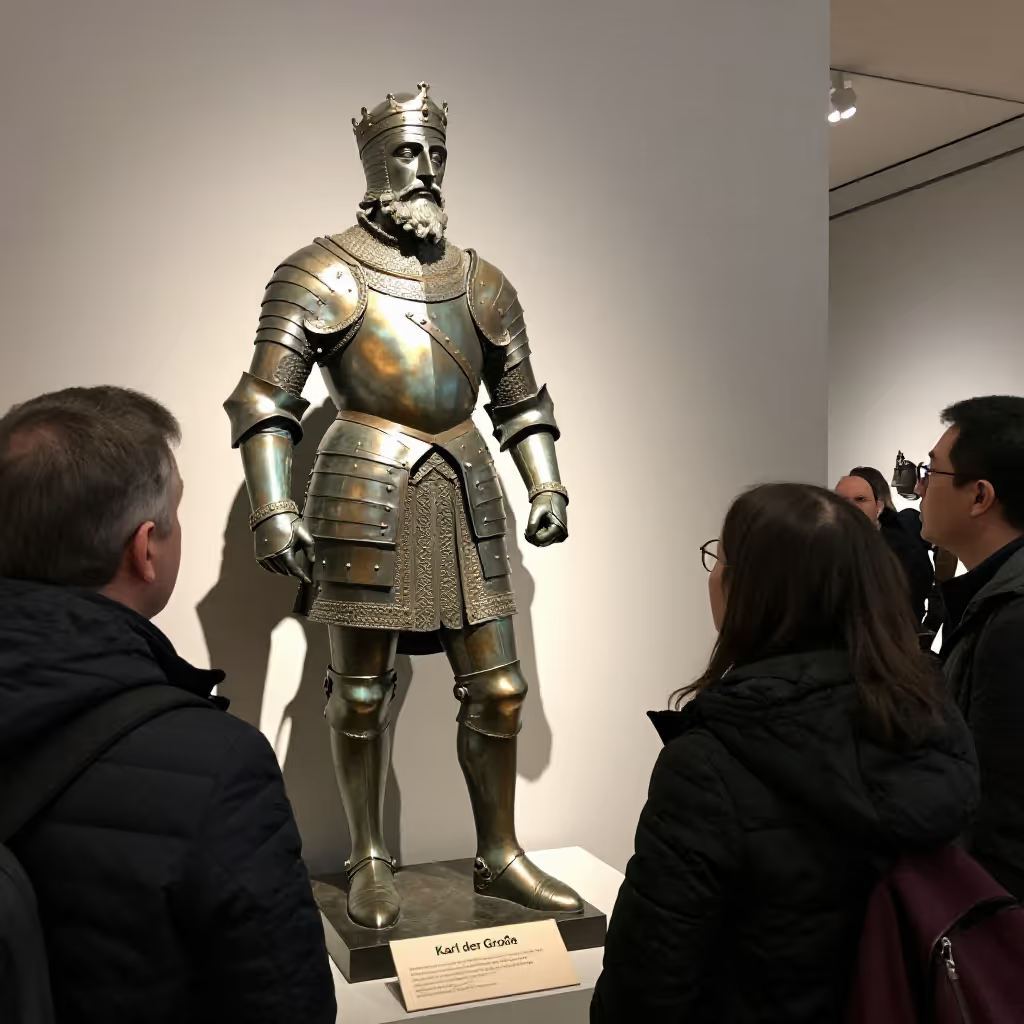
Karl der Große erhielt seinen Beinamen aufgrund seiner bedeutenden Herrschaft.
Charlemagne received his epithet because of his significant rule.

Usage tips
Word composition
'Beiname' (epithet) is made up of the prefix 'bei-' and the noun 'Name' (name). Here, 'bei-' means 'additional' or 'alongside,' so a Beiname is literally an 'additional name.'
EXAMPLE
Viele Herrscher im Mittelalter sind heute eher unter ihrem Beinamen als unter ihrem vollen Namen bekannt.
Many rulers in the Middle Ages are known today more by their epithet than by their full name.
Typical verbs
Common verbs used with 'Beiname' (epithet) are 'tragen' (to bear/carry), 'erhalten' (to receive), or 'bekommen' (to get) when the person is the subject. When someone gives the name, you use 'jemandem einen Beinamen geben' (to give someone an epithet).
EXAMPLE
Er erhielt den Beinamen „der Schweigsame“, weil er so wenig redete.
He received the epithet 'the Silent' because he spoke so little.
Historical context
Epithets are especially typical for historical figures. They often follow the pattern 'first name + der/die + adjective,' as in 'Friedrich der Große' (Frederick the Great) or 'Katharina die Große' (Catherine the Great).
EXAMPLE
Der englische König Richard I. trug den Beinamen „Löwenherz“.
The English king Richard I bore the epithet 'Lionheart.'
Compare with
near_synonym · confusable
Beiname vs Spitzname
nickname
'der Spitzname' and 'der Beiname' are both additional names for a person. A 'Spitzname' is usually informal and is used in everyday life by friends, family, or colleagues. A 'Beiname' sounds more official or historical and often points to a special quality, origin, or achievement. Learners may confuse the words because both stand alongside the actual name. For private, casual situations, 'Spitzname' fits; for famous people, history, or special qualities, 'Beiname' is usually more appropriate.
Beiname
Karl der Große trägt einen Beinamen, der seine Bedeutung zeigt.
Charlemagne bears an epithet that shows his importance.
Spitzname
Nele hat im Verein den Spitznamen „Blitz“, weil sie so schnell läuft.
At the club, Nele has the nickname 'Blitz' because she runs so fast.