

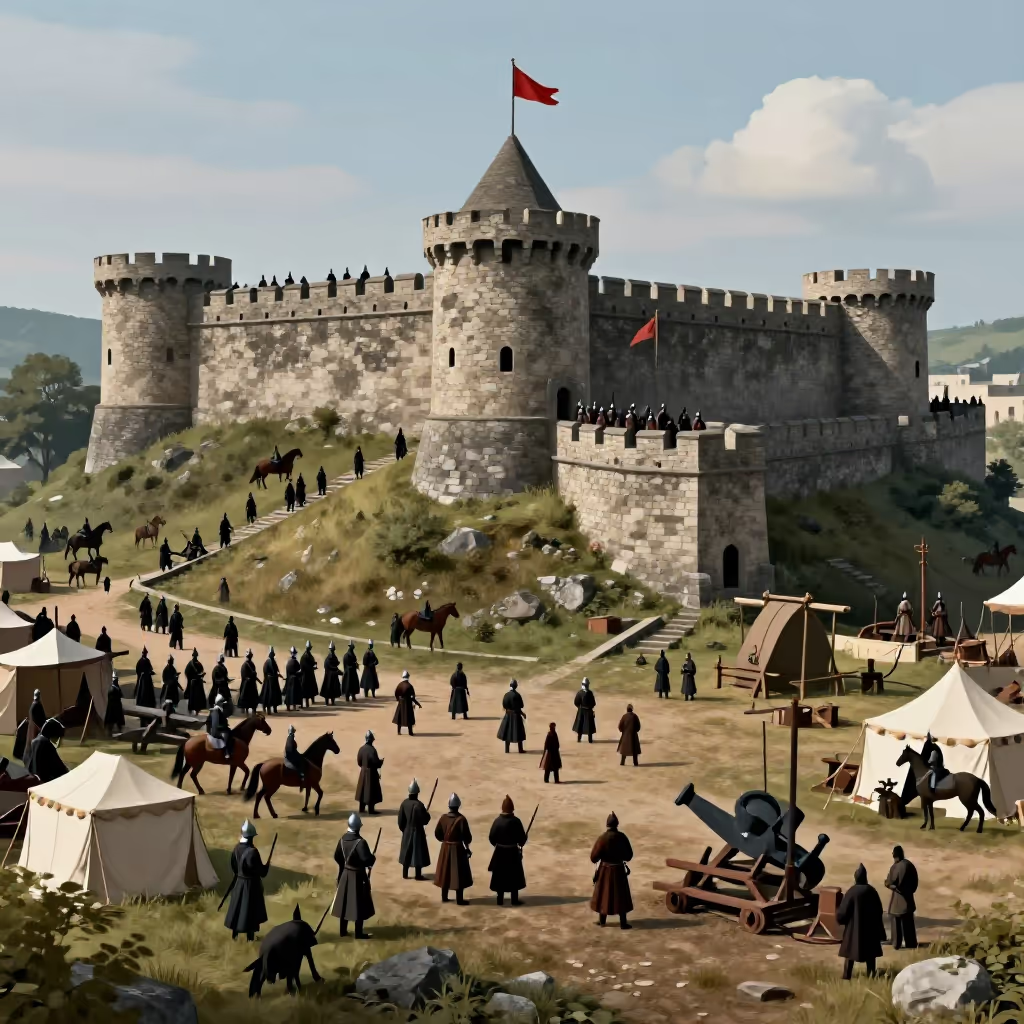
belagern
to besiege
To surround a city, fortress, or other place militarily with troops in order to force surrender.
EXAMPLE
Die Armee belagerte die feindliche Festung monatelang.
The army besieged the enemy fortress for months.
to besiege
Loading your saved state.
to besiege
To surround a city, fortress, or other place militarily with troops in order to force surrender.
Die Armee belagerte die feindliche Festung monatelang.
The army besieged the enemy fortress for months.

to besiege
To surround and press in on someone or something in large numbers, often in order to get something.
Nach dem Konzert belagerten die Fans den Bühnenausgang, um ein Autogramm zu ergattern.
After the concert, the fans besieged the stage exit to get an autograph.
The verb 'belagern' (to besiege) is inseparable. The prefix 'be-' remains firmly attached to the verb stem 'lagern' in all sentence forms and tenses and is never separated.
Die Fans haben den Star nach dem Auftritt belagert.
The fans besieged the star after the performance.
'Belagern' (to besiege) is a transitive verb and always requires a direct object in the accusative. You ask: Wen oder was belagert jemand? (Whom or what is someone besieging?)
Die Kinder belagerten die Eisdiele.
The children besieged the ice cream shop.
The meaning of 'belagern' (to besiege) becomes clear from the context. Military or historical terms like 'Armee' (army), 'Festung' (fortress), or 'Stadt' (city) point to the literal meaning. Words like 'Fans' (fans), 'Journalisten' (journalists), or 'Kinder' (children) point to the figurative meaning.
Die Ritter belagerten die Burg für mehrere Wochen.
The knights besieged the castle for several weeks.
In the figurative meaning, the verb is often used with groups of people who crowd around a person or place. Typical subjects are 'Fans' (fans), 'Reporter' (reporters), 'Fotografen' (photographers), or 'Kinder' (children).
Die Fotografen belagerten das Hotel des Filmstars.
The photographers besieged the film star's hotel.
to pressure / to weigh on
Both words describe unpleasant pressure on a person. Bedrängen emphasizes the pressure itself and is independent of how many people are involved. Belagern, by contrast, suggests that someone is surrounded by many people or strongly pressured at a particular place. Choose “bedrängen” for the pressure and “belagern” for being surrounded by a crowd.

Viele Reporter belagerten die Schauspielerin vor dem Eingang und versperrten ihr den Weg.
Many reporters surrounded the actress at the entrance and blocked her way.
Ein Reporter bedrängte die Schauspielerin vor dem Eingang mit immer neuen Fragen.
A reporter pressured the actress at the entrance with one question after another.