

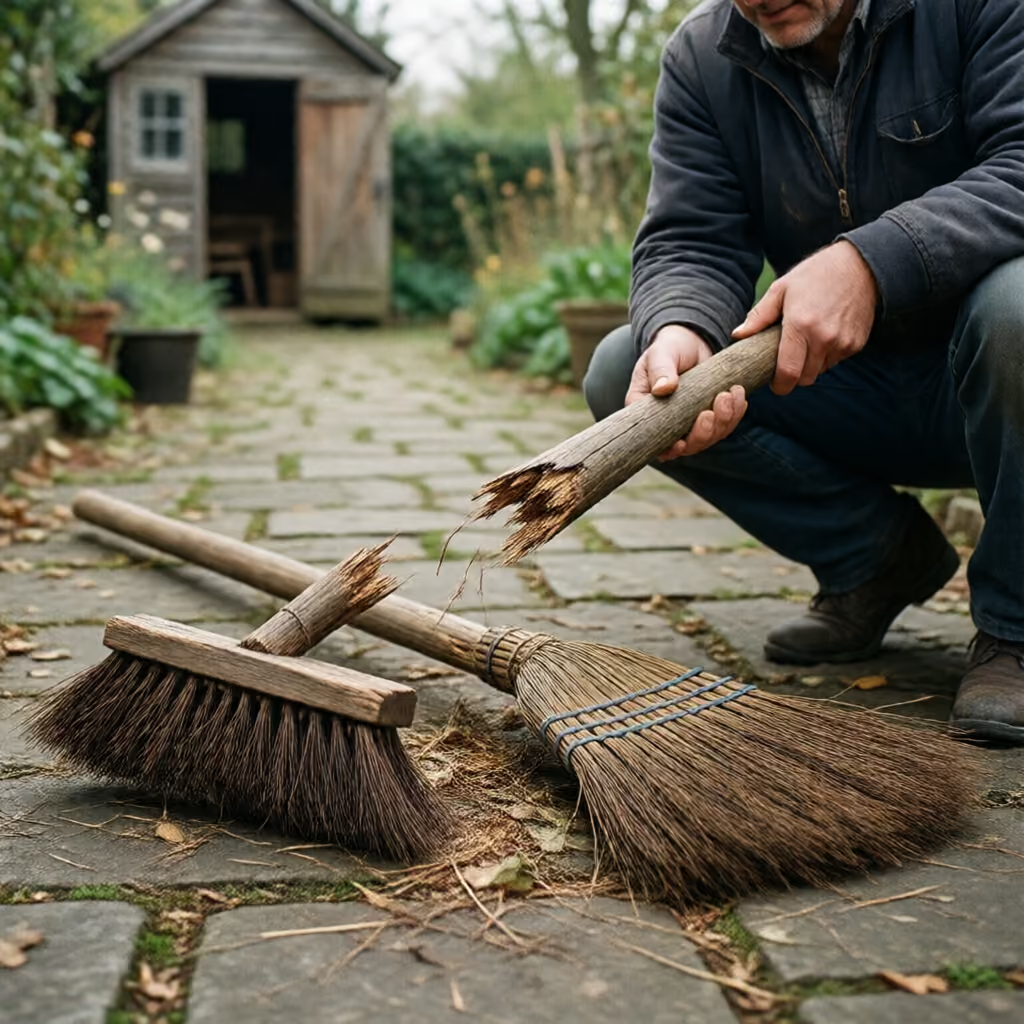
der Besenstiel
broom handle
The long handle to which the head of a broom is attached and which you hold while sweeping.
Der Besenstiel ist abgebrochen, deshalb kann ich den Hof nicht kehren.
The broom handle broke, so I can't sweep the courtyard.
broom handle
der Besenstiel, die Besenstiele
Loading your saved state.

broom handle
The long handle to which the head of a broom is attached and which you hold while sweeping.
Der Besenstiel ist abgebrochen, deshalb kann ich den Hof nicht kehren.
The broom handle broke, so I can't sweep the courtyard.
| gender | masculine der |
|---|---|
| plural | die Besenstiele |
| genitive | des Besenstiels |
| singular | plural | |
|---|---|---|
| nominative | der Besenstiel | die Besenstiele |
| accusative | den Besenstiel | die Besenstiele |
| dative | dem Besenstiel | den Besenstielen |
| genitive | des Besenstiels des Besenstieles | der Besenstiele |
The article changes with the case; it is shown in colour.
'Besenstiel' is made up of 'Besen' (broom) and 'Stiel' (handle). The two words are joined directly, without any additional letters in between.
Für meinen alten Besen brauche ich einen neuen Besenstiel.
I need a new broom handle for my old broom.
When making repairs, the phrases 'einen Besenstiel austauschen' (to replace a broom handle) and 'einen Besenstiel befestigen' (to attach a broom handle) are useful. The first pattern describes replacing the handle, while the second describes securing it to the broom head.
Kannst du den lockeren Besenstiel wieder richtig befestigen?
Can you attach the loose broom handle properly again?
The pattern 'den Besen am Besenstiel halten' (to hold the broom by the broom handle) describes which part of the broom you grip. 'Am' stands for 'an dem' and requires the dative.
Das Kind hielt den Besen mit beiden Händen am Besenstiel.
The child held the broom by the handle with both hands.