

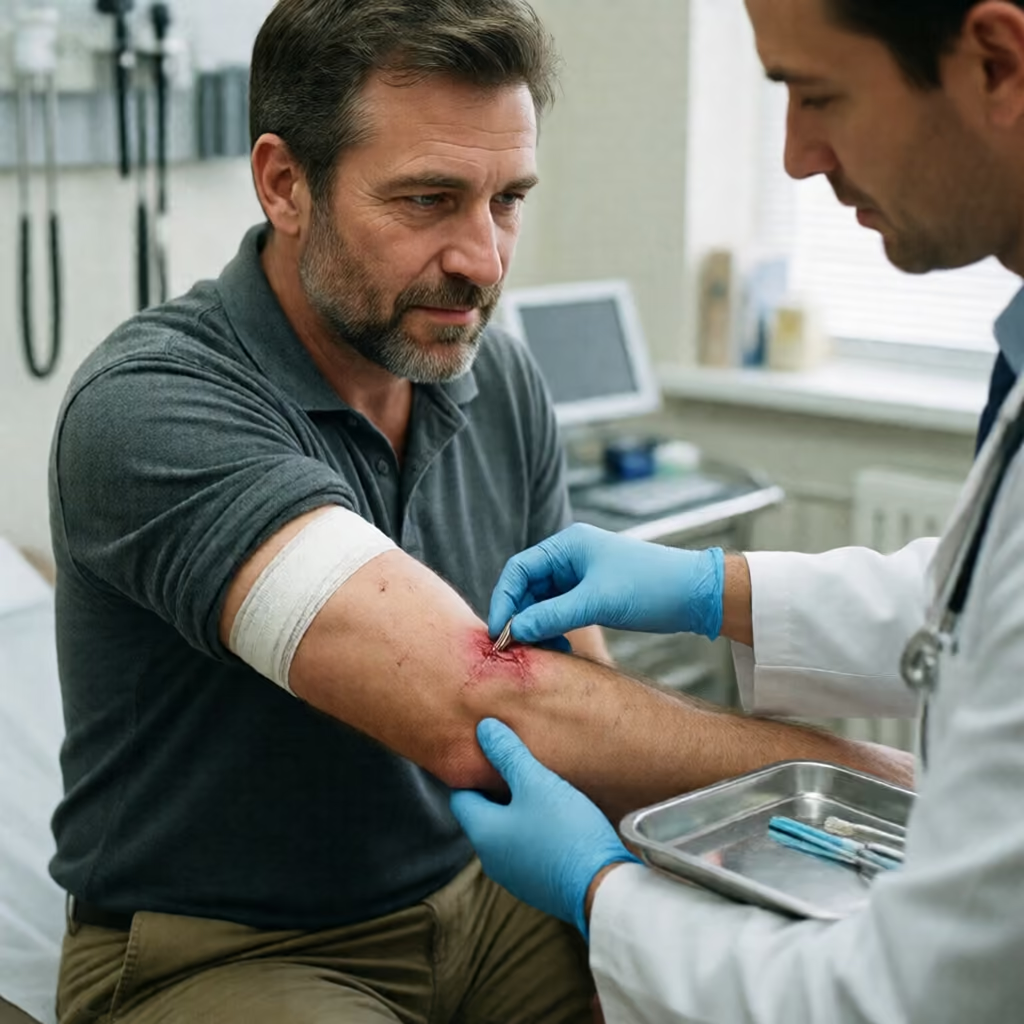
die Bisswunde
bite wound
An injury to the skin or tissue caused by the bite of a person or animal.
EXAMPLE
Der Arzt versorgte die Bisswunde am Arm sofort.
The doctor immediately treated the bite wound on his arm.
bite wound
die Bisswunde, die Bisswunden
Loading your saved state.
bite wound
An injury to the skin or tissue caused by the bite of a person or animal.
Der Arzt versorgte die Bisswunde am Arm sofort.
The doctor immediately treated the bite wound on his arm.
| gender | feminine die |
|---|---|
| plural | die Bisswunden |
| genitive | der Bisswunde |
| singular | plural | |
|---|---|---|
| nominative | die Bisswunde | die Bisswunden |
| accusative | die Bisswunde | die Bisswunden |
| dative | der Bisswunde | den Bisswunden |
| genitive | der Bisswunde | der Bisswunden |
The article changes with the case; it is shown in colour.
„Bisswunde“ consists of „Biss“ (bite) and „Wunde“ (wound). The first part names the cause of the injury, while the second names the injury itself.
Nach dem Angriff des Hundes musste ihre Bisswunde behandelt werden.
After the dog attack, her bite wound had to be treated.
The part of the body is often named with „an“ and the dative case, for example „eine Bisswunde am Bein“ (a bite wound on the leg) or „eine Bisswunde an der Hand“ (a bite wound on the hand).
Die Wanderin hatte eine Bisswunde an der linken Hand.
The hiker had a bite wound on her left hand.
Common collocations include „eine Bisswunde reinigen“ (to clean a bite wound), „eine Bisswunde desinfizieren“ (to disinfect a bite wound), and „eine Bisswunde versorgen“ (to treat a bite wound). You will encounter these collocations especially in first aid situations and at the doctor's office.
Die Ärztin reinigte und desinfizierte die Bisswunde.
The doctor cleaned and disinfected the bite wound.