

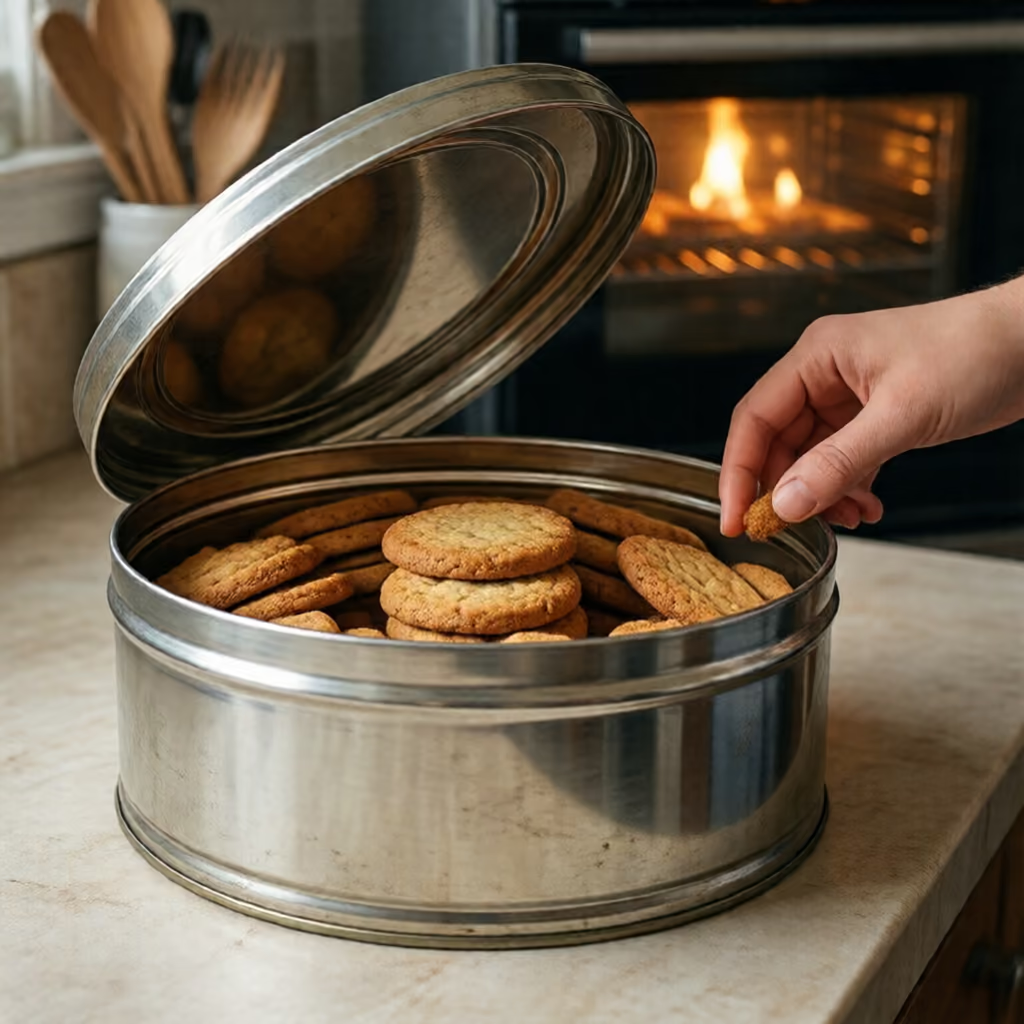
die Blechdose
tin
A container made of thin metal used to store food or other things.
EXAMPLE
Sie bewahrt ihre Kekse in einer Blechdose auf.
She keeps her cookies in a tin.
tin
die Blechdose, die Blechdosen
Loading your saved state.
tin
A container made of thin metal used to store food or other things.
Sie bewahrt ihre Kekse in einer Blechdose auf.
She keeps her cookies in a tin.
| gender | feminine die |
|---|---|
| plural | die Blechdosen |
| genitive | der Blechdose |
| singular | plural | |
|---|---|---|
| nominative | die Blechdose | die Blechdosen |
| accusative | die Blechdose | die Blechdosen |
| dative | der Blechdose | den Blechdosen |
| genitive | der Blechdose | der Blechdosen |
The article changes with the case; it is shown in colour.
'Blechdose' (tin) consists of 'Blech' (sheet metal) and 'Dose' (tin/container). The first part names the material: thin metal that can be shaped into a container.
Die Blechdose hat eine kleine Delle an der Seite.
The tin has a small dent on the side.
Common collocations include 'eine Blechdose öffnen' (to open a tin), 'der Deckel der Blechdose' (the lid of the tin), and 'eine Blechdose voller Kekse' (a tin full of cookies). After 'voller' (full of), the contents appear without an article.
Auf dem Dachboden fand er eine alte Blechdose voller Knöpfe.
He found an old tin full of buttons in the attic.
Der Deckel der Blechdose lässt sich nicht mehr schließen.
The lid of the tin can no longer be closed.
Typical patterns are 'etwas in einer Blechdose aufbewahren' (to store something in a tin) and 'etwas aus einer Blechdose nehmen' (to take something out of a tin). In both cases, 'in' and 'aus' are followed by the dative.
Mein Vater bewahrt alte Knöpfe in einer Blechdose auf.
My father keeps old buttons in a tin.
Sie nahm einen Teebeutel aus der Blechdose.
She took a tea bag out of the tin.