

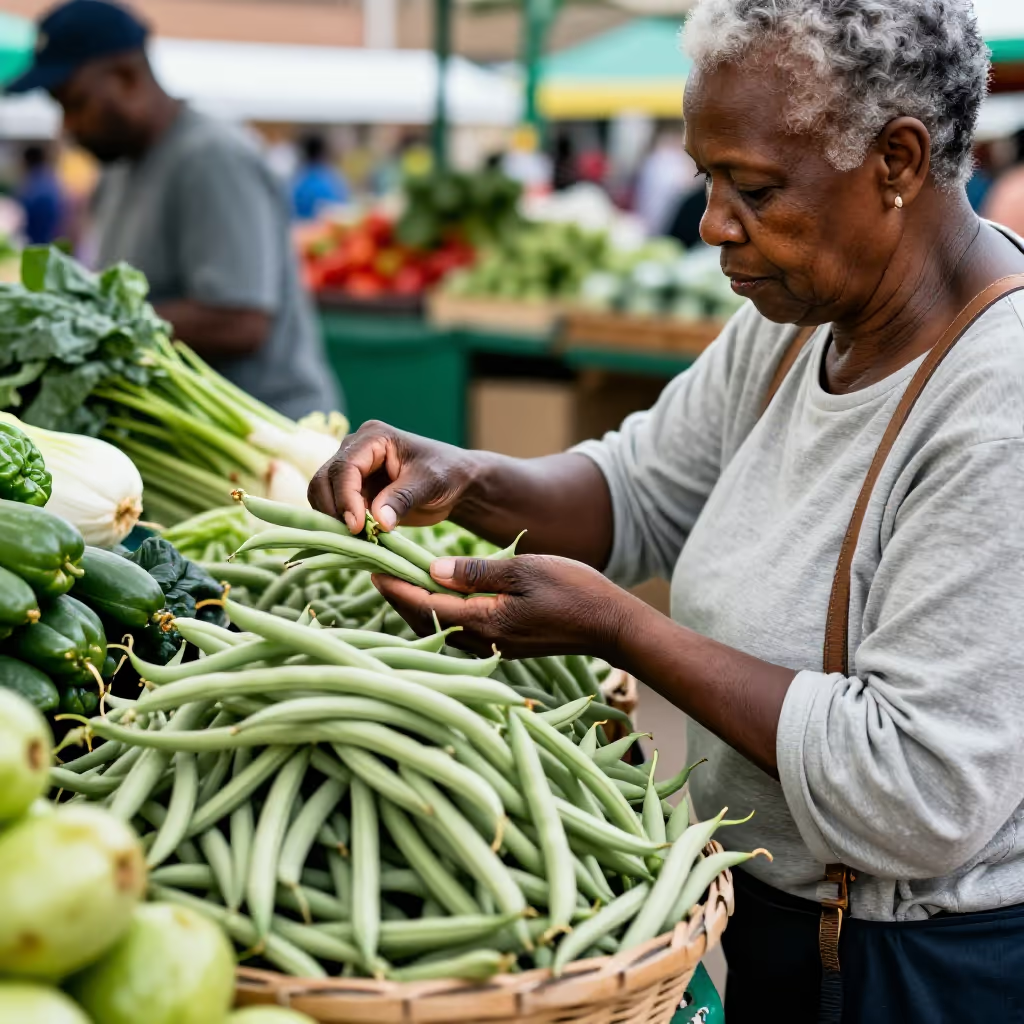
die Bohne
bean
The edible legume or seed of various plants, used as a vegetable.
EXAMPLE
Für das Chili con Carne brauchen wir eine Dose rote Bohnen.
For the chili con carne, we need a can of red beans.
bean
Loading your saved state.
bean
The edible legume or seed of various plants, used as a vegetable.
Für das Chili con Carne brauchen wir eine Dose rote Bohnen.
For the chili con carne, we need a can of red beans.

coffee bean
The seed of the coffee plant, from which coffee is prepared after roasting and grinding.
Ich mahle jeden Morgen frische Bohnen für meinen Espresso.
I grind fresh beans for my espresso every morning.

not at all
A colloquial expression meaning 'not at all' or 'absolutely not'.
Ob er kommt oder nicht, interessiert mich nicht die Bohne.
Whether he comes or not doesn't interest me at all.
Context tells you whether a vegetable bean or a coffee bean is meant. Words like 'kochen' (to cook), 'Salat' (salad), or 'Dose' (can) point to the legume. Words like 'mahlen' (to grind), 'rösten' (to roast), 'Kaffee' (coffee), or 'Espresso' (espresso) point to the coffee bean.
Ich esse gern einen Salat mit Thunfisch und Bohnen.
I like eating a salad with tuna and beans.
The expression 'nicht die Bohne' (not at all) is very colloquial. It is used to strongly emphasize a negation and should be avoided in formal situations or texts.
Seine Meinung interessiert mich nicht die Bohne.
His opinion doesn't interest me at all.
The expression 'nicht die Bohne' (not at all) usually comes at the end of a sentence or clause as an intensifier and means 'überhaupt nicht' (not at all) or 'gar nicht' (not at all).
Ich habe heute nicht die Bohne geschlafen.
I didn't sleep at all today.
'Bohne' (bean) is a very productive base word for many compound nouns. Examples include 'Kaffeebohne' (coffee bean), 'Kakaobohne' (cocoa bean), 'Sojabohne' (soybean), 'Kidneybohne' (kidney bean), or also the dish 'Bohnensuppe' (bean soup).
Für das Rezept benötigst du eine Tasse schwarze Bohnen.
For the recipe, you need a cup of black beans.
core / pit / nucleus
Both Kern and Bohne can refer to the part of a fruit taken from it. Kern emphasizes the fruit’s inner component; for the coffee plant, Bohne is the usual term for the product that is roasted and ground. In the context of coffee, Bohne is therefore usually the better choice.

Die Kaffeebohne wurde kurz vor dem Aufbrühen gemahlen.
The coffee bean was ground shortly before brewing.
Der Kern der Kaffeefrucht wurde aus dem Fruchtfleisch gelöst.
The pit of the coffee fruit was separated from the fruit pulp.