

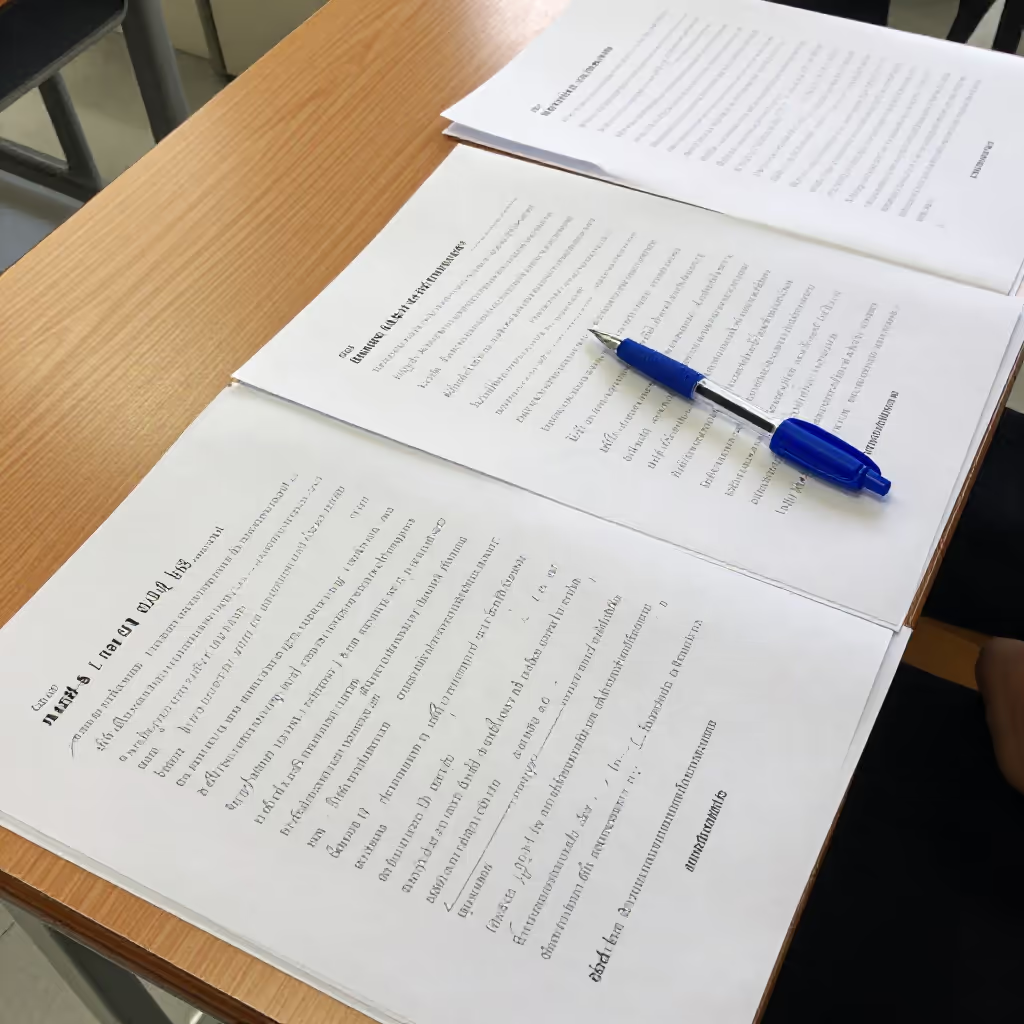
Used as an adjective to express that text or symbols have been written on a surface (e.g., paper).
example
Er reichte mir einen Zettel, der auf beiden Seiten dicht beschrieben war.
He handed me a note that was densely written on both sides.
Usage tips
Past participle as adjective
'Beschrieben' is the past participle of the verb 'beschreiben' (to describe / to write on). Used as an adjective, it means that something is written on a surface. So it describes the state of an object.
EXAMPLE
Das Notizbuch war voller beschriebener Seiten.
The notebook was full of written-on pages.
Word structure: prefix be-
The inseparable prefix 'be-' here turns the verb 'schreiben' (to write) into 'beschreiben' (to describe / to write on). It expresses that the action of writing is directed at a surface. The result is then a 'beschriebene' (written-on) surface.
EXAMPLE
Bitte beschreiben Sie nur die Vorderseite des Blattes.
Please write on only the front side of the sheet.
Typical collocations
This adjective is typically combined with surfaces that can be written on. Common examples are: 'ein beschriebenes Blatt' (a written-on sheet), 'ein beschriebener Zettel' (a written-on note), 'eine beschriebene Tafel' (a written-on board), or 'eine beschriebene Seite' (a written-on page).
EXAMPLE
An der Wand hing eine große, mit Formeln beschriebene Tafel.
A large board covered with formulas was hanging on the wall.
Compare with
antonym
beschrieben vs leer
empty
'leer' and 'beschrieben' can form a contrast when talking about paper, pages, or surfaces. 'leer' then means that there is nothing written on it or that there is no content. 'beschrieben' means that text or symbols are written on the surface. This contrast fits especially with notebooks, sheets of paper, forms, or blackboards/whiteboards. For other things, 'beschrieben' is not a general opposite of 'leer': an empty room is not automatically 'beschrieben'.
beschrieben
Am Ende der Stunde waren alle Seiten im Heft beschrieben.
By the end of the lesson, all the pages in the notebook had been written on.
leer
Nach dem Gespräch lag noch ein leeres Blatt auf dem Tisch.
After the conversation, there was still a blank sheet of paper on the table.