

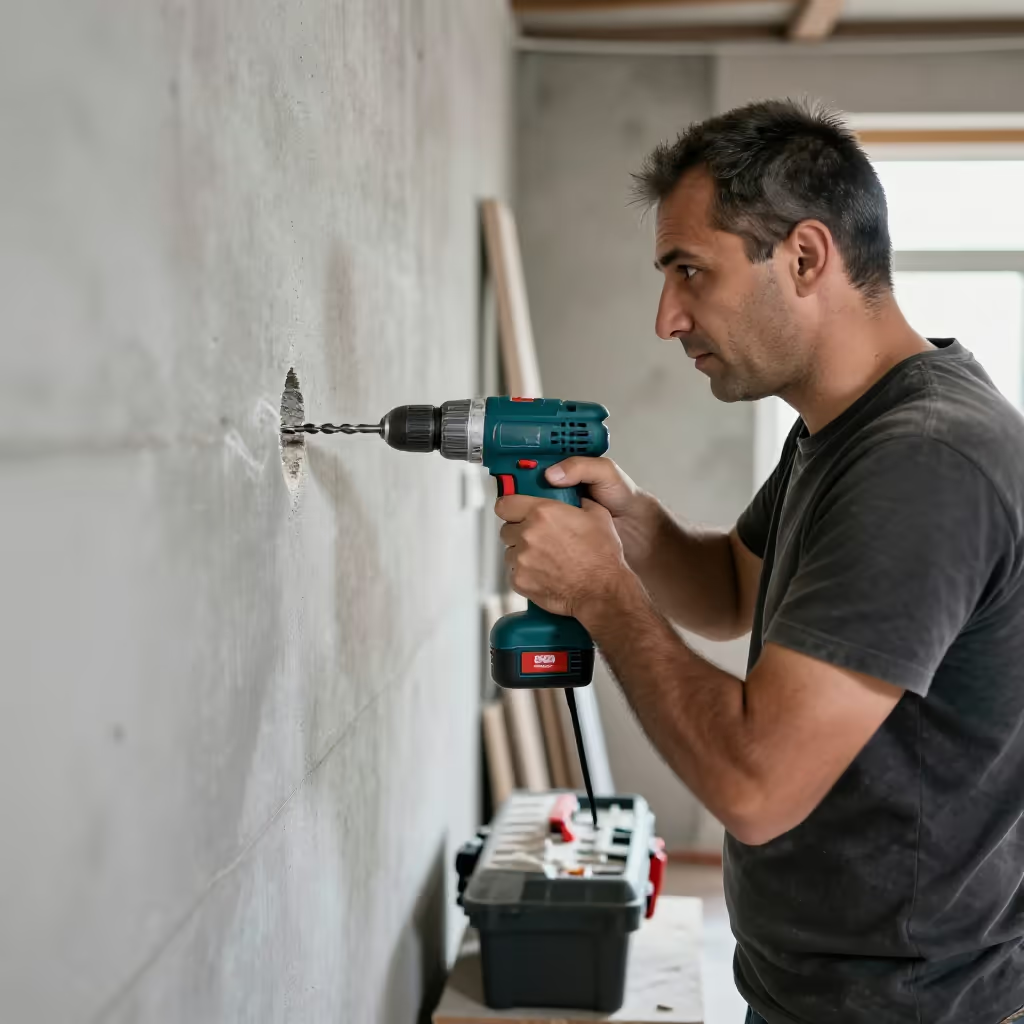
bohren
to drill
To make a hole in a solid material with a tool, usually a drill.
EXAMPLE
Er bohrt ein Loch in die Wand, um das Bild aufzuhängen.
He is drilling a hole in the wall to hang up the picture.
to drill / probe
Loading your saved state.
to drill
To make a hole in a solid material with a tool, usually a drill.
Er bohrt ein Loch in die Wand, um das Bild aufzuhängen.
He is drilling a hole in the wall to hang up the picture.

to probe
To ask questions repeatedly and persistently in order to obtain information.
Die Journalistin bohrte so lange, bis der Politiker eine Antwort gab.
The journalist kept probing until the politician gave an answer.

to bore into
To move slowly and forcefully into something, or to describe an intense, penetrating gaze.
Sein Blick bohrte sich förmlich in ihre Augen.
His gaze practically bored into her eyes.

to pick one's nose
Colloquial for removing nasal mucus with one's finger.
Es ist unhöflich, in der Öffentlichkeit in der Nase zu bohren.
It is rude to pick your nose in public.
The meaning of 'bohren' (to drill / probe) is very context-dependent. If it is about tools, it means making a hole. In connection with questions, it means 'to keep asking persistently'. The reflexive form 'sich bohren' (to bore its way) describes slow penetration.
Der Dorn bohrte sich langsam in seinen Finger.
The thorn slowly bored into his finger.
In the literal meaning, the construction 'ein Loch in etwas (Akkusativ) bohren' (to drill a hole into something) is often used. The preposition 'in' indicates where the hole is made.
Ich muss ein Loch in die Decke bohren, um die Lampe aufzuhängen.
I have to drill a hole in the ceiling to hang up the lamp.
In the figurative meaning of asking questions, 'bohren' (to probe) is often combined with the preposition 'nach'. You probe 'nach Informationen' (for information) or 'nach der Wahrheit' (for the truth).
Der Anwalt bohrte weiter, bis der Zeuge die Wahrheit sagte.
The lawyer kept probing until the witness told the truth.
The construction 'sich in etwas bohren' (to bore into something) is reflexive and always uses the preposition 'in' with the accusative. It describes a penetrating, often slow movement.
Der Splitter hat sich tief ins Holz gebohrt.
The splinter has bored deep into the wood.
The expression 'in der Nase bohren' (to pick one's nose) is a fixed phrase. It is used colloquially and is considered rude behavior.
Das Kind hat während des ganzen Films in der Nase gebohrt.
The child picked his nose throughout the entire film.
to ask
Nachfragen means asking an additional question for clarification or confirmation. In this context, bohren refers to asking repeatedly and persistently, often because the first answer was evasive or incomplete. Use nachfragen for a normal follow-up question and bohren for persistent questioning.

Weil der Zeuge auswich, bohrte die Reporterin weiter nach dem Grund.
Because the witness was evasive, the reporter kept probing for the reason.
Weil ich die Adresse nicht verstanden hatte, musste ich noch einmal nachfragen.
Because I hadn't understood the address, I had to ask again.