

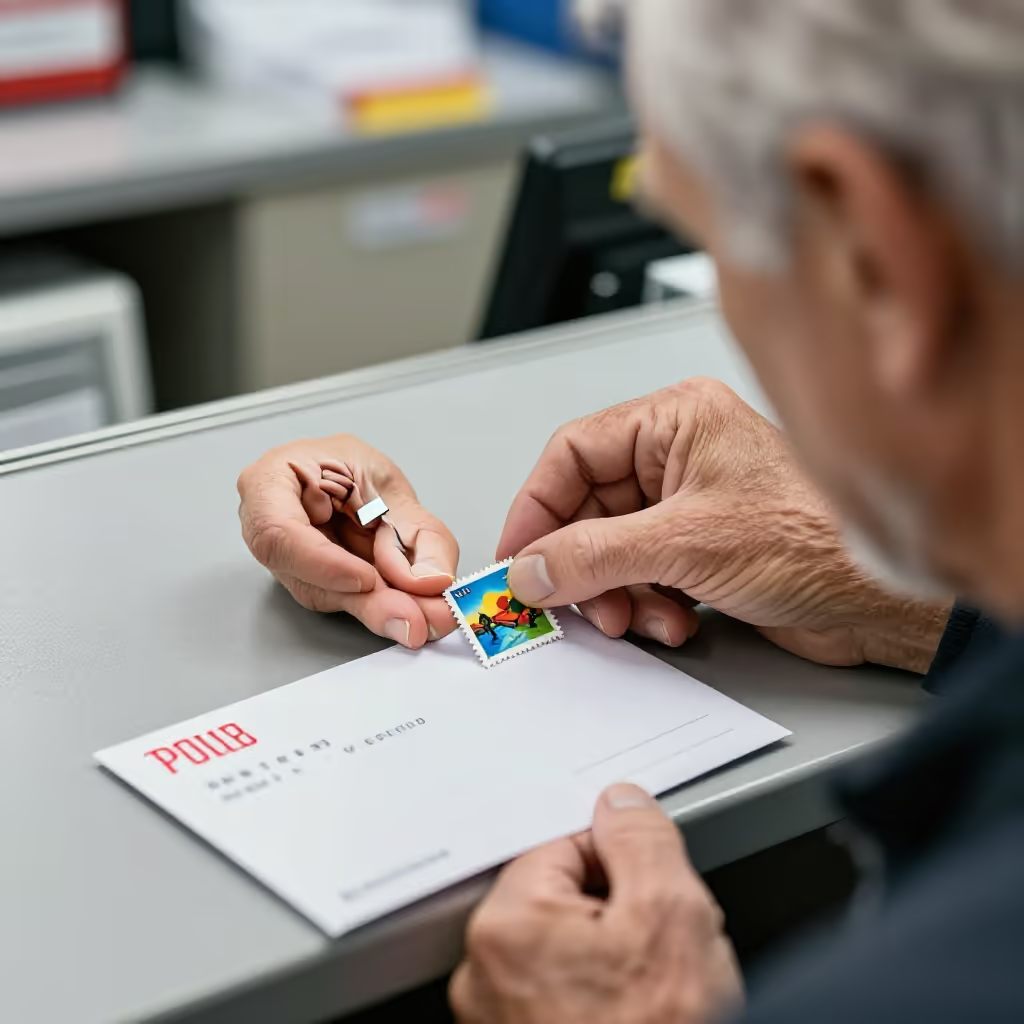
die Briefmarke
stamp
A small printed piece of paper that is stuck onto a letter or package to show that the postage has been paid.
Für diesen Brief ins Ausland brauchst du eine 1,10-Euro-Briefmarke.
For this letter abroad, you need a €1.10 stamp.

stamp
Loading your saved state.
stamp
A small printed piece of paper that is stuck onto a letter or package to show that the postage has been paid.
Für diesen Brief ins Ausland brauchst du eine 1,10-Euro-Briefmarke.
For this letter abroad, you need a €1.10 stamp.

The word is made up of 'Brief' (letter) and 'Marke' (mark/stamp). So it is literally a 'Marke' (mark) that you need for a letter.
Ohne Briefmarke kommt dein Brief nicht an.
Your letter won't arrive without a stamp.
Three actions are especially typical with stamps: you can 'kaufen' (buy) them, 'aufkleben' (stick them on) a letter, or 'sammeln' (collect) them as a hobby.
Mein Großvater sammelt seit seiner Kindheit Briefmarken.
My grandfather has been collecting stamps since his childhood.
When you stick a stamp onto something, German uses the preposition 'auf' with the accusative, because it describes movement to a place.
Bitte kleben Sie die Briefmarke oben rechts auf den Briefumschlag.
Please stick the stamp on the top right of the envelope.
brand / mark / stamp
'die Marke' and 'die Briefmarke' can mean the same thing in the context of mail. 'Briefmarke' is more precise and always means the small piece of paper used for postage. Here, 'Marke' is a short form that people understand when it is clear that you are talking about letters or packages. The important point is that 'Marke' also has other meanings, for example with products. Without a postal context, 'Briefmarke' is therefore clearer.

In der Postfiliale kauft Lisa eine Briefmarke für den Brief nach Österreich.
At the post office, Lisa buys a stamp for the letter to Austria.
Auf dem Umschlag fehlt noch eine Marke.
There is still a stamp missing from the envelope.