

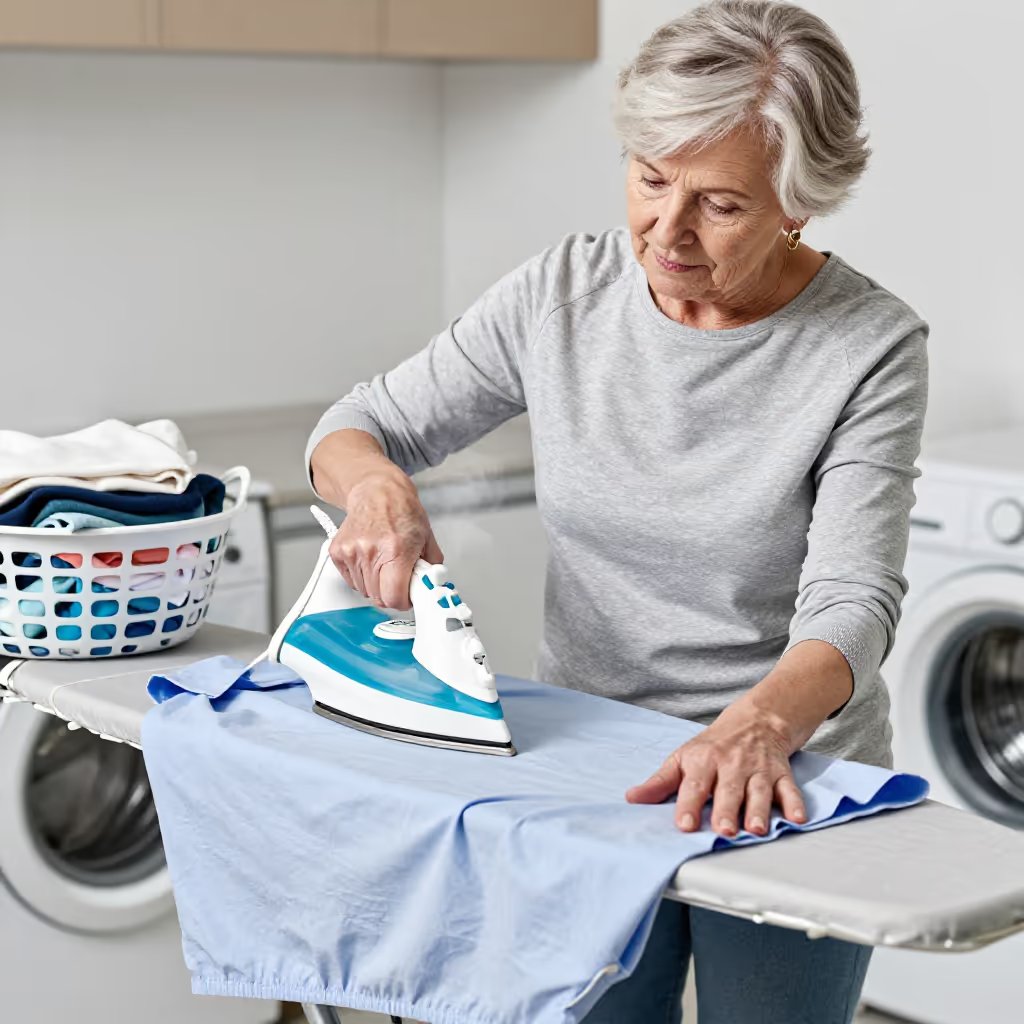
An electric household appliance with a heatable metal soleplate that is used to smooth wrinkles out of textiles through heat and pressure.
example
Ich muss noch schnell mein Hemd mit dem Bügeleisen glätten, bevor wir gehen.
I still need to quickly smooth my shirt with the iron before we leave.
Usage tips
Word composition
The word 'Bügeleisen' (iron) is made up of the verb 'bügeln' (to iron) and the noun 'Eisen' (iron). So it literally describes a tool made of iron that you use for ironing.
EXAMPLE
Pass auf, das Bügeleisen ist noch sehr heiß.
Be careful, the iron is still very hot.
Typical verbs
Common verbs connected with an iron are 'einstecken' (to plug in) and 'ausstecken' (to unplug) for the power connection, as well as 'einschalten' (to switch on) and 'ausschalten' (to switch off).
EXAMPLE
Hast du daran gedacht, das Bügeleisen auszustecken?
Did you remember to unplug the iron?
Use in a sentence
To express that you are using the device as a tool, the preposition 'mit' (with) is usually used, for example in the combination 'mit dem Bügeleisen glätten' (to smooth with the iron).
EXAMPLE
Diese Bluse muss man mit einem heißen Bügeleisen glätten.
This blouse has to be smoothed with a hot iron.
Compare with
synonym · confusable
Bügeleisen vs Eisen
iron
'das Eisen' and 'das Bügeleisen' can mean the same household appliance used to smooth clothing. 'Bügeleisen' is the clear and precise form. 'Eisen' is a short form in this sense and works mainly when the context of ironing is already clear. What can be confusing is that 'Eisen' can also mean the metal iron. Without context, 'das Eisen' can therefore mean something completely different. If you want to avoid misunderstandings, 'Bügeleisen' is usually safer.
Bügeleisen
Im Schrank steht ein altes Bügeleisen neben der Nähmaschine.
There is an old iron in the cupboard next to the sewing machine.
Eisen
Sie hat das Eisen nach dem Bügeln sofort ausgeschaltet.
She turned off the iron immediately after ironing.