


die Chronik
timeline
In social networks, a user's personal page where their activities, posts, and photos are displayed in chronological order.
Er hat ein neues Profilbild in seiner Chronik gepostet.
He posted a new profile picture on his timeline.
timeline / chronicle
Loading your saved state.
timeline
In social networks, a user's personal page where their activities, posts, and photos are displayed in chronological order.
Er hat ein neues Profilbild in seiner Chronik gepostet.
He posted a new profile picture on his timeline.

The word 'Chronik' (chronicle) is related to 'chronologisch' (chronological) and comes from the Greek word for time ('chronos'). All meanings have in common that they present events in chronological order.
Die Chronik des Vereins listet alle wichtigen Ereignisse seit der Gründung auf.
The chronicle of the club lists all important events since its founding.
This modern meaning of 'Chronik' (timeline) can be recognized by words from the area of social media, such as 'posten' (to post), 'teilen' (to share), 'Profil' (profile), 'Freunde' (friends), or 'Timeline' (timeline).
Sie hat auf Facebook ein Urlaubsfoto in ihrer Chronik geteilt.
She shared a vacation photo on her Facebook timeline.
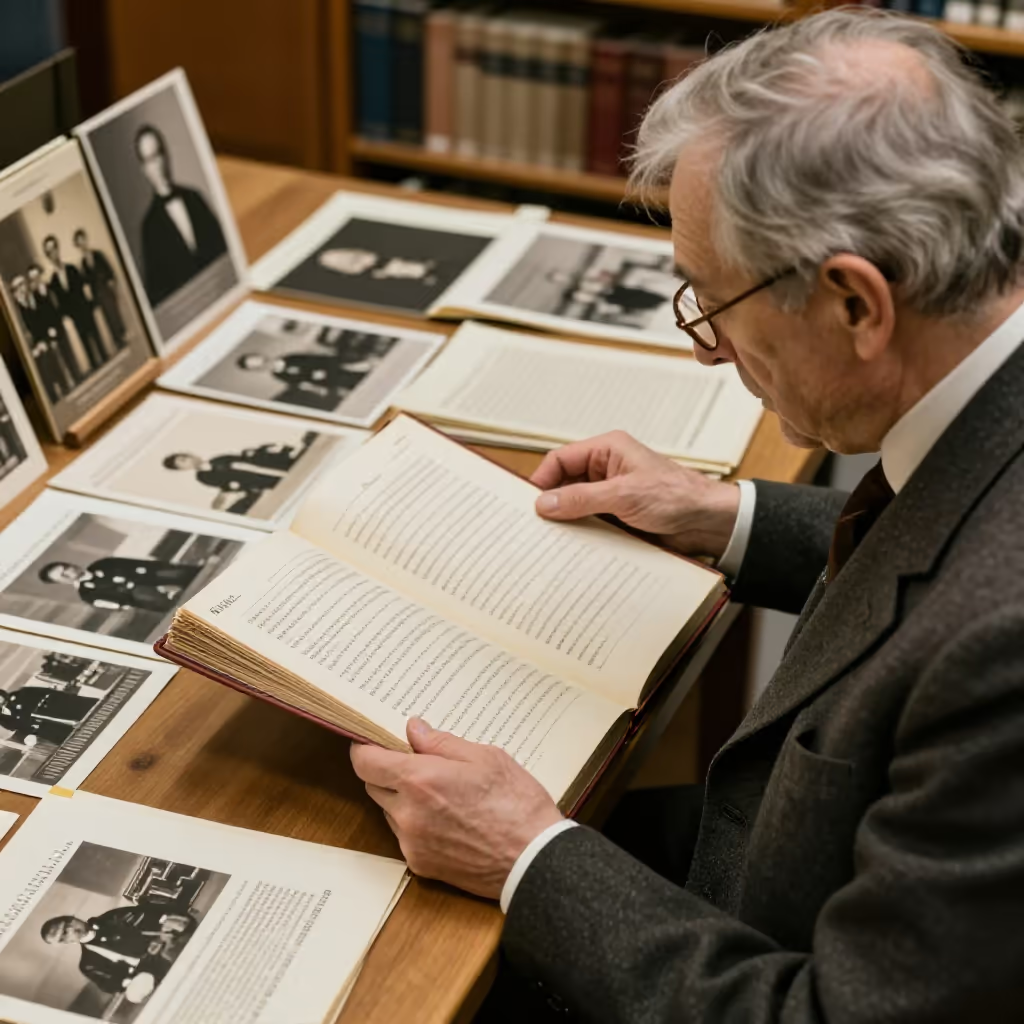
In a historical context, people often speak of the 'Chronik einer Stadt' (chronicle of a city), of a 'Kloster' (monastery), or of a 'Verein' (club/association). Typical verbs are 'eine Chronik führen' (to keep a chronicle) or 'in einer Chronik nachlesen' (to look something up in a chronicle).
Der Historiker fand in der alten Stadtchronik wichtige Informationen.
The historian found important information in the old city chronicle.
When 'Chronik' (chronicle) describes a book, it is often a novel that tells the story of a family, a dynasty, or an era over a long period of time.
Der Roman ist die Chronik einer Winzerfamilie an der Mosel.
The novel is the chronicle of a winegrowing family on the Moselle.
story / history
'die Geschichte' and 'die Chronik' can both be about past events. But 'Geschichte' is much more general: it can be a story or the history of a country, a city, or a person. 'Chronik' is used more when events are written down in order, often over a longer period of time. Learners may confuse the words because both have to do with the past. If only the topic of the past is important, 'Geschichte' usually fits. If the chronological order is the main focus, 'Chronik' is more precise.

Die Chronik des Vereins nennt jedes wichtige Ereignis seit der Gründung.
The club's chronicle lists every important event since its founding.
Im Museum erfährt man viel über die Geschichte der Stadt.
At the museum, you learn a lot about the history of the city.