

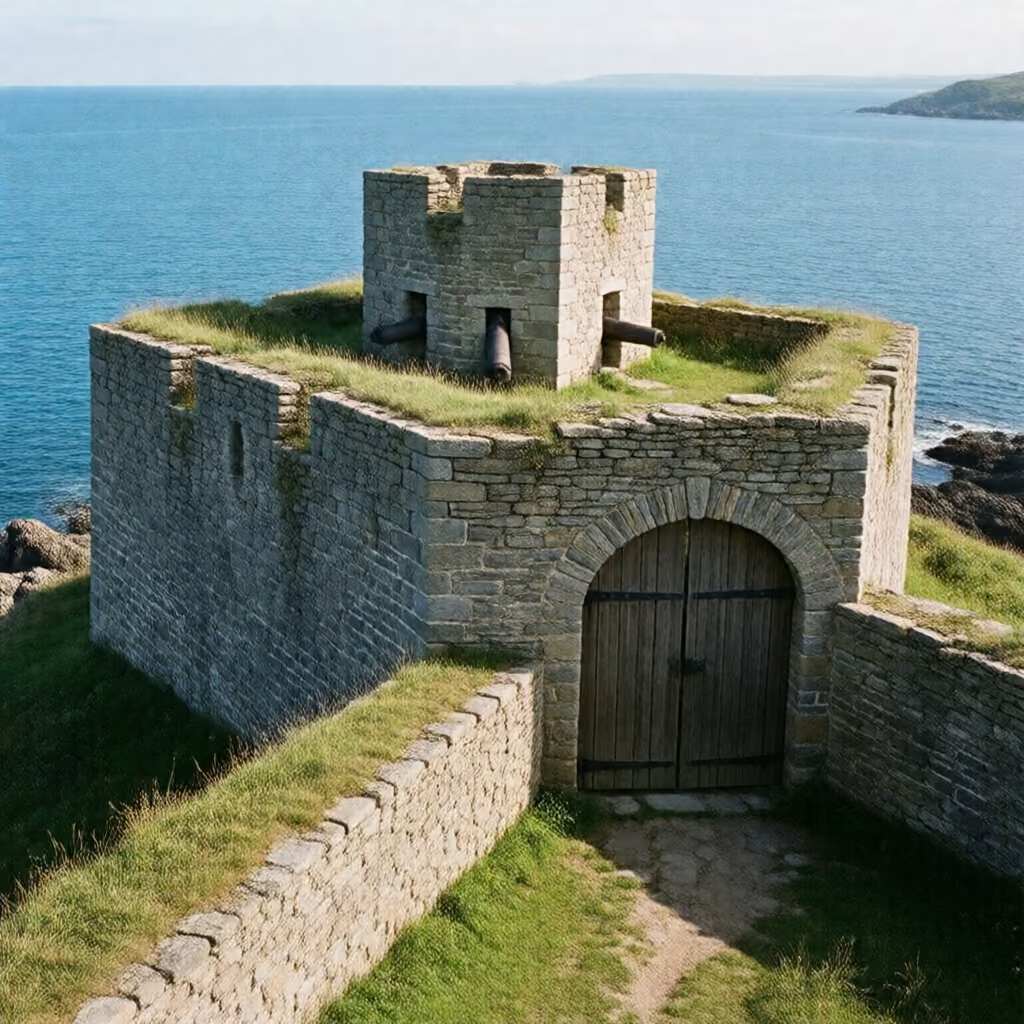
das Fort
fort
A usually relatively small, fortified military installation used to defend a place or area.
EXAMPLE
Das Fort bewachte den Eingang zur Bucht.
The fort guarded the entrance to the bay.
fort
das Fort, die Forts
Loading your saved state.
fort
A usually relatively small, fortified military installation used to defend a place or area.
Das Fort bewachte den Eingang zur Bucht.
The fort guarded the entrance to the bay.
| gender | neuter das |
|---|---|
| plural | die Forts |
| genitive | des Forts |
| singular | plural | |
|---|---|---|
| nominative | das Fort | die Forts |
| accusative | das Fort | die Forts |
| dative | dem Fort | den Forts |
| genitive | des Forts | der Forts |
The article changes with the case; it is shown in colour.
The verbs „errichten“ (to build), „ausbauen“ (to expand), „verteidigen“ (to defend), „besetzen“ (to occupy), and „stürmen“ (to storm) are often used with „Fort“. These collocations are especially common in reports about military conflicts and fortifications.
Die Armee ließ das Fort an der Küste ausbauen.
The army had the fort on the coast expanded.
„Fort“ is particularly common in historical or military texts, for example in connection with sieges, cannons, garrisons, or colonial conflicts. The word is therefore mainly used in everyday life when talking about history, museums, or specific buildings.
Im Museum erfuhren die Besucher viel über die Soldaten, die früher im Fort stationiert waren.
At the museum, the visitors learned a lot about the soldiers who used to be stationed in the fort.
With „Fort“, locations are often expressed using prepositions such as „in“, „vor“, or „hinter“. The dative is used for being inside or staying somewhere, while the accusative is used for movement into the interior.
Die Soldaten warteten im Fort auf Verstärkung.
The soldiers waited in the fort for reinforcements.
Die Besucher gingen durch das Tor in das Fort.
The visitors went through the gate into the fort.