

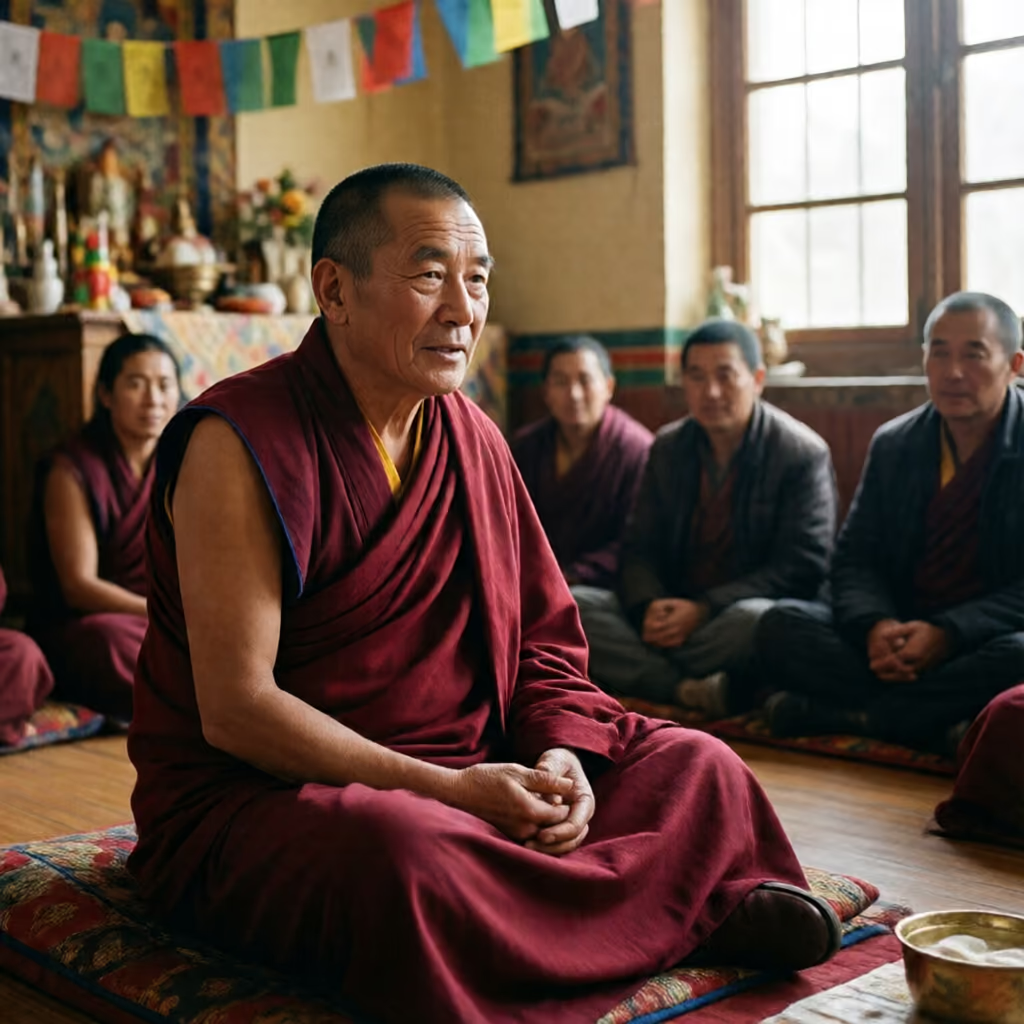
der Lama
lama
A spiritual teacher or dignitary in Tibetan Buddhism.
EXAMPLE
Der Lama erklärte den Gläubigen die Bedeutung der Meditation.
The lama explained the significance of meditation to the faithful.
lama
der Lama, die Lamas
Loading your saved state.
lama
A spiritual teacher or dignitary in Tibetan Buddhism.
Der Lama erklärte den Gläubigen die Bedeutung der Meditation.
The lama explained the significance of meditation to the faithful.
| gender | masculine der |
|---|---|
| plural | die Lamas |
| genitive | des Lamas |
| singular | plural | |
|---|---|---|
| nominative | der Lama | die Lamas |
| accusative | den Lama | die Lamas |
| dative | dem Lama | den Lamas |
| genitive | des Lamas | der Lamas |
The article changes with the case; it is shown in colour.
'Lama' (lama) can be used as a religious title directly before a person's name. In this combination, there is often no article.
Lama Tenzin spricht heute über Meditation.
Lama Tenzin is speaking about meditation today.
Common collocations are 'ein hoher Lama' (a high-ranking lama) and 'ein angesehener Lama' (a respected lama). Here, 'hoch' (high-ranking) refers to religious rank, while 'angesehen' (respected) refers to the respect the person enjoys.
Ein hoher Lama besuchte das Kloster und sprach mit den Mönchen.
A high-ranking lama visited the monastery and spoke with the monks.
Zu dem Fest wurde ein angesehener Lama eingeladen.
A respected lama was invited to the festival.
To refer to a lama as someone's teacher, you can use the pattern 'bei einem Lama lernen' (to study with a lama). After 'bei' (with), the person is in the dative case.
Sie hat mehrere Jahre bei einem Lama in Nepal gelernt.
She studied with a lama in Nepal for several years.