

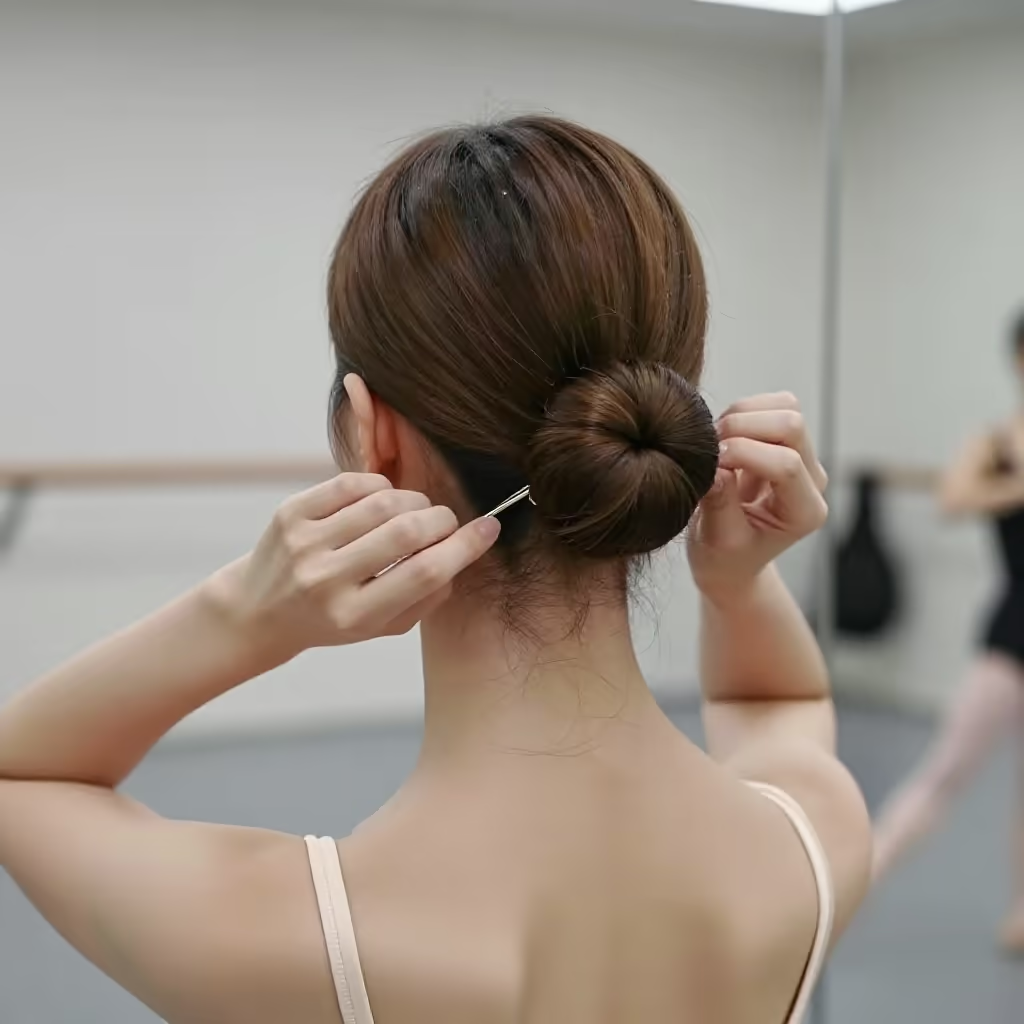
A hairstyle in which long hair is twisted together into a knot or ball at the back of the head or on top of the head and pinned in place.
example
Sie trägt ihr Haar meistens zu einem praktischen Dutt gebunden.
She usually wears her hair tied in a practical bun.
Usage tips
Typical verbs
To describe how a bun is made, German uses verbs like 'binden' (to tie), 'stecken' (to pin), 'machen' (to make), or 'drehen' (to twist). To say that someone has this hairstyle, you use the verb 'tragen' (to wear).
EXAMPLE
Sie hat sich die Haare schnell zu einem Dutt gebunden.
She quickly tied her hair into a bun.
Construction with 'zu'
A very common formulation is 'sich die Haare zu einem Dutt...' (to do one's hair into a bun...) followed by a verb like 'binden' (to tie) or 'stecken' (to pin). This construction describes the process of styling the hair.
EXAMPLE
Kannst du mir helfen, meine Haare zu einem Dutt zu stecken?
Can you help me pin my hair into a bun?
Typical adjectives
A bun can be described more precisely. Common adjectives are 'hoch' (high) or 'tief' (low) for the position on the head, as well as 'locker' (loose) or 'fest' (tight) for the way it is tied.
EXAMPLE
Für den Abend machte sie sich einen eleganten, hohen Dutt.
For the evening, she made herself an elegant high bun.
Compare with
confusable
Dutt vs Knoten
knot / node
'der Knoten' and 'der Dutt' can both have to do with hair or with something tied together. 'der Knoten' is more general: it can be in a rope, in a cable, or also a tangled spot in the hair. 'der Dutt', on the other hand, is a hairstyle in which long hair is intentionally twisted into a round shape and pinned in place. The words can be confused because a bun looks like a hair knot. When talking about the hairstyle, 'Dutt' is more precise. When something is tangled messily or tied tightly, 'Knoten' fits better.
Dutt
Für den Tanzkurs trägt sie ihre Haare heute in einem Dutt.
For dance class today, she is wearing her hair in a bun.
Knoten
Nach dem Schwimmen hatte Lisa einen Knoten im nassen Haar.