

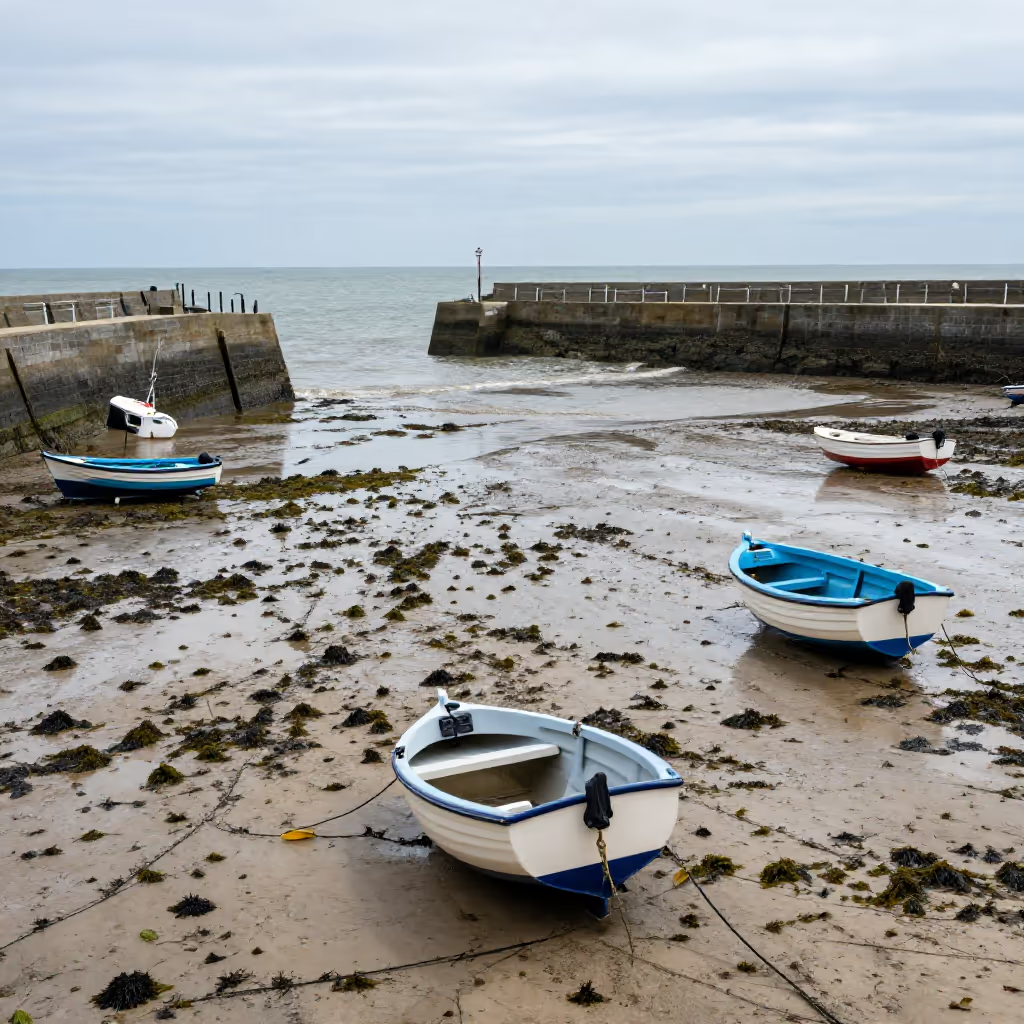
die Ebbe
low tide
The periodic lowering of the sea level as part of the tides. It is the opposite of high tide.
EXAMPLE
Bei Ebbe kann man im Watt spazieren gehen und Muscheln suchen.
At low tide, you can walk on the mudflats and look for shells.
low tide
Loading your saved state.
low tide
The periodic lowering of the sea level as part of the tides. It is the opposite of high tide.
Bei Ebbe kann man im Watt spazieren gehen und Muscheln suchen.
At low tide, you can walk on the mudflats and look for shells.

short on money
A colloquial expression meaning that you have only a little money left or no money at all.
Kurz vor dem Monatsende herrscht bei vielen Studenten Ebbe in der Kasse.
Shortly before the end of the month, many students are short on money.
'Ebbe' (low tide) is almost always mentioned together with its counterpart 'Flut' (high tide). The fixed phrase 'Ebbe und Flut' (low tide and high tide) describes the entire tidal cycle.
An der Küste bestimmen Ebbe und Flut den Tagesrhythmus.
On the coast, low tide and high tide determine the daily rhythm.
To express that something happens during the time of low water level, you use the preposition 'bei' with the dative: 'bei Ebbe' (at low tide).
Bei Ebbe kann man weit ins Watt hinauslaufen.
At low tide, you can walk far out onto the mudflats.
The second meaning exists almost only in the fixed idiom 'Ebbe in der Kasse haben' (to be short on money) or 'Ebbe in der Kasse sein/herrschen' (to be short on money). It figuratively describes an empty wallet.
Nach dem teuren Urlaub herrscht bei uns Ebbe in der Kasse.
After the expensive vacation, we're short on money.
The idiom 'Ebbe in der Kasse' (short on money) is colloquial. It is used in informal conversations among friends or within the family.
Ich kann nicht mit ins Kino kommen, bei mir ist gerade Ebbe in der Kasse.
I can't come to the movies with you; I'm short on money right now.