

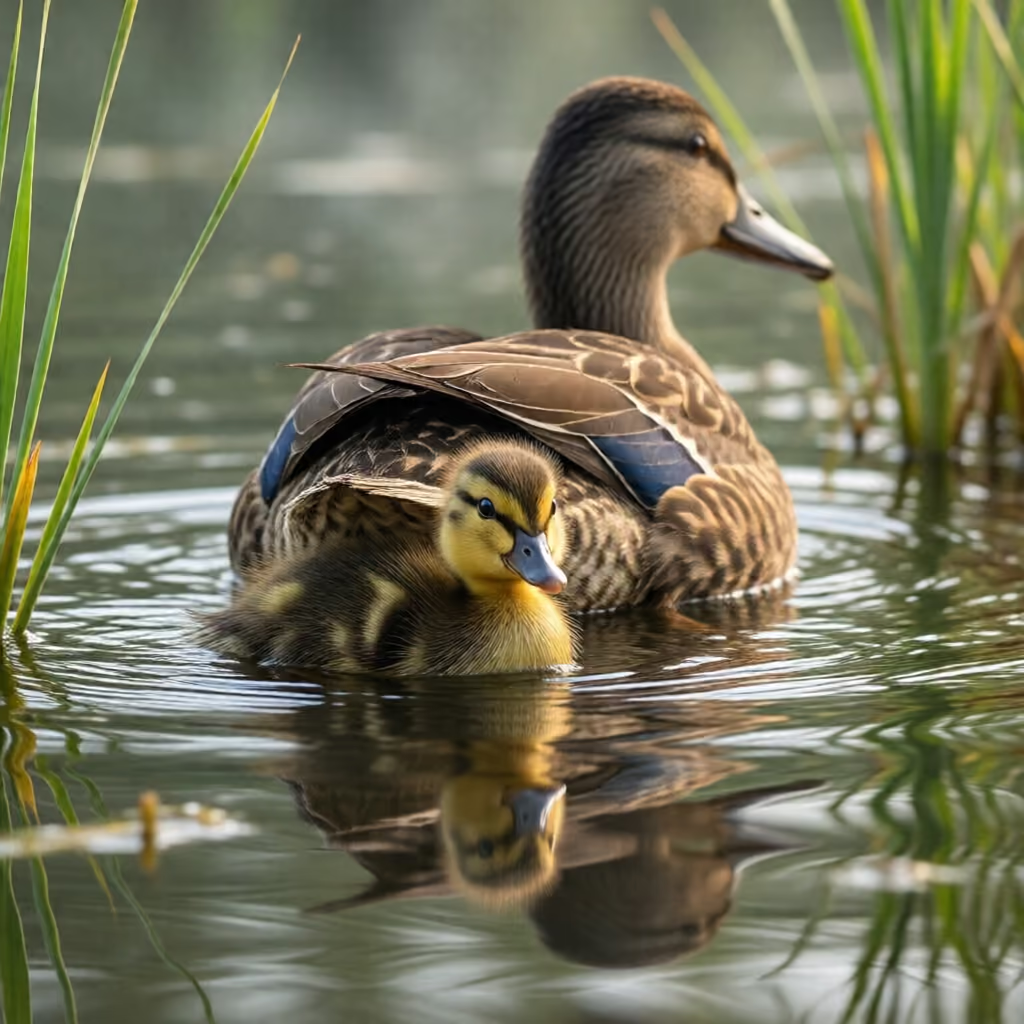
das Entlein
duckling
A young or small duck. The word is often used as an affectionate term or a diminutive.
EXAMPLE
Das Entlein schwamm dicht hinter seiner Mutter her.
The duckling swam close behind its mother.
duckling
das Entlein, die Entlein
Loading your saved state.
duckling
A young or small duck. The word is often used as an affectionate term or a diminutive.
Das Entlein schwamm dicht hinter seiner Mutter her.
The duckling swam close behind its mother.
| gender | neuter das |
|---|---|
| plural | die Entlein |
| genitive | des Entleins |
| singular | plural | |
|---|---|---|
| nominative | das Entlein | die Entlein |
| accusative | das Entlein | die Entlein |
| dative | dem Entlein | den Entlein |
| genitive | des Entleins | der Entlein |
The article changes with the case; it is shown in colour.
'Entlein' (duckling) is formed from 'Ente' (duck) and the diminutive suffix '-lein'; the final 'e' in 'Ente' is dropped. This suffix also helps you recognize a diminutive or an affectionate tone in other words.
Auf dem Teich schwimmt eine Ente mit fünf kleinen Entlein.
A duck is swimming on the pond with five little ducklings.
'Das hässliche Entlein' (The Ugly Duckling) is the title of a well-known fairy tale. The expression can also refer to a person who is initially undervalued and later develops in a surprisingly positive way.
Als Kind galt sie als hässliches Entlein, später wurde sie für ihre Schönheit bewundert.
As a child, she was considered an ugly duckling; later, she was admired for her beauty.
Typical combinations are 'Entlein schlüpfen' (ducklings hatch) and 'Entlein füttern' (to feed ducklings). With 'schlüpfen' (to hatch), the ducklings are the subject; with 'füttern' (to feed), they are the object in the accusative case.
Heute sind drei Entlein aus ihren Eiern geschlüpft.
Today, three ducklings hatched from their eggs.
Die Kinder dürfen die Entlein mit geeignetem Futter füttern.
The children are allowed to feed the ducklings suitable food.