

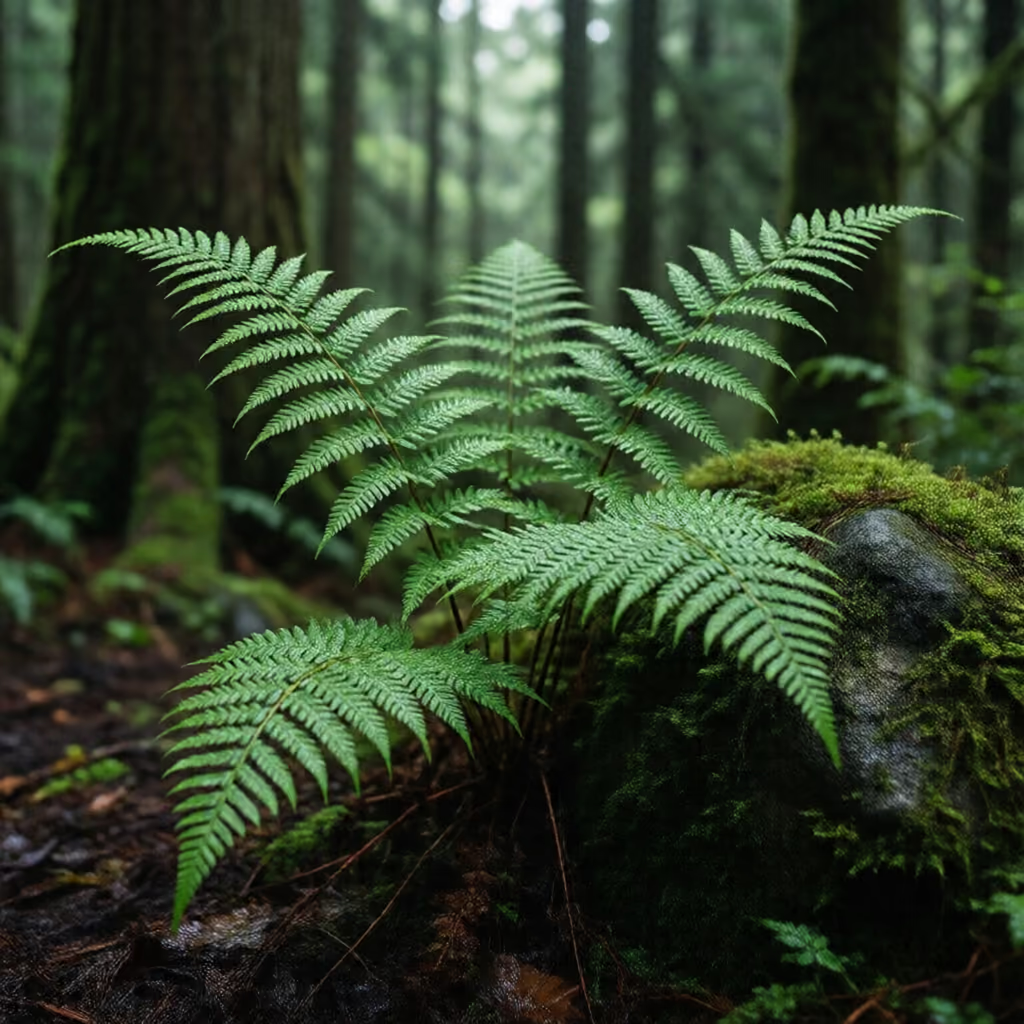
der Farn
fern
A usually green plant without flowers that reproduces through spores and often prefers damp, shady places.
EXAMPLE
Im schattigen Wald wächst der Farn besonders gut.
The fern grows particularly well in the shady forest.
fern
der Farn, die Farne
Loading your saved state.
fern
A usually green plant without flowers that reproduces through spores and often prefers damp, shady places.
Im schattigen Wald wächst der Farn besonders gut.
The fern grows particularly well in the shady forest.
| gender | masculine der |
|---|---|
| plural | die Farne |
| genitive | des Farnes |
| singular | plural | |
|---|---|---|
| nominative | der Farn | die Farne |
| accusative | den Farn | die Farne |
| dative | dem Farn | den Farnen |
| genitive | des Farnes des Farns | der Farne |
The article changes with the case; it is shown in colour.
'Farn' (fern) is often associated with shady and damp locations. Typical phrases include 'Farn wächst im Schatten' (ferns grow in the shade), 'Farn auf feuchtem Boden' (ferns on damp soil), and 'Farn im Wald' (ferns in the forest).
Hinter dem alten Haus wächst dichter Farn im feuchten Boden.
Dense ferns grow in the damp soil behind the old house.
The verbs 'wachsen' (to grow), 'sprießen' (to sprout), and 'bedecken' (to cover) are especially often used with 'Farn' (fern). This is often about how ferns cover the forest floor or a slope.
Im Frühling sprießt der Farn am Rand des Waldweges.
In spring, ferns sprout along the edge of the forest path.
'Farn' (fern) also appears as the first part of compounds that refer to parts of this plant or larger stands of it, such as 'Farnwedel' (fern frond) and 'Farnwald' (fern forest). This makes it easier to work out the meaning of such words.
Im Herbst färben sich die Farnwedel im Wald goldbraun.
In autumn, the fern fronds in the forest turn golden brown.