

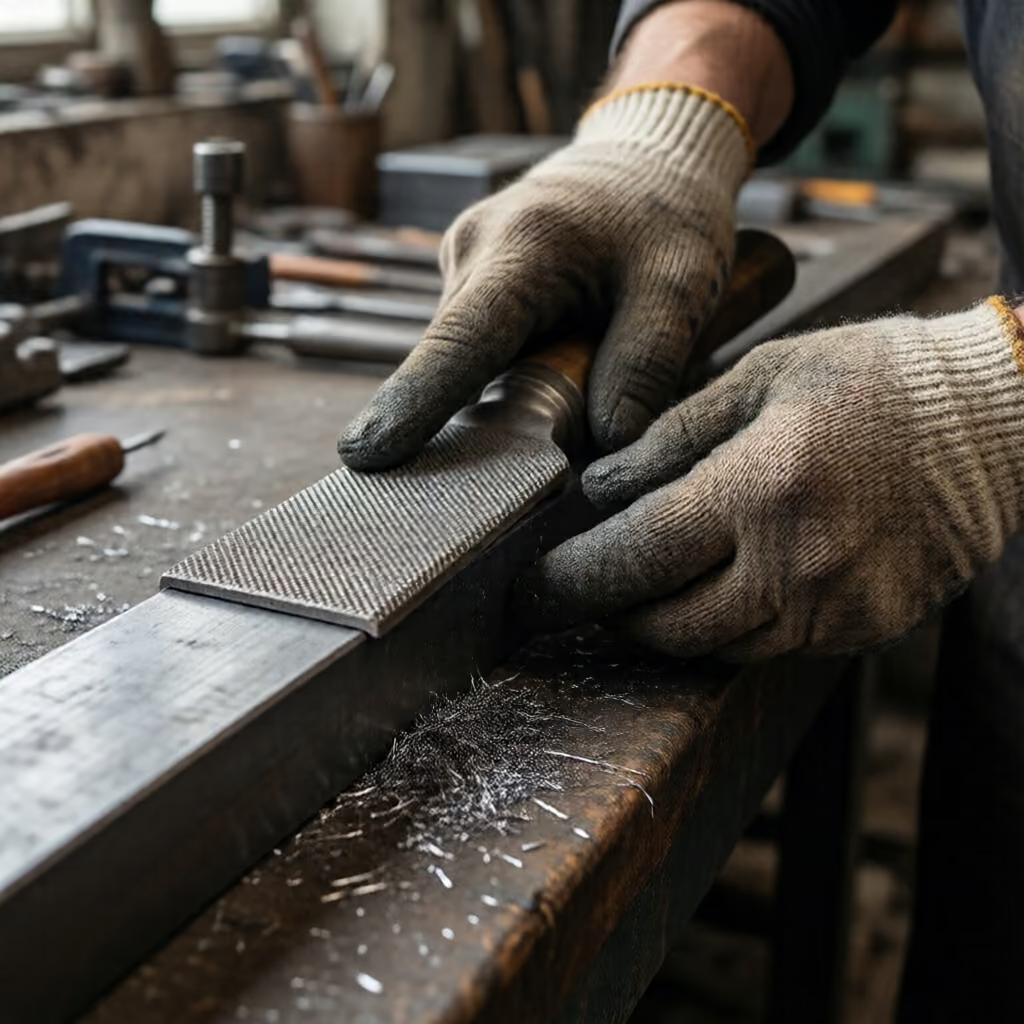
die Feile
file
A tool with a rough, ridged surface used to remove and smooth material such as metal, wood, or plastic.
Mit der Feile glättete sie die scharfe Kante des Metallstücks.
She used the file to smooth the sharp edge of the piece of metal.
file
die Feile, die Feilen
Loading your saved state.

file
A tool with a rough, ridged surface used to remove and smooth material such as metal, wood, or plastic.
Mit der Feile glättete sie die scharfe Kante des Metallstücks.
She used the file to smooth the sharp edge of the piece of metal.
| gender | feminine die |
|---|---|
| plural | die Feilen |
| genitive | der Feile |
| singular | plural | |
|---|---|---|
| nominative | die Feile | die Feilen |
| accusative | die Feile | die Feilen |
| dative | der Feile | den Feilen |
| genitive | der Feile | der Feilen |
The article changes with the case; it is shown in colour.
'Feile' (file) belongs to the verb 'feilen' (to file). This connection helps you remember the tool together with the corresponding activity.
Zum Feilen der Metallkante brauchst du eine feine Feile.
To file the metal edge, you need a fine file.
'Feile' (file) frequently appears at the end of compound words. The first part often shows what the tool is intended for, as in 'Nagelfeile' (nail file) or 'Metallfeile' (metal file).
Für ihre Fingernägel benutzt sie eine Nagelfeile, für das Werkstück eine Metallfeile.
She uses a nail file for her fingernails and a metal file for the workpiece.
Common collocations are 'eine grobe Feile' (a coarse file) and 'eine feine Feile' (a fine file). Here, these adjectives describe the tool's working surface: A coarse file removes more material, while a fine file is suitable for smoother surfaces.
Für die letzten Unebenheiten nimmt er eine feine Feile.
He uses a fine file for the final uneven spots.