


feindselig
hostile
Showing an attitude or behavior marked by rejection, hatred, or aggression, as toward an enemy.
EXAMPLE
Er warf mir einen feindseligen Blick zu und sagte kein Wort.
He gave me a hostile look and did not say a word.
hostile
Loading your saved state.
hostile
Showing an attitude or behavior marked by rejection, hatred, or aggression, as toward an enemy.
Er warf mir einen feindseligen Blick zu und sagte kein Wort.
He gave me a hostile look and did not say a word.
The word is made up of 'Feind' (enemy) and the ending '-selig'. It describes an attitude or feeling that corresponds to the soul or nature of an enemy.
Sein Verhalten uns gegenüber war offen feindselig.
His behavior toward us was openly hostile.
To express whom the hostile attitude is directed toward, the preposition 'gegenüber' is often used with the dative. The person or group then comes before 'gegenüber'.
Die Mannschaft war dem Schiedsrichter gegenüber sehr feindselig eingestellt.
The team was very hostile toward the referee.
'Feindselig' (hostile) is often used to describe nonverbal signals or general moods. Typical combinations are 'eine feindselige Haltung' (a hostile attitude), 'ein feindseliger Blick' (a hostile look), or 'eine feindselige Atmosphäre' (a hostile atmosphere).
Im Raum herrschte eine feindselige Stille.
There was a hostile silence in the room.
aggressive
Aggressiv mainly emphasizes attack-oriented behavior in a person. Feindselig describes more of a rejecting attitude marked by hatred or aggression, even when no attack takes place. Use aggressiv for visible action against someone, and feindselig when the rejecting attitude is the main focus.
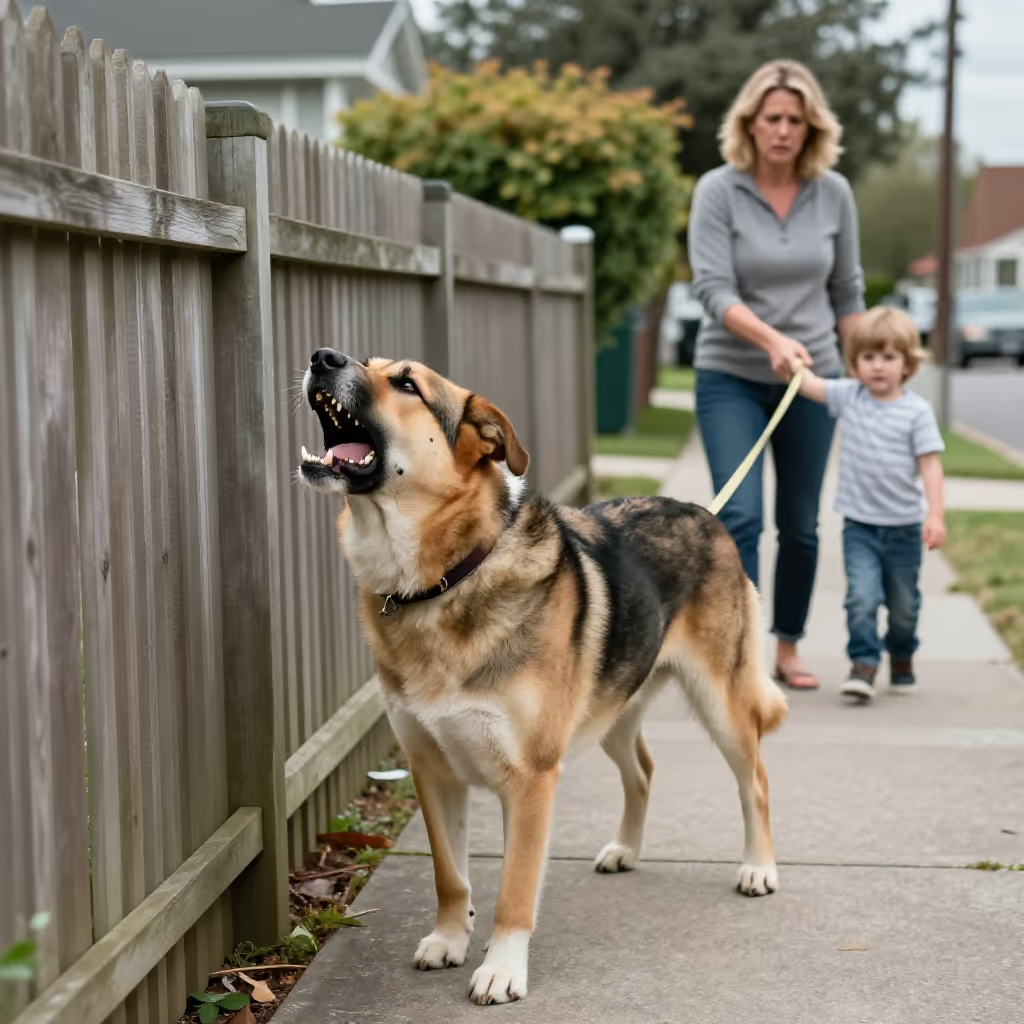
Der feindselige Mann vermied seinen Nachbarn und zeigte ihm deutlich seine Ablehnung.
The hostile man avoided his neighbor and made his disapproval clear.
Der aggressive Mann ging auf seinen Nachbarn zu und schrie ihn an.
The aggressive man approached his neighbor and yelled at him.