

feindlich
hostile
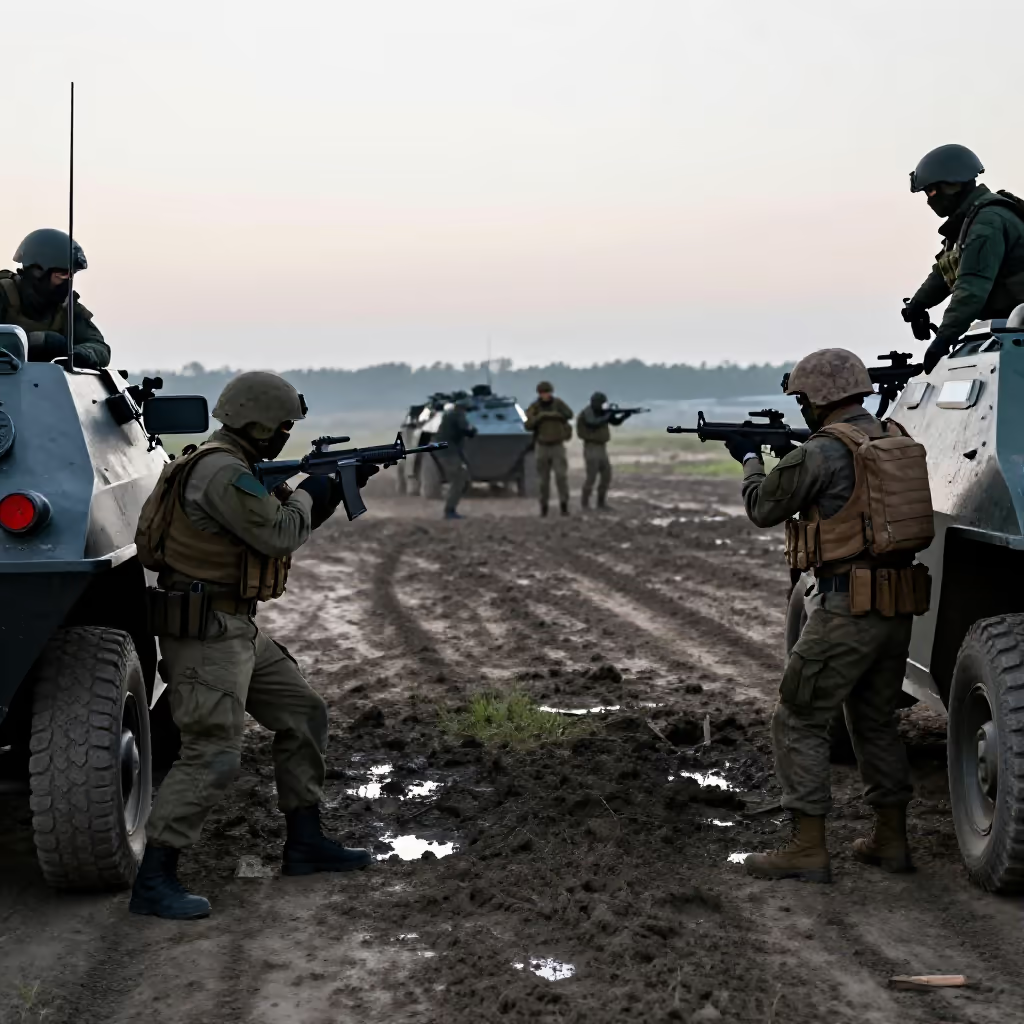
Relating to an enemy in a war, battle, or conflict; opposing.
EXAMPLE
Die Soldaten überquerten die feindlichen Linien bei Nacht.
The soldiers crossed the hostile lines at night.
hostile
Loading your saved state.
hostile
Relating to an enemy in a war, battle, or conflict; opposing.
Die Soldaten überquerten die feindlichen Linien bei Nacht.
The soldiers crossed the hostile lines at night.

hostile
Showing an attitude of rejection, dislike, or aggression toward a person or thing.
Er begegnete dem neuen Vorschlag mit einer feindlichen Einstellung.
He met the new proposal with a hostile attitude.

hostile
Describing conditions that are harmful, unfavorable, or unsuitable for living beings or certain processes.
Die Wüste ist eine lebensfeindliche Umgebung mit extremen Temperaturen.
The desert is a life-hostile environment with extreme temperatures.
The adjective 'feindlich' (hostile) is derived directly from the noun 'der Feind' (the enemy). The ending '-lich' turns the noun into an adjective and means something like 'like an enemy' or 'belonging to the enemy.'
Die beiden Länder hatten lange Zeit eine feindliche Beziehung.
The two countries had a hostile relationship for a long time.
To express toward whom a hostile attitude exists, the preposition 'gegenüber' (toward) is often used with the dative. Another fixed expression is 'jemandem feindlich gesinnt sein' (to be hostile toward someone), also with the dative.
Er war dem neuen Kollegen von Anfang an feindlich gesinnt.
He was hostile toward the new colleague from the very beginning.
The word '-feindlich' (-hostile) is often used as the second part of compound adjectives to express that something is harmful or unfavorable to a particular thing. Typical examples are 'lebensfeindlich' (hostile to life), 'umweltfeindlich' (environmentally harmful), or 'kinderfeindlich' (unfriendly to children).
Eine Politik, die Familien benachteiligt, wird als kinderfeindlich kritisiert.
A policy that disadvantages families is criticized as unfriendly to children.
In a military or economic context, 'feindlich' (hostile) is often combined with certain nouns. Common combinations are 'feindliche Truppen' (enemy troops), 'feindliches Gebiet' (enemy territory), or, in business, 'eine feindliche Übernahme' (a hostile takeover).
Das Unternehmen konnte die feindliche Übernahme erfolgreich abwehren.
The company was able to successfully fend off the hostile takeover.
opposing
Both words can describe a side that faces one's own side in a conflict. Gegnerisch neutrally describes belonging to the other side, while feindlich also suggests a hostile or aggressive relationship. For mere opposing positions, gegnerisch is therefore usually more appropriate.

Im politischen Konflikt stand die feindliche Gruppe unserer Bewegung gegenüber.
In the political conflict, the hostile group stood against our movement.
Im politischen Streit stand die gegnerische Gruppe unserer Bewegung gegenüber.
In the political dispute, the opposing group stood against our movement.