

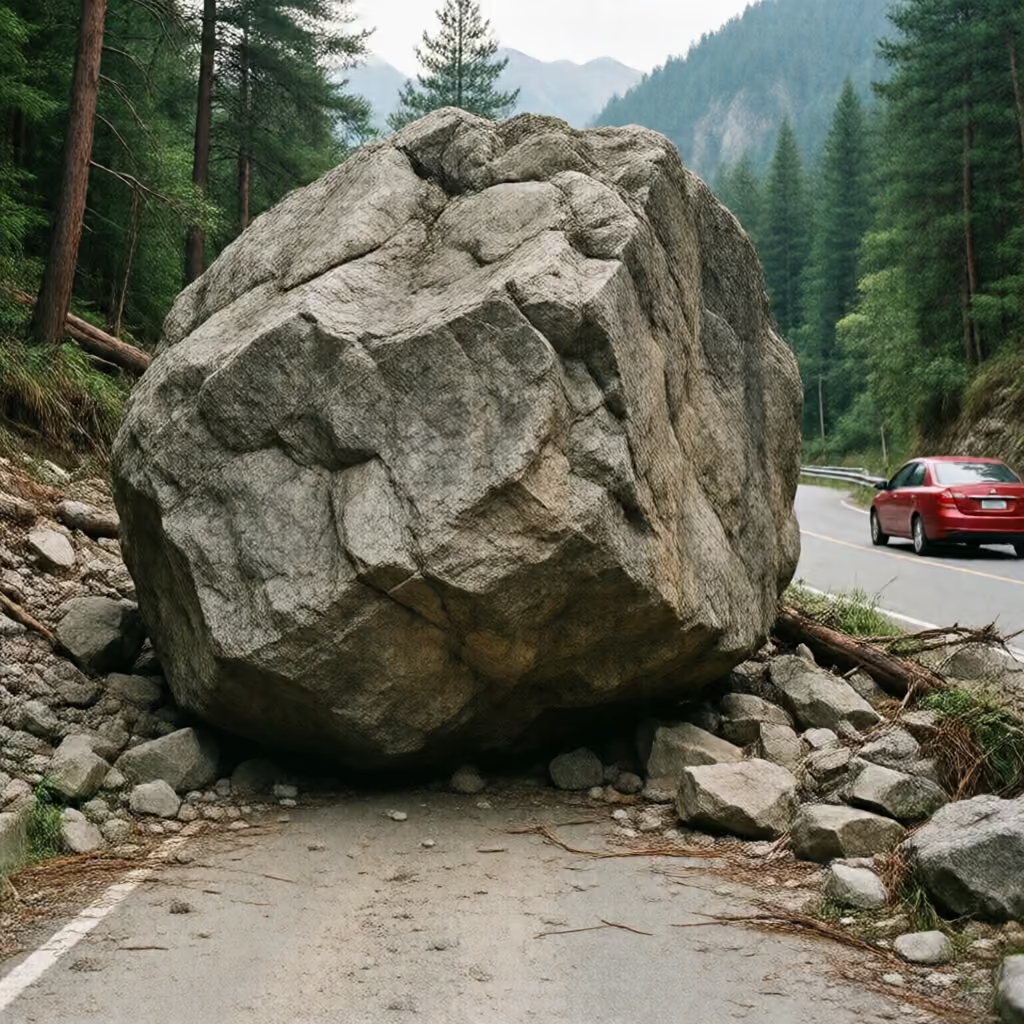
der Felsbrocken
boulder
A large, heavy piece of rock.
EXAMPLE
Nach dem Erdrutsch versperrte ein riesiger Felsbrocken die Straße.
After the landslide, a huge boulder blocked the road.
boulder
der Felsbrocken, die Felsbrocken
Loading your saved state.
boulder
A large, heavy piece of rock.
Nach dem Erdrutsch versperrte ein riesiger Felsbrocken die Straße.
After the landslide, a huge boulder blocked the road.
| gender | masculine der |
|---|---|
| plural | die Felsbrocken |
| genitive | des Felsbrockens |
| singular | plural | |
|---|---|---|
| nominative | der Felsbrocken | die Felsbrocken |
| accusative | den Felsbrocken | die Felsbrocken |
| dative | dem Felsbrocken | den Felsbrocken |
| genitive | des Felsbrockens | der Felsbrocken |
The article changes with the case; it is shown in colour.
'Felsbrocken' is made up of 'Fels' (rock) and 'Brocken' (chunk). The component 'Brocken' refers to a single, irregularly shaped piece; 'Fels' indicates the material.
Am Fuß der Felswand lagen mehrere Felsbrocken.
Several boulders lay at the foot of the rock face.
When boulders start moving, the collocations 'sich lösen' (to break loose), 'ins Tal stürzen' (to plunge into the valley), and 'den Hang hinunterrollen' (to roll down the slope) are often used. You can use these to describe the course of a rockfall.
Ein Felsbrocken löste sich aus der Wand und rollte den Hang hinunter.
A boulder broke loose from the rock face and rolled down the slope.
When a boulder is an obstacle, 'den Weg versperren' (to block the path) and 'die Straße blockieren' (to block the road) are typical collocations. To describe its removal, 'einen Felsbrocken wegräumen' (to clear away a boulder) is often used.
Die Feuerwehr musste einen Felsbrocken wegräumen, der die Zufahrt blockierte.
The fire department had to clear away a boulder that was blocking the access road.