

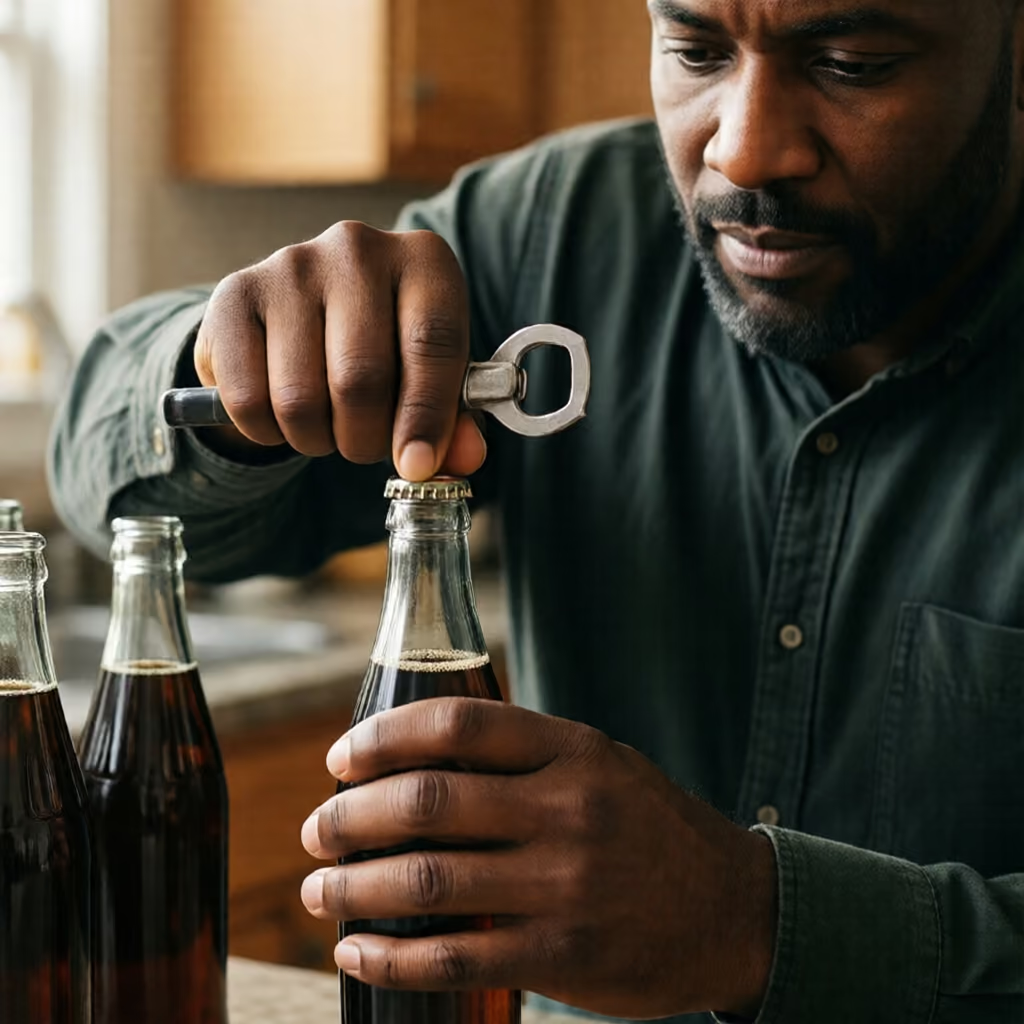
der Flaschenöffner
bottle opener
A tool used to remove the cap from a bottle, especially a crown cap.
EXAMPLE
Mit dem Flaschenöffner bekam sie die Bierflasche schnell auf.
She quickly opened the beer bottle with the bottle opener.
bottle opener
der Flaschenöffner, die Flaschenöffner
Loading your saved state.
bottle opener
A tool used to remove the cap from a bottle, especially a crown cap.
Mit dem Flaschenöffner bekam sie die Bierflasche schnell auf.
She quickly opened the beer bottle with the bottle opener.
| gender | masculine der |
|---|---|
| plural | die Flaschenöffner |
| genitive | des Flaschenöffners |
| singular | plural | |
|---|---|---|
| nominative | der Flaschenöffner | die Flaschenöffner |
| accusative | den Flaschenöffner | die Flaschenöffner |
| dative | dem Flaschenöffner | den Flaschenöffnern |
| genitive | des Flaschenöffners | der Flaschenöffner |
The article changes with the case; it is shown in colour.
'Flaschenöffner' (bottle opener) consists of 'Flasche' (bottle), the linking element '-n-', and 'Öffner' (opener). The first part indicates what the tool is intended for; the second part names its function.
In der Küchenschublade liegt ein Flaschenöffner.
There is a bottle opener in the kitchen drawer.
When you specify which tool you are using, use 'mit' (with) plus the dative: 'mit einem Flaschenöffner' (with a bottle opener) or 'mit dem Flaschenöffner' (with the bottle opener). This pattern works especially well with the verb 'öffnen' (to open).
Kannst du die Limonadenflasche mit einem Flaschenöffner öffnen?
Can you open the lemonade bottle with a bottle opener?
Common phrases include 'einen Flaschenöffner brauchen' (to need a bottle opener), 'einen Flaschenöffner suchen' (to look for a bottle opener), and 'einen Flaschenöffner zur Hand haben' (to have a bottle opener at hand). 'Zur Hand haben' (to have at hand) means that the tool is immediately available.
Beim Picknick hatten wir leider keinen Flaschenöffner zur Hand.
Unfortunately, we didn't have a bottle opener at hand during the picnic.