

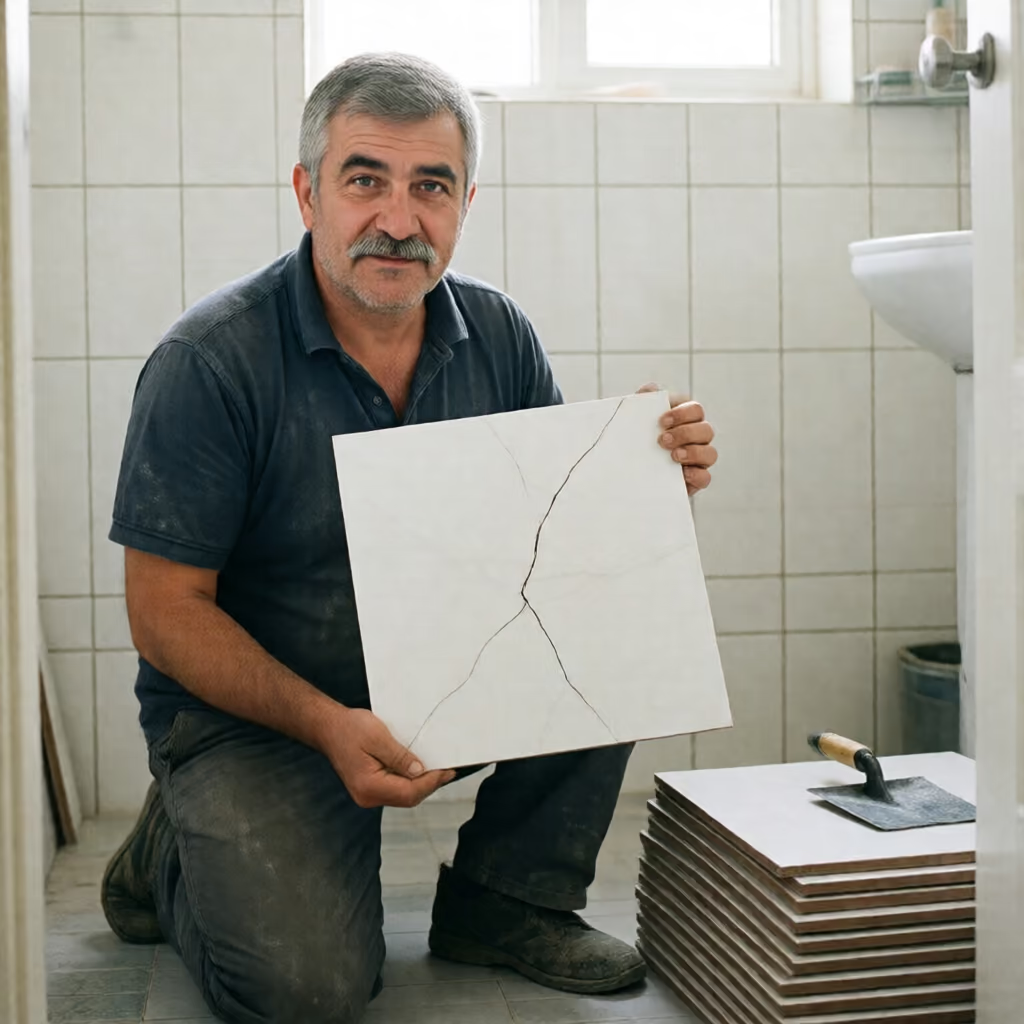
die Fliese
tile
A thin, usually rectangular slab made of ceramic, stone, or a similar material, used to cover walls, floors, or other surfaces.
EXAMPLE
Im Badezimmer ist eine Fliese gesprungen.
A tile has cracked in the bathroom.
tile
die Fliese, die Fliesen
Loading your saved state.
tile
A thin, usually rectangular slab made of ceramic, stone, or a similar material, used to cover walls, floors, or other surfaces.
Im Badezimmer ist eine Fliese gesprungen.
A tile has cracked in the bathroom.
| gender | feminine die |
|---|---|
| plural | die Fliesen |
| genitive | der Fliese |
| singular | plural | |
|---|---|---|
| nominative | die Fliese | die Fliesen |
| accusative | die Fliese | die Fliesen |
| dative | der Fliese | den Fliesen |
| genitive | der Fliese | der Fliesen |
The article changes with the case; it is shown in colour.
'Fliese' (tile) is often used with verbs such as 'legen' (to lay), 'verlegen' (to install), 'reinigen' (to clean), and 'austauschen' (to replace). These verbs describe typical tasks involving tiles.
Der Handwerker verlegt heute die Fliesen in der Küche.
The tradesperson is installing the tiles in the kitchen today.
'Fliese' (tile) forms many compounds that describe the place of use or the material more precisely, such as 'Bodenfliese' (floor tile), 'Wandfliese' (wall tile), and 'Keramikfliese' (ceramic tile). The compound often tells you where a tile is used or what it is made of.
Für den Eingangsbereich suchen wir robuste Fliesen, am liebsten pflegeleichte Keramikfliesen.
For the entrance area, we are looking for durable tiles, preferably easy-care ceramic tiles.
Tiles often develop damage such as cracks, breaks, or stains. Typical expressions are therefore 'eine Fliese ersetzen' (to replace a tile), 'eine Fliese reinigen' (to clean a tile), and 'eine Fliese ist beschädigt' (a tile is damaged).
Wir müssen die beschädigte Fliese hinter dem Waschbecken ersetzen.
We need to replace the damaged tile behind the sink.