

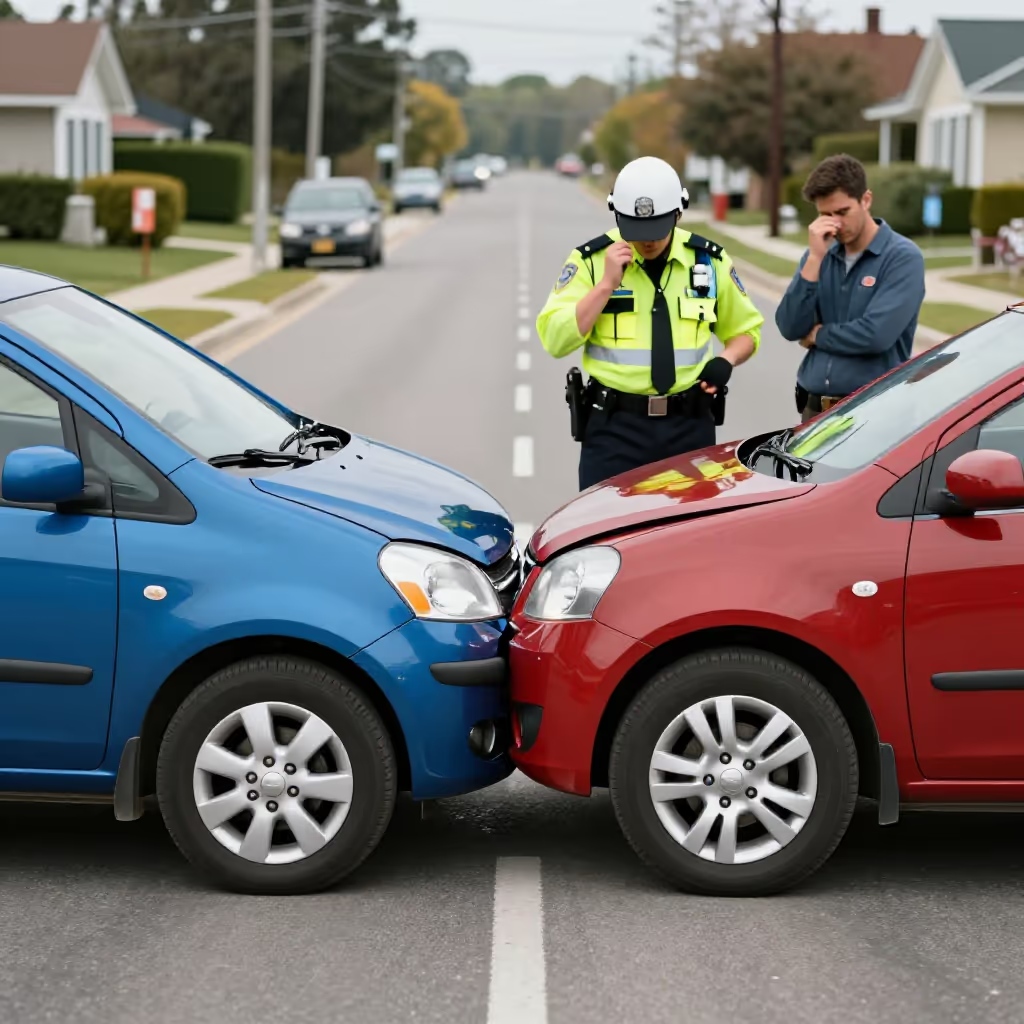
frontal
Related to the front side; coming from the front or concerning the front side.
EXAMPLE
Bei dem Unfall kam es zu einem frontalen Zusammenstoß zweier Fahrzeuge.
The accident involved a frontal collision between two vehicles.
Loading your saved state.
Related to the front side; coming from the front or concerning the front side.
Bei dem Unfall kam es zu einem frontalen Zusammenstoß zweier Fahrzeuge.
The accident involved a frontal collision between two vehicles.

direct
In a figurative sense: direct, open, and confrontational, without evading the issue.
In der Debatte startete sie einen frontalen Angriff auf die Argumente der Opposition.
In the debate, she launched a direct attack on the opposition's arguments.

teacher-centered
Related to a form of teaching ('Frontalunterricht') in which the teacher stands in front of the class and presents the material while the students primarily listen.
Der Unterricht wurde sehr frontal gestaltet, es gab kaum Gruppenarbeit.
The lesson was very teacher-centered; there was hardly any group work.
The adjective 'frontal' is derived from the noun 'die Front' (the front). So it always describes something that has to do with the front side or with a direct confrontation.
Die Soldaten bereiteten sich auf einen Angriff an der Front vor.
The soldiers prepared for an attack at the front.
The noun that 'frontal' describes reveals the exact meaning. A 'frontaler Zusammenstoß' (frontal collision) is literally from the front, a 'frontaler Angriff' (direct attack) in a discussion is direct and confrontational, and 'frontaler Unterricht' (teacher-centered instruction) describes a particular teaching method.
Das Auto hat einen frontalen Schaden.
The car has frontal damage.
In the literal meaning, 'frontal' is often used in connection with accidents and views. Typical combinations are 'frontaler Zusammenstoß' (frontal collision), 'frontale Kollision' (frontal collision), or 'eine frontale Ansicht' (a frontal view).
Das Museum bietet eine frontale Ansicht der Skulptur.
The museum offers a frontal view of the sculpture.
In the figurative sense, 'frontal' describes a direct confrontation. Common phrases are 'ein frontaler Angriff' (a direct attack), 'frontale Kritik üben' (to offer direct criticism), or 'eine frontale Auseinandersetzung' (a direct confrontation).
Die Politikerin wählte in der Talkshow den frontalen Angriff.
The politician chose a direct attack on the talk show.
direct
Direkt and frontal can both describe open criticism. Direkte Kritik gets to the point without beating around the bush, but it need not be aggressive. Frontale Kritik is additionally clearly confrontational and comes across as a deliberate attack; this word therefore fits a sharper dispute.

Die Chefin kritisierte den Plan frontal und suchte bewusst die Konfrontation.
The boss criticized the plan head-on and deliberately sought confrontation.
Die Chefin kritisierte den Plan direkt, aber in ruhigem Ton.
The boss criticized the plan directly, but in a calm tone.