

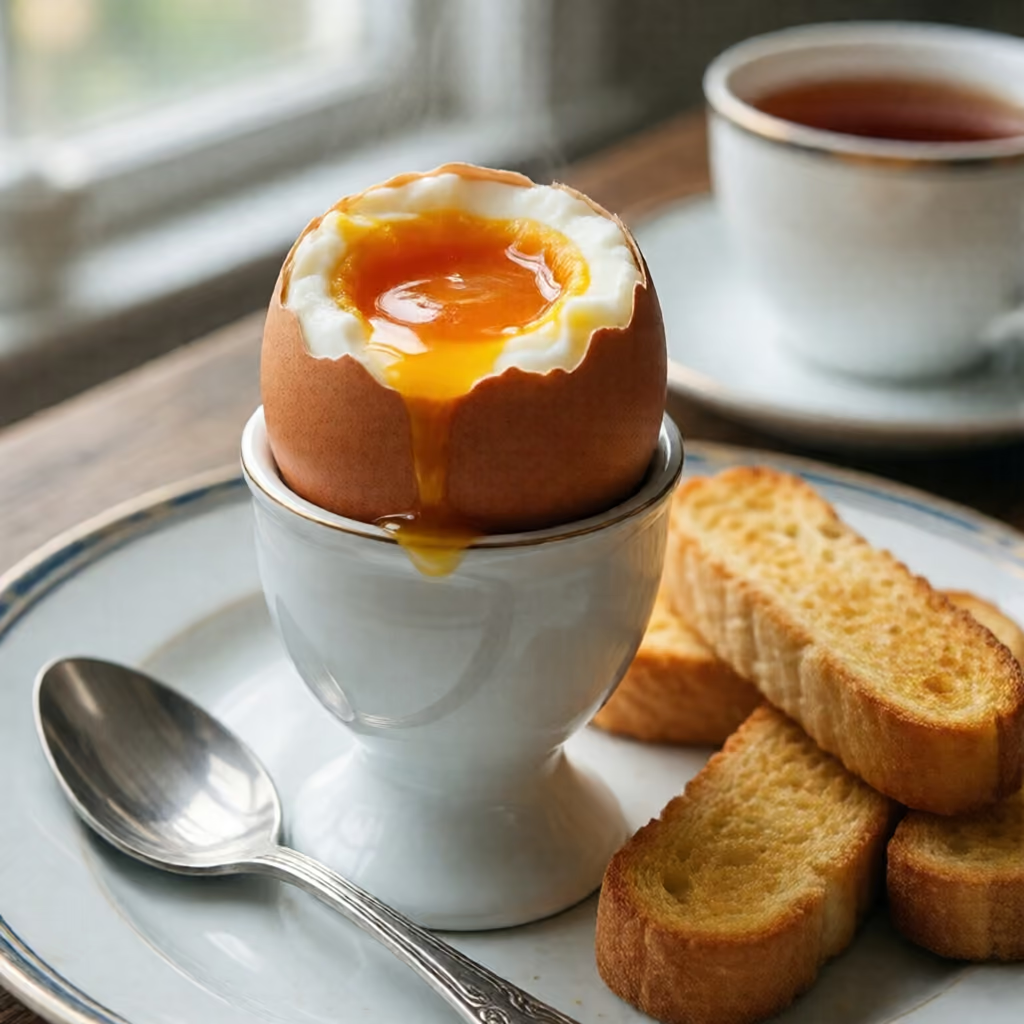
das Frühstücksei
breakfast egg
A boiled egg eaten for breakfast.
EXAMPLE
Mein Frühstücksei koche ich am liebsten so, dass das Eigelb noch weich ist.
I like to boil my breakfast egg so that the yolk is still soft.
breakfast egg
das Frühstücksei, die Frühstückseier
Loading your saved state.
breakfast egg
A boiled egg eaten for breakfast.
Mein Frühstücksei koche ich am liebsten so, dass das Eigelb noch weich ist.
I like to boil my breakfast egg so that the yolk is still soft.
| gender | neuter das |
|---|---|
| plural | die Frühstückseier |
| genitive | des Frühstückseis |
| singular | plural | |
|---|---|---|
| nominative | das Frühstücksei | die Frühstückseier |
| accusative | das Frühstücksei | die Frühstückseier |
| dative | dem Frühstücksei | den Frühstückseiern |
| genitive | des Frühstückseis des Frühstückseies | der Frühstückseier |
The article changes with the case; it is shown in colour.
'Frühstücksei' (breakfast egg) is made up of 'Frühstück' (breakfast) and 'Ei' (egg). The first word describes when or on what occasion the egg is eaten.
Am Sonntag bereitet mein Vater für alle ein Frühstücksei zu.
On Sundays, my father prepares a breakfast egg for everyone.
'Frühstücksei' (breakfast egg) is especially often used with verbs such as 'kochen' (to boil), 'essen' (to eat), and 'zubereiten' (to prepare). The descriptions 'weich' (soft), 'hart' (hard), and 'halbweich' (medium-soft) are also common.
Sie kocht jeden Morgen ein weiches Frühstücksei.
She boils a soft breakfast egg every morning.
'Frühstücksei' (breakfast egg) is often used together with information about the desired consistency because the state of the yolk is especially important when boiling the egg.
Mein Frühstücksei muss hart sein, ich mag kein flüssiges Eigelb.
My breakfast egg has to be hard-boiled; I don't like runny yolk.