

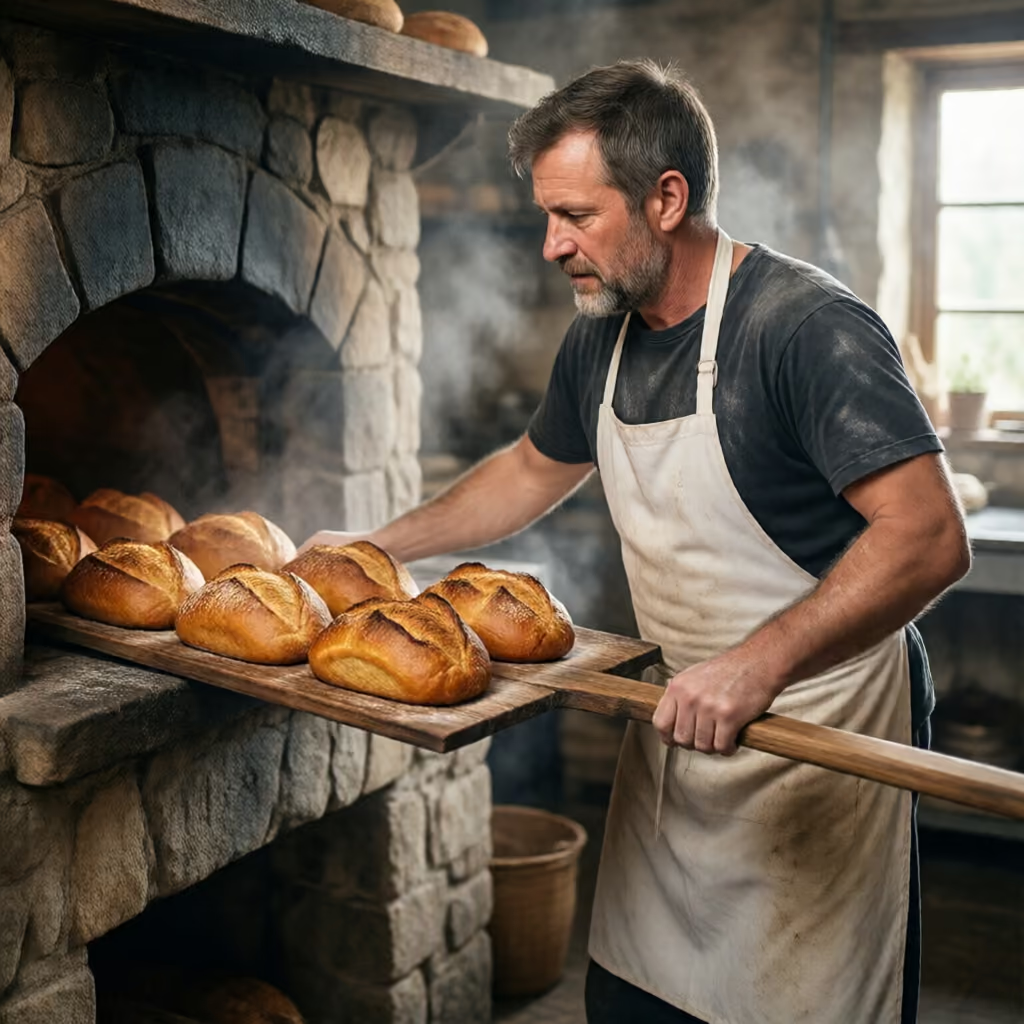
gebacken
baked
Prepared and cooked by baking, usually referring to bread, cake, or similar foods.
EXAMPLE
Das Brot ist frisch gebacken.
The bread is freshly baked.
baked
Loading your saved state.
baked
Prepared and cooked by baking, usually referring to bread, cake, or similar foods.
Das Brot ist frisch gebacken.
The bread is freshly baked.

newly qualified
Having just entered a particular profession or achieved a particular qualification; new in this role.
Die frisch gebackene Ärztin beginnt heute ihre erste Stelle.
The newly qualified doctor is starting her first job today.

to manage something
To cope with a task or problem and complete it successfully; this colloquial expression is usually used with „kriegen“ (to get) or „bekommen“ (to get).
Kriegst du die Reparatur bis morgen gebacken?
Can you manage to get the repair done by tomorrow?
| basic form | gebacken |
|---|
| masc. | fem. | neut. | plural | |
|---|---|---|---|---|
| nom. | -e | -e | -e | -en |
| acc. | -en | -e | -e | -en |
| dat. | -en | -en | -en | -en |
| gen. | -en | -en | -en | -en |
Add the ending to gebacken.
| masc. | fem. | neut. | plural | |
|---|---|---|---|---|
| nom. | -er | -e | -es | -en |
| acc. | -en | -e | -es | -en |
| dat. | -en | -en | -en | -en |
| gen. | -en | -en | -en | -en |
Add the ending to gebacken.
| masc. | fem. | neut. | plural | |
|---|---|---|---|---|
| nom. | -er | -e | -es | -e |
| acc. | -en | -e | -es | -e |
| dat. | -em | -er | -em | -en |
| gen. | -en | -er | -en | -er |
Add the ending to gebacken.
„Gebacken“ (baked) is the participle of the verb „backen“ (to bake) and consists of „ge-“, the stem „back“, and „-en“. This connection helps you recognize the word when it is used as a description before a noun.
Der Duft von frisch gebackenem Brot zieht durch die Küche.
The smell of freshly baked bread fills the kitchen.
Common collocations include „frisch gebacken“ (freshly baked), „selbst gebacken“ (homemade), and „fertig gebacken“ (fully baked). These emphasize freshness, homemade preparation, or the end of the baking time.
Zum Geburtstag hat sie einen selbst gebackenen Kuchen mitgebracht.
She brought a homemade cake for her birthday.
When „frisch gebacken“ (newly qualified) appears before a role or profession, it has the figurative meaning. Typical collocations include „frisch gebackene Eltern“ (new parents), „frisch gebackener Vater“ (new father), and „frisch gebackener Doktor“ (newly qualified doctor).
Wir haben den frisch gebackenen Eltern zur Geburt ihrer Tochter gratuliert.
We congratulated the new parents on the birth of their daughter.
The pattern is „etwas gebacken kriegen“ or „etwas gebacken bekommen“ (to manage something), with the task as the accusative object. In a simple main clause, „gebacken“ comes at the end; the expression is often used with „nicht“ (not) or „nichts“ (nothing).
Ich kriege den Bericht heute einfach nicht gebacken.
I simply can't get the report done today.