

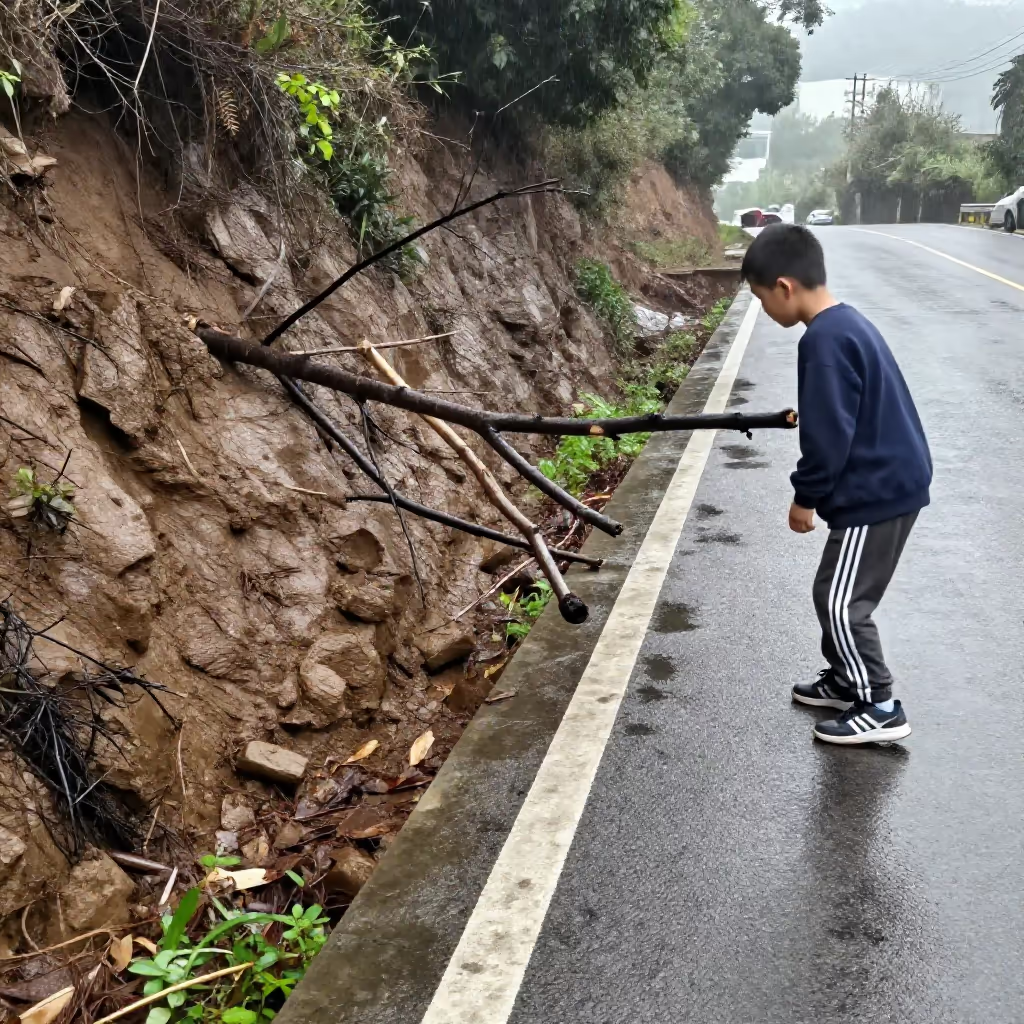
die Gefahr
danger
A situation or condition that can lead to harm, injury, or another negative event; a risk.
EXAMPLE
Bei Glatteis besteht große Gefahr, mit dem Auto auszurutschen.
On black ice, there is a great danger of skidding with the car.
danger
Loading your saved state.
danger
A situation or condition that can lead to harm, injury, or another negative event; a risk.
Bei Glatteis besteht große Gefahr, mit dem Auto auszurutschen.
On black ice, there is a great danger of skidding with the car.

to be in danger
To be in a threatening or risky situation.
Die Bergsteiger waren durch den plötzlichen Wetterumschwung in großer Gefahr.
The mountain climbers were in great danger because of the sudden change in weather.

to be out of danger
To no longer be in a threatening or risky situation.
Nach der erfolgreichen Operation ist der Patient nun außer Gefahr.
After the successful operation, the patient is now out of danger.
The noun 'die Gefahr' (danger) belongs to a word family. The related adjective is 'gefährlich' (dangerous), and the verb is 'gefährden' (to endanger), which means to put someone or something in danger.
Das Fahren bei Nebel ist sehr gefährlich.
Driving in fog is very dangerous.
The preposition 'in' is very important here. A change of state is expressed with the accusative ('in Gefahr geraten' — to get into danger), while a state is expressed with the dative ('in Gefahr sein' — to be in danger).
Das kleine Boot geriet durch den Sturm in große Gefahr.
The small boat got into great danger because of the storm.
Common verbs used with 'Gefahr' (danger) are 'bestehen' (to exist; the danger exists), 'darstellen' (to represent; something poses a danger), and 'laufen' in 'Gefahr laufen, etwas zu tun' (to run the risk of doing something).
Es besteht die Gefahr, dass der alte Baum beim nächsten Sturm umfällt.
There is a danger that the old tree will fall over in the next storm.
The expression 'außer Gefahr sein' (to be out of danger) is a fixed combination and means that a threatening situation has been overcome. It is often used in a medical context.
Die Ärzte bestätigten, dass der verletzte Fahrer außer Gefahr ist.
The doctors confirmed that the injured driver is out of danger.
risk
Both words refer to possible negative consequences. „Die Gefahr“ refers more to the threatening situation or the potential harm itself, while „das Risiko“ places more emphasis on the possibility of it occurring and on evaluating a course of action. Use „Gefahr“ for the threat and „Risiko“ when weighing the possibilities.

Auf dem vereisten Weg besteht die Gefahr eines Sturzes.
The icy path poses a danger of falling.
Auf dem vereisten Weg besteht ein hohes Risiko zu stürzen.
There is a high risk of falling on the icy path.