

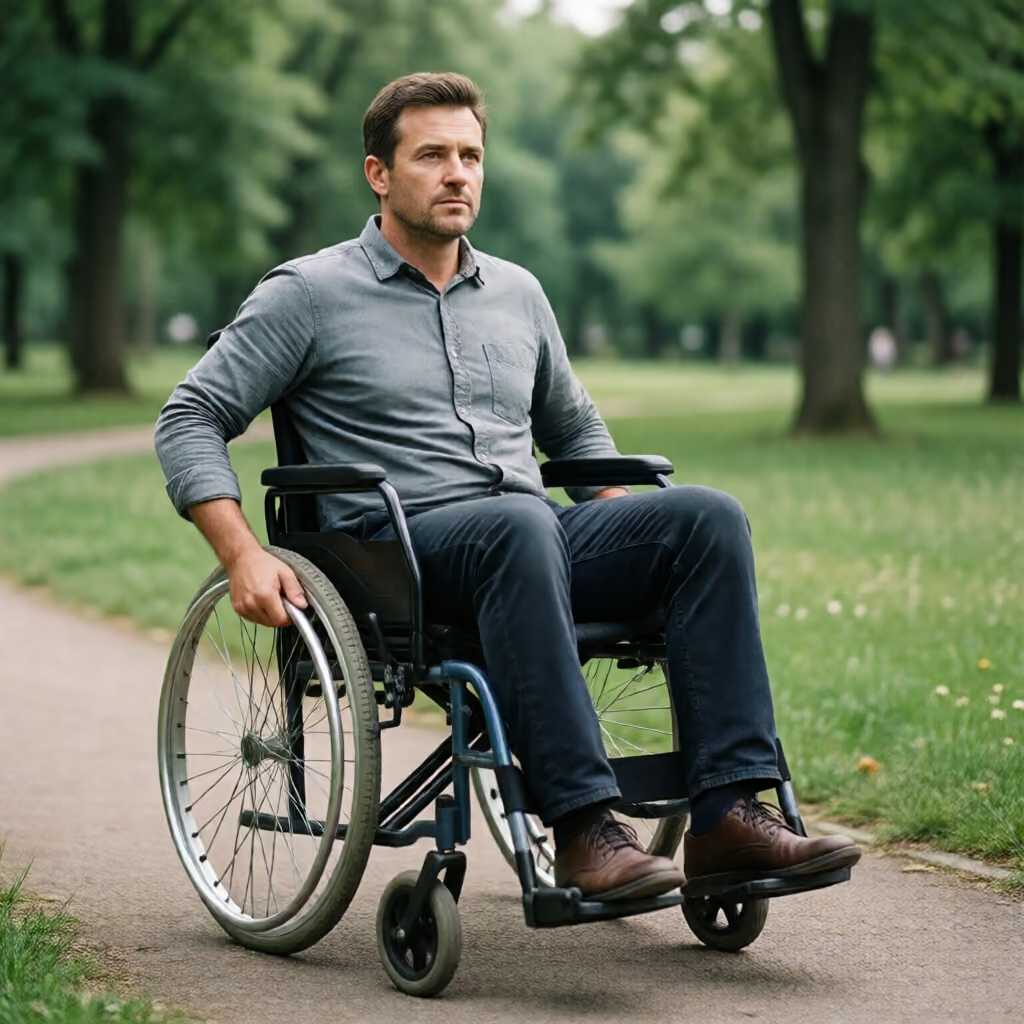
gelähmt
paralyzed
Unable to move certain parts of the body because of a disorder affecting the nerves or muscles.
EXAMPLE
Seit dem Unfall ist sein linkes Bein gelähmt.
His left leg has been paralyzed since the accident.
paralyzed
Loading your saved state.
paralyzed
Unable to move certain parts of the body because of a disorder affecting the nerves or muscles.
Seit dem Unfall ist sein linkes Bein gelähmt.
His left leg has been paralyzed since the accident.

paralyzed
Temporarily unable to move or act because of a strong feeling such as fear or horror.
Vor Entsetzen stand sie wie gelähmt da und konnte keinen Schritt mehr tun.
She stood there as if paralyzed with horror and could not take another step.
| basic form | gelähmt |
|---|
| masc. | fem. | neut. | plural | |
|---|---|---|---|---|
| nom. | -e | -e | -e | -en |
| acc. | -en | -e | -e | -en |
| dat. | -en | -en | -en | -en |
| gen. | -en | -en | -en | -en |
Add the ending to gelähmt.
| masc. | fem. | neut. | plural | |
|---|---|---|---|---|
| nom. | -er | -e | -es | -en |
| acc. | -en | -e | -es | -en |
| dat. | -en | -en | -en | -en |
| gen. | -en | -en | -en | -en |
Add the ending to gelähmt.
| masc. | fem. | neut. | plural | |
|---|---|---|---|---|
| nom. | -er | -e | -es | -e |
| acc. | -en | -e | -es | -e |
| dat. | -em | -er | -em | -en |
| gen. | -en | -er | -en | -er |
Add the ending to gelähmt.
'Gelähmt' (paralyzed) is the past participle of 'lähmen' (to paralyze) and is also used as an adjective. The form therefore often describes a state that has resulted from an event or cause.
Nach der Operation war sein Arm vorübergehend gelähmt.
After the operation, his arm was temporarily paralyzed.
In its physical meaning, 'gelähmt' (paralyzed) is often used with body parts or sides of the body. Typical collocations include 'ein gelähmtes Bein' (a paralyzed leg), 'ein gelähmter Arm' (a paralyzed arm), and 'eine gelähmte Körperhälfte' (a paralyzed side of the body).
Nach dem Schlaganfall war die rechte Körperhälfte gelähmt.
After the stroke, the right side of his body was paralyzed.
The figurative meaning can often be recognized from the expression 'wie gelähmt' (as if paralyzed) or from phrases such as 'vor Angst' (with fear), 'vor Schreck' (with fright), and 'vor Entsetzen' (with horror). A strong feeling is given as the cause.
Als plötzlich ein Schuss fiel, blieb sie wie gelähmt stehen.
When a shot suddenly rang out, she stood there as if paralyzed.