

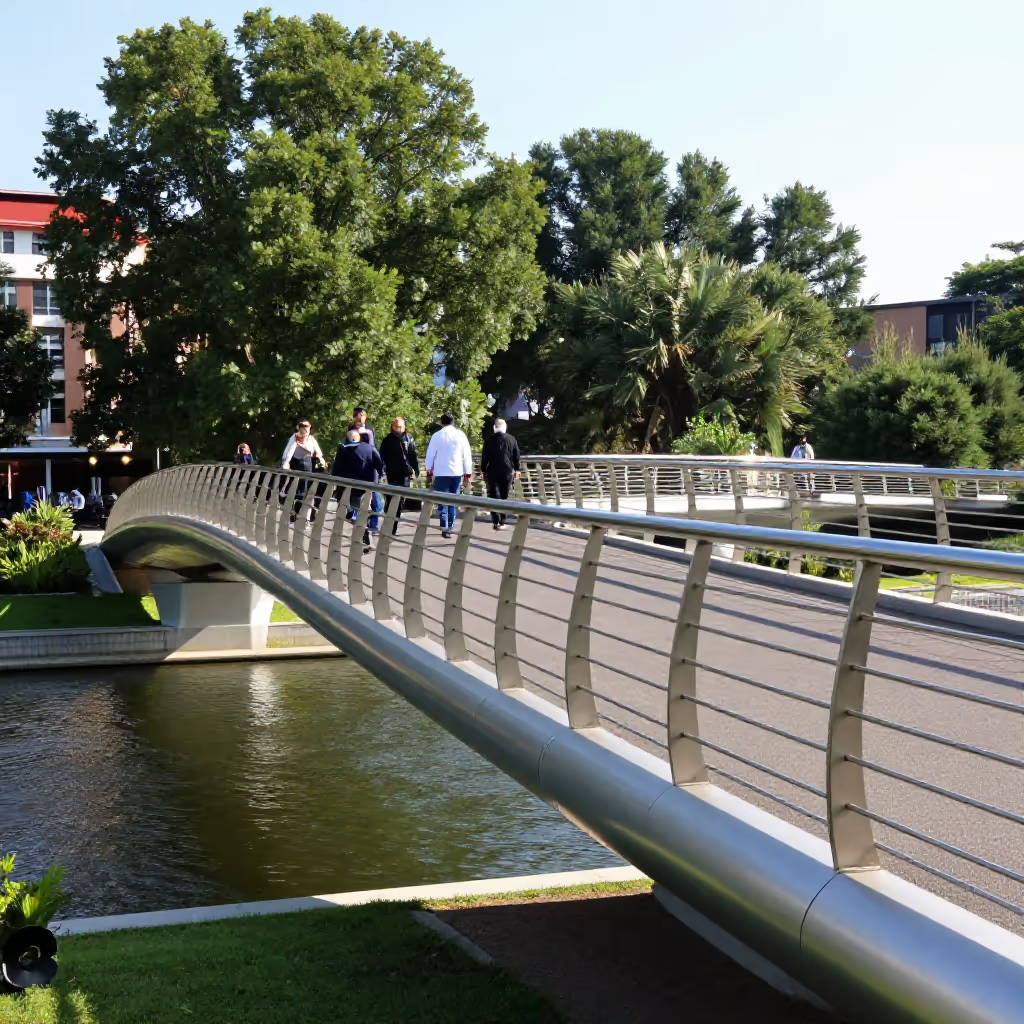
Describes a shape that has one or more elegant curves or arches. It is often used for dynamic or harmonious lines.
example
Die geschwungene Unterschrift des Künstlers ist sein Markenzeichen.
The artist's sweeping signature is his trademark.
Usage tips
Word structure
'Geschwungen' (curved/sweeping) is the past participle of the verb 'schwingen' (to swing). It describes a shape that looks as if it were created through a dynamic, swinging movement.
EXAMPLE
Die Brücke hat eine elegant geschwungene Form.
The bridge has an elegantly curved shape.
Typical collocations
This adjective is often used to describe architectural elements, handwriting, or lines. Typical combinations are 'eine geschwungene Treppe' (a curved staircase), 'eine geschwungene Linie' (a curved line), or 'eine geschwungene Handschrift' (sweeping handwriting).
EXAMPLE
Die geschwungene Treppe führt in den ersten Stock.
The curved staircase leads to the first floor.
Style and meaning
The word 'geschwungen' (curved/sweeping) emphasizes not only a curve, but also its elegance and dynamism. It is used for harmonious and aesthetically pleasing shapes.
EXAMPLE
Die Vase hat ein schönes, geschwungenes Design.
The vase has a beautiful, curved design.
Compare with
antonym
geschwungen vs gerade
right now / straight
'gerade' and 'geschwungen' both describe the shape of lines, paths, or objects. 'gerade' means that something runs without a curve or bend. 'geschwungen' means that something has round, often beautiful curves. So for a road, a line, or a piece of furniture, 'gerade' is more direct and linear, while 'geschwungen' is softer and more curved.
geschwungen
Im Park führt ein geschwungener Pfad um den kleinen See.
In the park, a curved path leads around the small lake.
gerade
Der Weg zum Bahnhof ist ganz gerade.
The path to the train station is completely straight.