


gesellig
sociable
Describes a person who likes being with other people often and maintains social contacts.
EXAMPLE
Mein Bruder ist sehr gesellig und kennt in der ganzen Stadt Leute.
My brother is very sociable and knows people all over town.
sociable
Loading your saved state.
sociable
Describes a person who likes being with other people often and maintains social contacts.
Mein Bruder ist sehr gesellig und kennt in der ganzen Stadt Leute.
My brother is very sociable and knows people all over town.
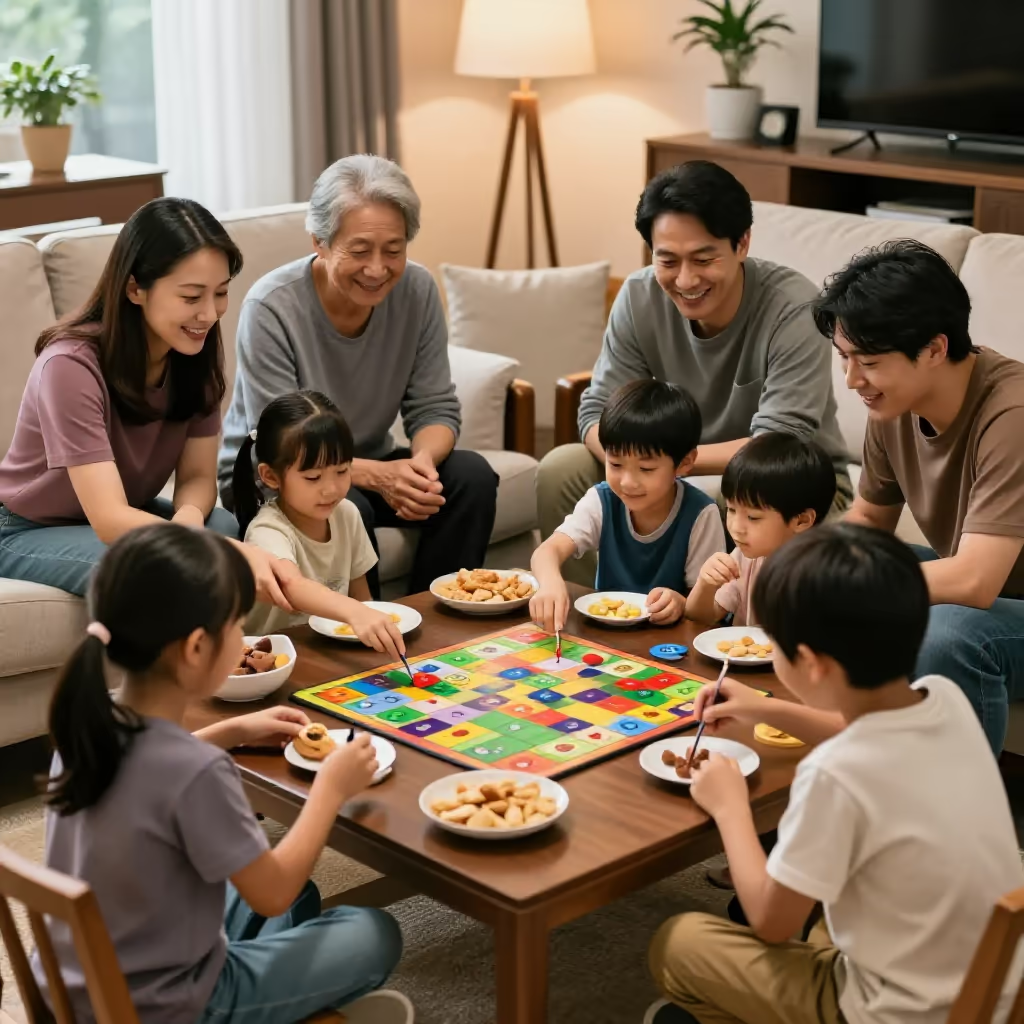
convivial
Describes a situation or occasion marked by a pleasant, communal atmosphere.
Wir verbrachten einen geselligen Abend bei Wein und gutem Essen.
We spent a convivial evening with wine and good food.
The adjective 'gesellig' (sociable) is related to the noun 'der Geselle', which used to mean 'companion' or 'comrade'. So the root of the word lies in the idea of community and being together.
Er ist ein geselliger Typ und immer für einen Spaß zu haben.
He is a sociable guy and always up for some fun.
You can recognize the meaning from the context: if 'gesellig' (sociable) refers to a person, it describes their character. If it refers to a situation such as an evening or a group, it describes the atmosphere.
Anna ist eine sehr gesellige Person.
Anna is a very sociable person.
When 'gesellig' (sociable) describes a person, it is often used with 'sein' (to be) or as an adjective before a noun. Typical formulations are 'ein geselliger Mensch sein' (to be a sociable person) or 'von Natur aus gesellig sein' (to be sociable by nature).
Sie ist von Natur aus gesellig und liebt große Partys.
She is sociable by nature and loves big parties.
To describe a pleasant social atmosphere, 'gesellig' (convivial) is often combined with nouns such as 'Abend' (evening), 'Runde' (group/gathering), or 'Beisammensein' (get-together). A fixed expression is 'in geselliger Runde' (in a convivial group).
Lasst uns den Abend in geselliger Runde ausklingen.
Let's wind down the evening in good company.
social
Sozial and gesellig can both describe a person who enjoys maintaining social contacts. Gesellig particularly emphasizes that someone is often and happily in company. In this area, sozial is more general and refers to a tendency to be with other people and maintain social contacts.

Mara ist gesellig und verbringt den Abend am liebsten in einer großen Runde.
Mara is sociable and would rather spend the evening in a large group.
Mara ist sozial und findet in der neuen Klasse schnell Kontakt.
Mara is sociable and quickly connects with people in her new class.