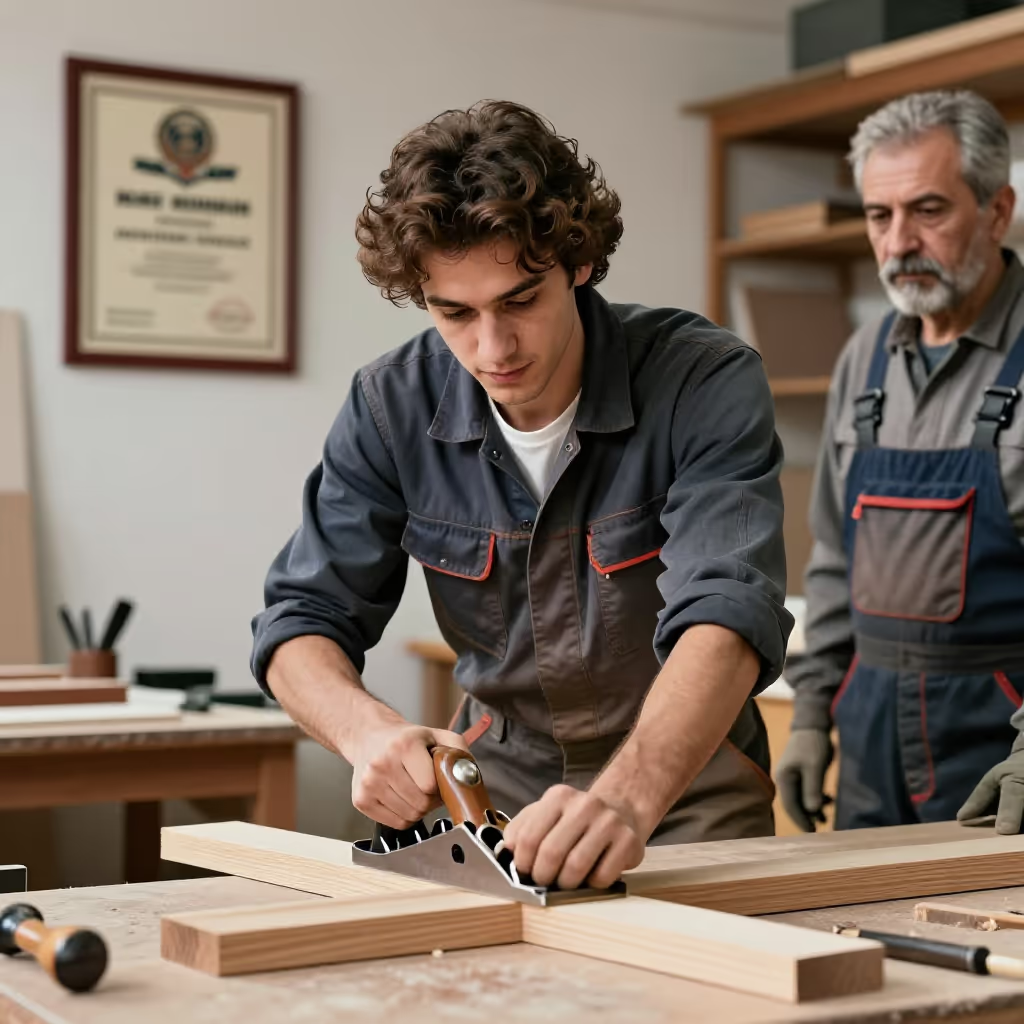
A craftsperson who has successfully completed their vocational training (apprenticeship) but is not yet a master craftsperson.
example
Nach seiner Prüfung durfte er als Geselle in der Tischlerei arbeiten.
After his exam, he was allowed to work as a journeyman in the carpentry workshop.

Usage tips
Common mistake: N-declension
'Der Geselle' (the journeyman/fellow) is an N-declension noun. This means it takes the ending '-n' in all cases except the nominative singular. This is an important rule for correct usage.
EXAMPLE
Der Geselle arbeitet in der Werkstatt.
The journeyman works in the workshop.
Context clues
You can recognize the meaning from the context. If it is about crafts, training, or a master craftsperson, it means the craftsperson. In combination with negative adjectives such as 'übel' (nasty) or 'zwielichtig' (shady), it means a suspicious person.
EXAMPLE
Der Tischler sucht einen neuen Gesellen.
The carpenter is looking for a new journeyman.
Cultural context
In German crafts and trades, the 'Geselle' (journeyman) is an important part of the training system. After the apprenticeship (vocational training), you become a journeyman and can later take the exam to become a master craftsperson.
EXAMPLE
Nach drei Jahren Lehre hat er seine Prüfung zum Gesellen bestanden.
After three years of apprenticeship, he passed his journeyman's exam.
Fixed expressions
In the negative meaning, 'Geselle' (fellow) is almost always used in fixed expressions with an adjective. Typical examples are 'ein übler Geselle' (a nasty fellow), 'ein komischer Geselle' (a strange fellow), or 'ein dunkler Geselle' (a sinister fellow).
EXAMPLE
Von diesem komischen Gesellen würde ich kein Auto kaufen.
I wouldn't buy a car from that strange fellow.
Compare with
confusable
Geselle vs Meister
master / champion
'der Meister' and 'der Geselle' both belong to the world of skilled trades and describe different stages of training. A 'Geselle' (journeyman) has completed an apprenticeship and can work in the profession, but is not yet a master craftsman. A 'Meister' has also passed the master craftsman's examination and may, for example, run a business or train apprentices. Learners may confuse the words because both refer to trained craftspeople. In practical terms: 'Geselle' is the stage after training; 'Meister' is the higher stage after that.
Geselle
Nach seiner Ausbildung arbeitet Paul als Geselle in einer Bäckerei.
After his training, Paul works as a journeyman in a bakery.
Meister
Der Meister prüft am Abend, ob die Arbeit sauber gemacht wurde.
In the evening, the master craftsman checks whether the work was done neatly.