

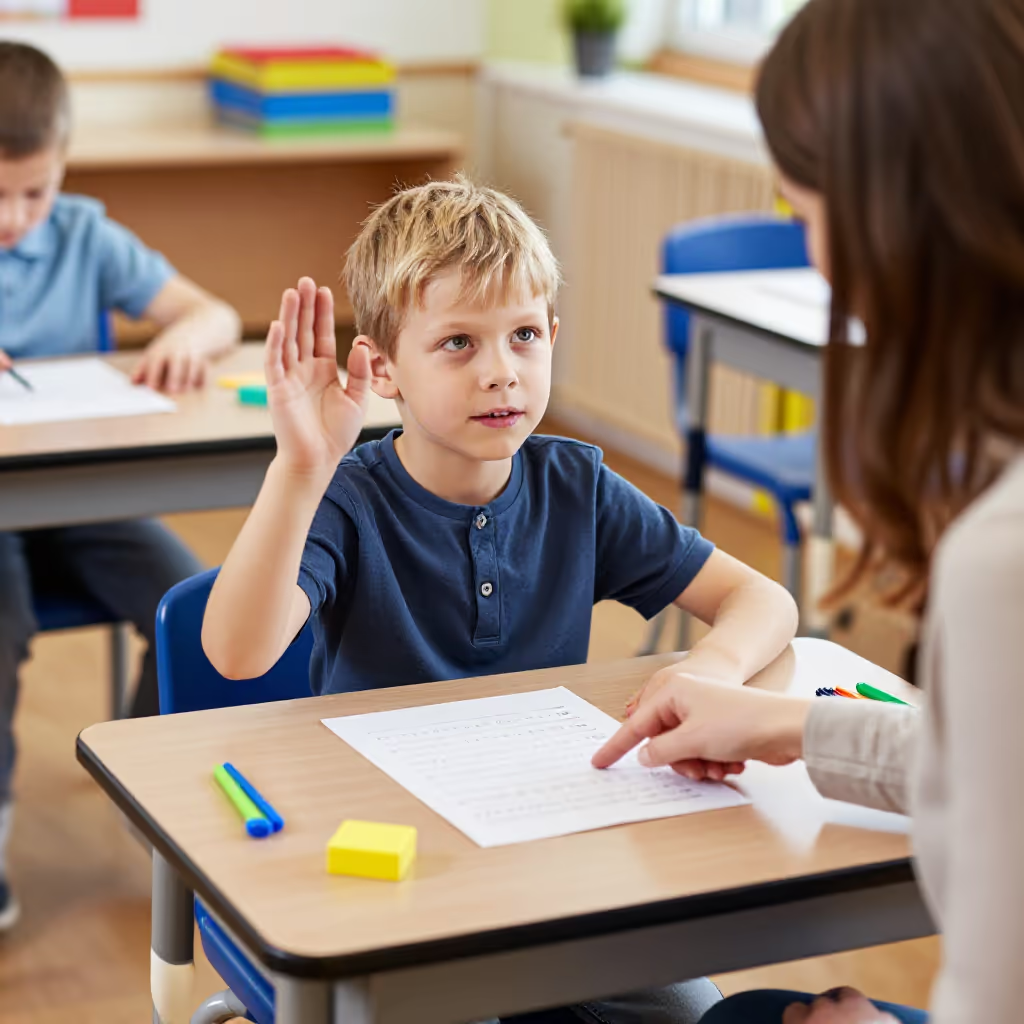
A child who attends elementary school. In Germany, elementary school usually includes grades 1 to 4.
example
Die Grundschüler machten einen Ausflug in den Zoo.
The elementary school students went on a trip to the zoo.
Usage tips
Word composition
The word is made up of 'Grundschule' (elementary school) and the ending '-er'. 'Grundschule' itself consists of 'Grund' (base, foundation) and 'Schule' (school), meaning the basic school.
EXAMPLE
In Deutschland gehen Kinder mit etwa sechs Jahren in die Grundschule.
In Germany, children start elementary school at about six years old.
Person designation
The ending '-er' is often used in German to refer to a male person who belongs to a place or thing. A 'Grundschüler' (elementary school student) is therefore someone who belongs to the 'Grundschule' (elementary school).
EXAMPLE
Ein Berliner ist eine Person aus Berlin.
A Berliner is a person from Berlin.
Cultural context
A Grundschüler in Germany is typically between six and ten years old. During this time, children learn the basics such as reading, writing, and arithmetic.
EXAMPLE
Als Grundschüler habe ich gelernt, flüssig zu lesen.
As an elementary school student, I learned to read fluently.
Compare with
near_synonym · confusable
Grundschüler vs Schüler
student / pupil
'der Schüler' and 'der Grundschüler' both belong to the area of school. 'der Schüler' is the general term for a person who attends a school. 'der Grundschüler' is more specific and refers to a child in elementary school, so usually in the first years of school. The words can be confused because every Grundschüler is also a Schüler. If the age or type of school is important, 'Grundschüler' fits better. If that is not important, 'Schüler' is enough.
Grundschüler
Auf dem Schulhof zeigt der Grundschüler stolz seinen neuen Ranzen.
In the schoolyard, the elementary school student proudly shows off his new satchel.
Schüler
Die Lehrerin hilft dem Schüler nach dem Test bei einer schweren Aufgabe.
After the test, the teacher helps the student with a difficult task.