

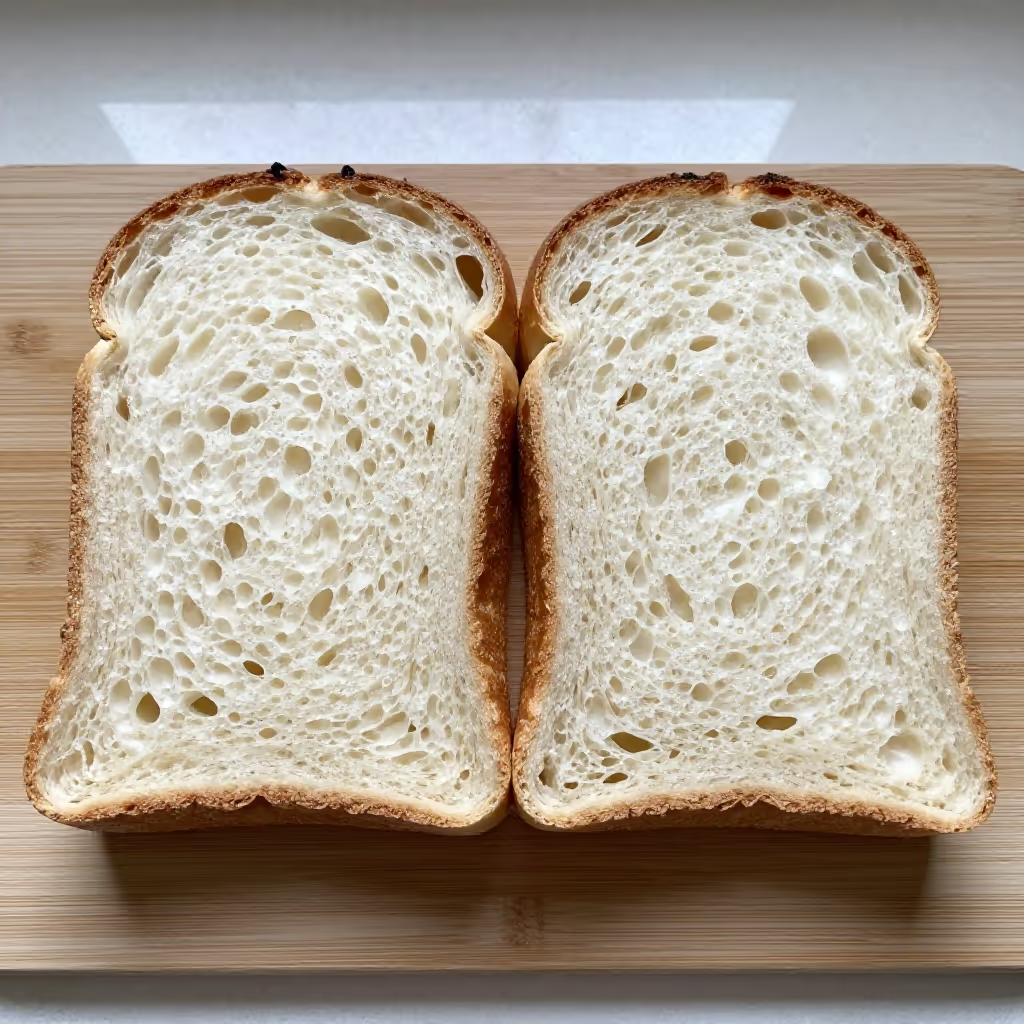
halb
half
Describes half of something, one of two equal parts.
EXAMPLE
Ich hätte gern ein halbes Hähnchen mit Pommes.
I'd like half a chicken with fries.
half
Loading your saved state.
half
Describes half of something, one of two equal parts.
Ich hätte gern ein halbes Hähnchen mit Pommes.
I'd like half a chicken with fries.

half past
Used when telling time and means 30 minutes before the next full hour.
Wir treffen uns um halb acht am Kino.
We're meeting at half past seven at the cinema.
half / partly
Means incomplete, not entirely, or not properly.
Er hat die Aufgabe nur halb erledigt.
He only half completed the task.

almost
Expresses that someone is almost or nearly in a certain state.
Ich bin vor Langeweile halb gestorben.
I was almost dying of boredom.
'Halb' (half) is declined when it stands as an adjective before a noun. When it describes a verb or another adjective as an adverb, it remains unchanged.
Er hat nur einen halben Apfel gegessen.
He ate only half an apple.
Before geographical names or nouns without an article, 'halb' (half) often stands directly before the word and is not declined.
Halb Deutschland spricht über das Thema.
Half of Germany is talking about the topic.
When telling time, 'halb' always means 30 minutes BEFORE the next full hour. So 'halb neun' is 8:30, not 9:30.
Der Zug fährt um halb drei ab.
The train leaves at half past two.
The expression 'halbe Sachen machen' (to do things by halves) is a fixed expression and means to complete a task incompletely or carelessly.
Wenn du etwas tust, dann richtig. Mach keine halben Sachen!
If you're going to do something, do it properly. Don't do things by halves!
In the meaning of 'fast' (almost) or 'beinahe' (nearly), 'halb' is often used in exaggerated expressions to describe a strong feeling.
Ich habe mich halb totgelacht.
I almost died laughing.
almost
„fast“ is the general way to express that someone or something is almost in a certain state. „halb“ can express the same thing in fixed or especially vivid descriptions of states and is then more marked. „fast“ usually fits a neutral statement, but use „halb“ in expressions such as „halb tot“.

Nach dem langen Aufstieg war ich halb erschöpft.
After the long climb, I was half exhausted.
Nach dem langen Aufstieg war ich fast erschöpft.
After the long climb, I was almost exhausted.