


der Geist
mind
A person's ability to think, feel, and will; the reason or intellect.
EXAMPLE
Sie ist eine Frau von wachem Geist und großem Herzen.
She is a woman with an alert mind and a big heart.
spirit / mind
Loading your saved state.
mind
A person's ability to think, feel, and will; the reason or intellect.
Sie ist eine Frau von wachem Geist und großem Herzen.
She is a woman with an alert mind and a big heart.

ghost
The soul of a deceased person perceived as a bodiless apparition.
Die Legende besagt, dass der Geist eines Ritters in der Burg umhergeht.
Legend has it that the ghost of a knight wanders around the castle.

spirit
The fundamental character, attitude, or meaning inherent in something.
Wir müssen im Geist der Fairness und Zusammenarbeit handeln.
We must act in the spirit of fairness and cooperation.

give up the ghost
To die or, in the case of devices, to break down for good.
Nach zwanzig Jahren hat unser alter Kühlschrank endlich seinen Geist aufgegeben.
After twenty years, our old refrigerator finally gave up the ghost.

spirit
A high-proof alcoholic drink obtained through distillation, usually from fruit.
Nach dem Essen trank er einen klaren Geist aus Williamsbirnen.
After the meal, he drank a clear spirit made from Williams pears.
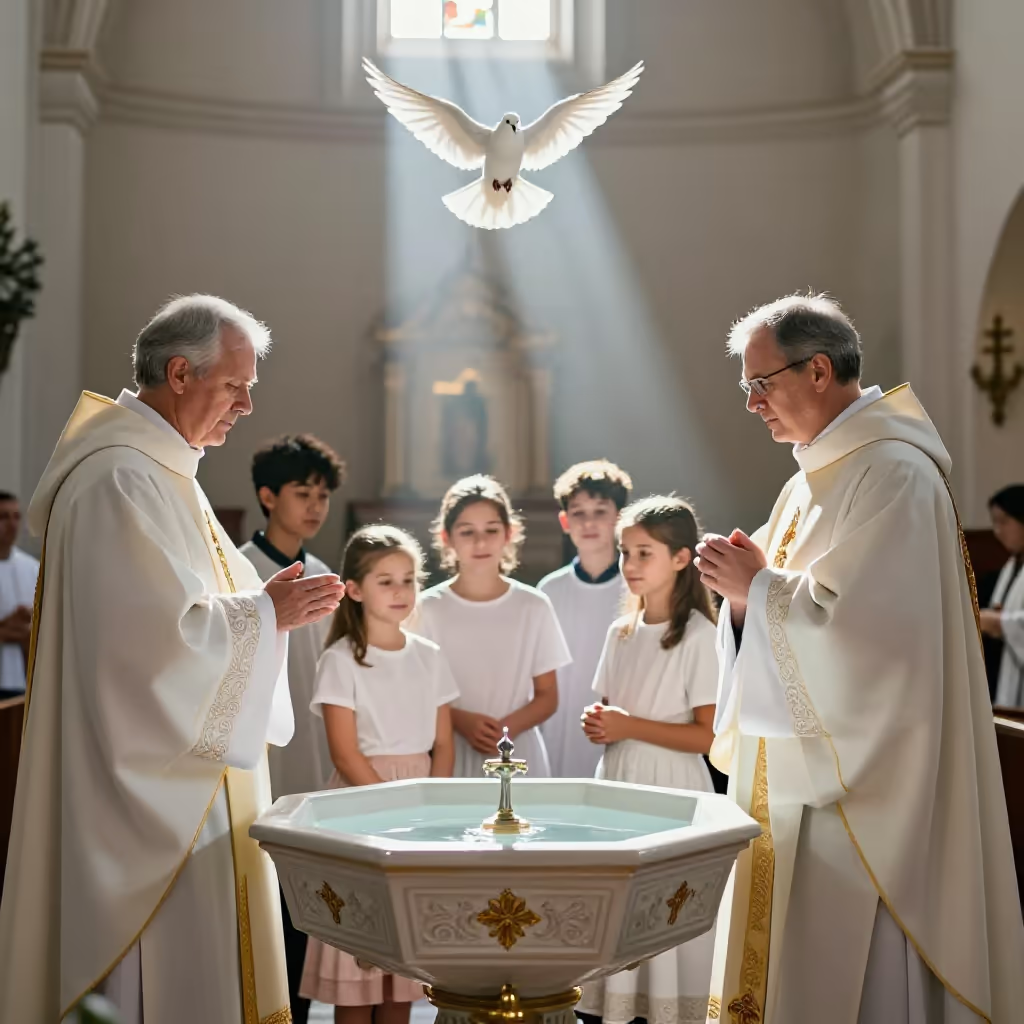
Holy Spirit
In Christianity, the third person of the divine Trinity.
An Pfingsten feiern Christen die Sendung des Heiligen Geistes.
At Pentecost, Christians celebrate the sending of the Holy Spirit.
The plural 'die Geister' almost always refers to ghosts or supernatural beings. The other meanings of 'Geist' (mind, essence, alcohol) are usually used in the singular.
Glaubst du an Geister?
Do you believe in ghosts?
The word family of 'Geist' (spirit/mind) helps with understanding. Adjectives like 'geistig' (mental) or verbs like 'begeistern' (be-geistern, literally: to infuse with a spirit) relate to the mind or soul.
Regelmäßiges Lesen fördert die geistige Fitness.
Regular reading promotes mental fitness.
When 'Geist' (mind) refers to the intellect, it is often described with adjectives like 'scharf' (sharp), 'wach' (alert), 'klar' (clear), or 'brillant' (brilliant).
Trotz ihres hohen Alters hat sie noch einen sehr wachen Geist.
Despite her advanced age, she still has a very alert mind.
To describe the 'Essenz' (essence) or 'Charakter' (character) of something, the structures 'im Geist von...' (in the spirit of...) or 'der Geist der/des...' (the spirit of the...) are often used. A well-known example is the word 'Zeitgeist'.
Die Entscheidung wurde ganz im Geist der Unternehmensphilosophie getroffen.
The decision was made entirely in the spirit of the company's philosophy.
The expression 'seinen Geist aufgeben' (to give up the ghost) is used colloquially for devices that break down. The possessive pronoun ('sein', 'ihr') agrees with the device.
Meine alte Waschmaschine hat gestern endgültig ihren Geist aufgegeben.
My old washing machine finally gave up the ghost yesterday.
In the context of drinks or distilleries, 'Geist' (spirit) refers to an alcoholic spirit obtained through distillation. It often appears in compound words such as 'Himbeergeist' (raspberry spirit).
Als Digestif bestellten wir einen Obstler, einen klaren Geist aus Äpfeln und Birnen.
As a digestif, we ordered an Obstler, a clear spirit made from apples and pears.
meaning / sense
The Sinn of a rule or project is its intended meaning or purpose. Geist, on the other hand, refers to the underlying attitude or character expressed in it. Sinn is the right choice when asking about the goal; Geist is used for the guiding attitude.

Der Geist des Projekts zeigt sich im offenen und respektvollen Umgang der Abteilungen.
The spirit of the project is reflected in the open and respectful way the departments interact.
Der Sinn des Projekts ist, dass alle Abteilungen ihre Erfahrungen teilen.
The purpose of the project is for all departments to share their experience.