

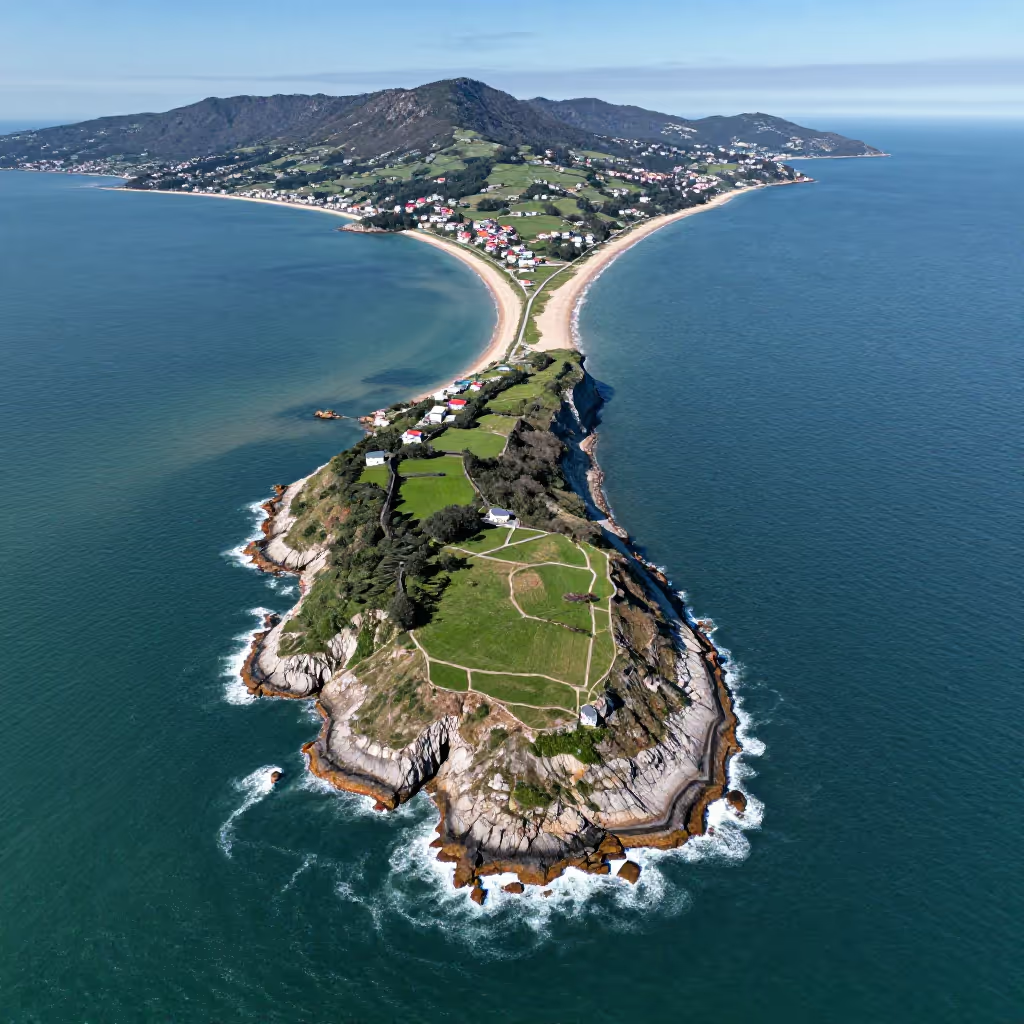
A piece of land that is surrounded by water on three sides and connected to the mainland on only one side.
example
Die koreanische Halbinsel liegt zwischen dem Gelben Meer und dem Japanischen Meer.
The Korean Peninsula lies between the Yellow Sea and the Sea of Japan.
Usage tips
Word composition
The word is made up of 'halb' (half) and 'Insel' (island). An island is completely surrounded by water; a 'Halbinsel' (peninsula) is only 'half' surrounded, that is, on three out of four sides.
EXAMPLE
Italien ist eine berühmte Halbinsel, die wie ein Stiefel geformt ist.
Italy is a famous peninsula shaped like a boot.
Correct preposition
To describe a place or an activity on a peninsula, you use the preposition 'auf' with the dative.
EXAMPLE
Wir haben unseren Urlaub auf der Halbinsel Krim verbracht.
We spent our vacation on the Crimean Peninsula.
Geographic names
The word 'Halbinsel' (peninsula) is often part of geographic proper names. In these cases, it usually comes after the actual name.
EXAMPLE
Die Iberische Halbinsel umfasst die Länder Spanien und Portugal.
The Iberian Peninsula includes the countries Spain and Portugal.
Compare with
confusable
Halbinsel vs Insel
island
'die Insel' and 'die Halbinsel' both describe land near water. The difference is simple but important: an island is completely surrounded by water. A peninsula is surrounded by water on only three sides and remains connected to the mainland on one side. The words can be confused because both can look like separate pieces of land in the water. If you cannot reach the mainland at all without a bridge or boat, it is an island. If there is still a natural land connection, it is a peninsula.
Halbinsel
Die Halbinsel ragt weit ins Meer, ist aber im Norden mit dem Festland verbunden.
The peninsula extends far into the sea, but it is connected to the mainland in the north.
Insel
Im Sommer fahren wir mit der Fähre auf eine kleine Insel.
In the summer, we take the ferry to a small island.