

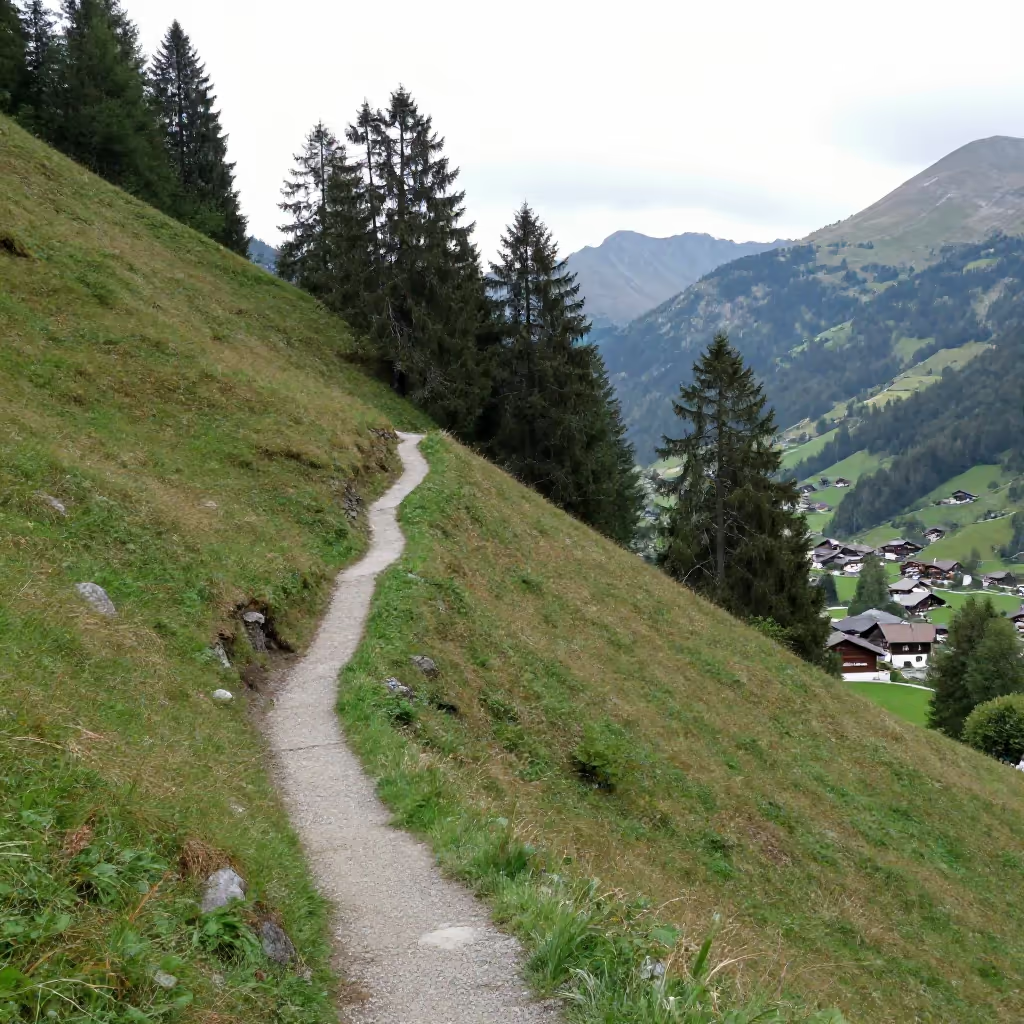
der Hang
slope
An inclined, downward-sloping surface on a mountain or hill.
EXAMPLE
Die Kinder rodelten den steilen Hang hinunter.
The children sledded down the steep slope.
slope / tendency
Loading your saved state.
slope
An inclined, downward-sloping surface on a mountain or hill.
Die Kinder rodelten den steilen Hang hinunter.
The children sledded down the steep slope.

tendency toward
An inclination or inner urge toward a particular behavior or trait, often one viewed negatively.
Er hat einen Hang zur Übertreibung, wenn er Geschichten erzählt.
He has a tendency toward exaggeration when he tells stories.
You can recognize the meaning from the context. If it is about mountains, hills, or skiing, it refers to the inclined surface. If the word appears with 'zu' and describes a person, it refers to a character tendency.
Am steilen Hang war das Wandern sehr anstrengend.
Hiking on the steep slope was very exhausting.
For the geographic meaning, the prepositions are important. A position is described with 'am Hang' (on the slope), and movement with 'den Hang hinauf' (up the slope) or 'den Hang hinunter' (down the slope).
Unser Haus steht direkt am Hang mit Blick auf das Tal.
Our house stands right on the slope with a view of the valley.
The figurative meaning is almost always used in the fixed expression 'einen Hang zu etwas haben' (to have a tendency toward something). The preposition 'zu' is always followed by the dative.
Sie hat einen Hang zu dramatischen Auftritten.
She has a tendency toward dramatic appearances.
The tendency is often meant in a slightly negative or ironic way. Typical combinations are 'ein Hang zur Unordnung' (a tendency toward messiness), 'ein Hang zum Perfektionismus' (a tendency toward perfectionism), or 'ein Hang zur Melancholie' (a tendency toward melancholy).
Sein Hang zum Perfektionismus macht die Zusammenarbeit manchmal schwierig.
His tendency toward perfectionism sometimes makes working together difficult.
tendency / trend
Tendenz and Hang can both describe a personal inclination toward a certain behavior. Tendenz is more neutral and often describes a recurring pattern. Hang usually suggests a stronger inclination and often refers to behavior viewed negatively.

Jonas hat einen ausgeprägten Hang dazu, Entscheidungen bis zum letzten Moment aufzuschieben.
Jonas has a pronounced tendency to put off decisions until the last moment.
Jonas hat die Tendenz, Entscheidungen lange aufzuschieben.
Jonas tends to put off decisions for a long time.