

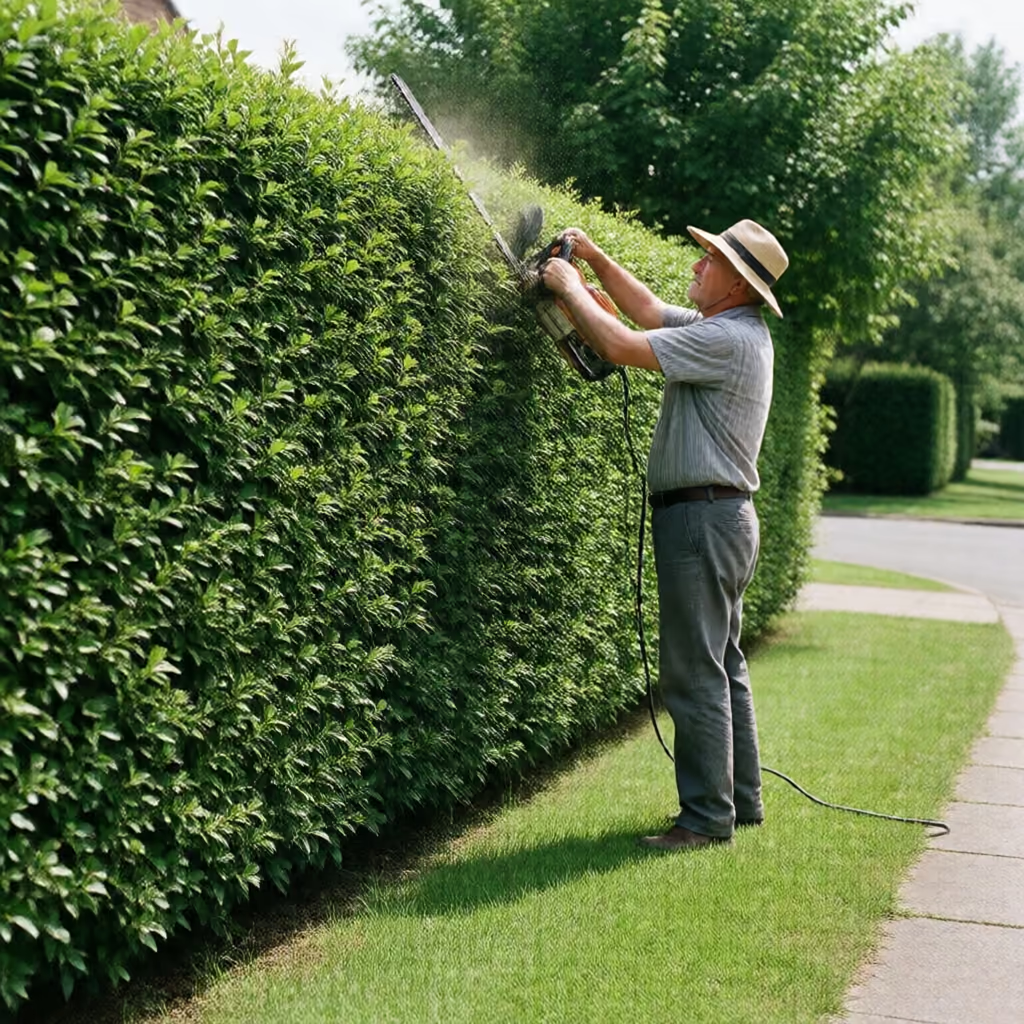
die Hecke
hedge
A densely planted row of shrubs that often serves as a boundary, privacy screen, or fence.
EXAMPLE
Die Hecke trennt unseren Garten vom Gehweg.
The hedge separates our garden from the sidewalk.
hedge
die Hecke, die Hecken
Loading your saved state.
hedge
A densely planted row of shrubs that often serves as a boundary, privacy screen, or fence.
Die Hecke trennt unseren Garten vom Gehweg.
The hedge separates our garden from the sidewalk.
| gender | feminine die |
|---|---|
| plural | die Hecken |
| genitive | der Hecke |
| singular | plural | |
|---|---|---|
| nominative | die Hecke | die Hecken |
| accusative | die Hecke | die Hecken |
| dative | der Hecke | den Hecken |
| genitive | der Hecke | der Hecken |
The article changes with the case; it is shown in colour.
Typical collocations include „eine Hecke pflanzen“ (to plant a hedge), „eine Hecke schneiden“ (to trim a hedge), and „eine Hecke stutzen“ (to prune a hedge). Schneiden and stutzen refer to regular maintenance and achieving the desired shape.
Wir müssen die Hecke schneiden, damit sie nicht zu weit auf den Gehweg wächst.
We need to trim the hedge so that it doesn't grow too far onto the sidewalk.
With „eine Hecke aus“ (a hedge made of) and the name of a plant in the dative, you can specify which plants make up the hedge. This collocation is useful, for example, when planning a garden or buying plants.
Wir haben eine Hecke aus Buchen gepflanzt.
We planted a hedge made of beech trees.
In „hinter der Hecke“ (behind the hedge), der Hecke is in the dative: the phrase indicates a location. „Hinter die Hecke“ (behind the hedge) uses the accusative and indicates the destination of a movement.
Die Mülltonnen stehen hinter der Hecke.
The garbage bins are behind the hedge.
Wir stellen die Mülltonnen hinter die Hecke.
We are putting the garbage bins behind the hedge.