

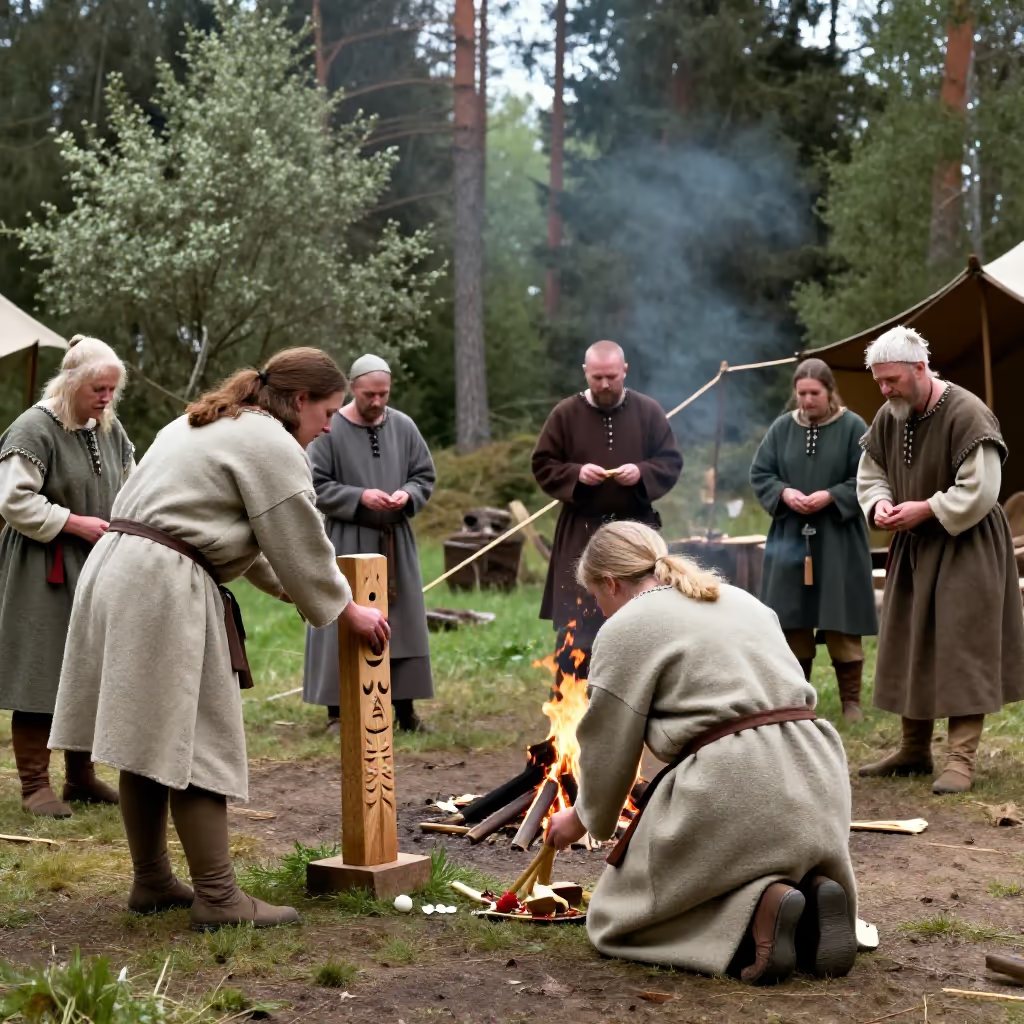
Relating to the polytheistic religions and cultures of antiquity and the pre-Christian period, especially the Germanic, Celtic, Roman, or Greek ones. Followers of these religions are referred to as pagans.
example
Die Wintersonnenwende war ein wichtiges heidnisches Fest der Germanen.
The winter solstice was an important pagan festival of the Germanic peoples.

Usage tips
Word family
The adjective 'heidnisch' (pagan) is derived from the noun 'der Heide' (pagan; plural: die Heiden). A Heide is a person who belongs to a pagan religion.
EXAMPLE
Historiker erforschen die Lebensweise der alten Heiden.
Historians research the way of life of the ancient pagans.
Typical collocations
In its historical meaning, 'heidnisch' (pagan) is often combined with terms such as 'heidnische Götter' (pagan gods), 'heidnische Rituale' (pagan rituals), 'heidnische Bräuche' (pagan customs), or 'heidnische Feste' (pagan festivals).
EXAMPLE
Viele unserer heutigen Weihnachtsbräuche haben heidnische Wurzeln.
Many of our present-day Christmas customs have pagan roots.
Context clue
The historical meaning (m01) can be recognized through connections with ancient or pre-Christian topics. The figurative meaning (m02) often describes a modern, non-religious lifestyle from a critical, religious perspective and is less common.
EXAMPLE
Archäologen fanden eine alte heidnische Kultstätte.
Archaeologists found an old pagan cult site.
Register and style
The use of 'heidnisch' (pagan) in the sense of 'ungläubig' (godless / unbelieving) or 'nicht-religiös' (non-religious) can today be perceived as outdated or derogatory. It is mostly used only in a very conservative or ironic context.
EXAMPLE
Er nannte unseren Konsum am Black Friday mit einem Augenzwinkern ein „heidnisches Ritual“.
With a wink, he called our Black Friday consumption a 'pagan ritual.'
Compare with
antonym
heidnisch vs christlich
Christian
'christlich' and 'heidnisch' can express a religious contrast. 'christlich' refers to Christianity, its teachings, culture, or followers. 'heidnisch' often refers to pre-Christian or non-Christian religions, especially from antiquity or old Germanic and Celtic cultures. In historical texts, the contrast is especially clear: Christian customs on one side, pagan customs on the other. You should use 'heidnisch' carefully because, depending on the context, it can sound judgmental.
heidnisch
Im Museum sahen wir Schmuck aus einer heidnischen Kultur.
At the museum, we saw jewelry from a pagan culture.
christlich
Das Dorf hat eine alte christliche Kirche im Zentrum.
The village has an old Christian church in the center.