

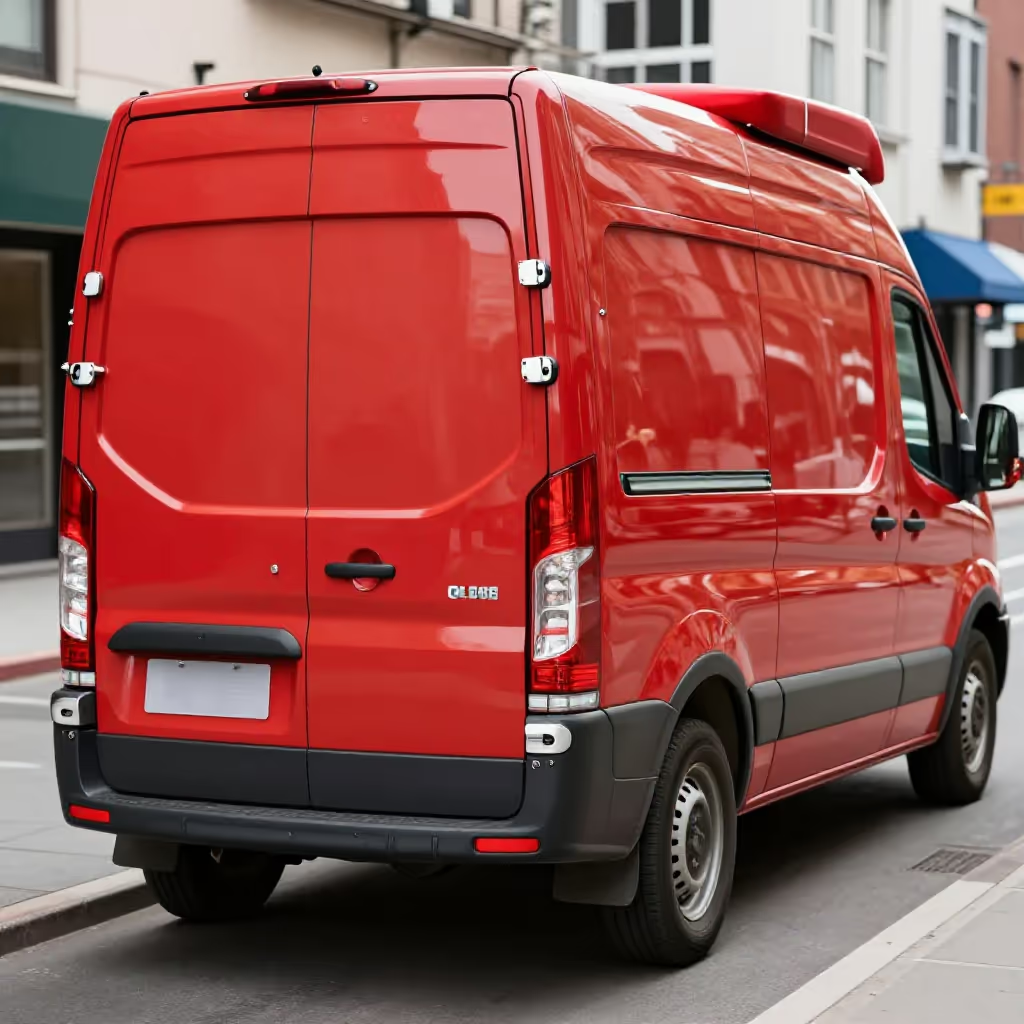
hinten
at the back
Indicates a position located in the rear part, on the back side, or at the end of something.
EXAMPLE
Im Bus waren nur noch ganz hinten Plätze frei.
On the bus, there were only seats free right at the back.
at the back / behind
Loading your saved state.
at the back
Indicates a position located in the rear part, on the back side, or at the end of something.
Im Bus waren nur noch ganz hinten Plätze frei.
On the bus, there were only seats free right at the back.

to get in line at the back
To join the end of a queue.
Wenn du auch ein Ticket willst, musst du dich hinten anstellen.
If you want a ticket too, you'll have to get in line at the back.

to make no sense at all
An idiomatic expression that means something is completely illogical, wrong, or inconsistent.
Seine Erklärung für die Verspätung stimmt hinten und vorne nicht.
His explanation for being late makes no sense at all.
'Hinten' belongs to a word family that describes positions. 'Hinten' is the adverb (Wo? → hinten; Where? → at the back), 'hinter' is the preposition (hinter dem Haus; behind the house), and 'hintere' is the adjective (die hintere Tür; the back/rear door).
Die hintere Bremse am Fahrrad funktioniert nicht.
The rear brake on the bike doesn't work.
The adverb 'hinten' (at the back) always describes a position and answers the question 'Wo?' (Where?). It does not express movement or direction.
Wo sitzt du im Kino am liebsten? Ich sitze gern ganz hinten.
Where do you like to sit in the movie theater? I like sitting right at the back.
The phrase 'sich hinten anstellen' (to get in line at the back) means to join the end of a queue. It can also be used metaphorically to mean 'to have to wait' or 'to not be that important.'
Wer zuerst kommt, mahlt zuerst. Alle anderen müssen sich hinten anstellen.
First come, first served. Everyone else has to get in line at the back.
The idiom 'das stimmt hinten und vorne nicht' (that doesn't add up at all) is a strong expression used to say that something is completely wrong, illogical, or contradictory.
Er sagt, er war krank, aber ich habe ihn in der Stadt gesehen. Seine Geschichte stimmt hinten und vorne nicht.
He says he was sick, but I saw him in town. His story doesn't add up at all.
behind
„Hinter“ and „hinten“ can both indicate a position in the rear area. „Hinter“ is a preposition and needs a reference object, while „hinten“ names the location on its own. Use „hinter“ for a precise relationship to something and „hinten“ when the rear area is already clear.

Der Rucksack liegt hinten im Klassenzimmer.
The backpack is at the back of the classroom.
Der Rucksack liegt hinter dem Stuhl.
The backpack is behind the chair.