


über ... hinweg
over / across
Expresses a duration of time or the bridging of a spatial distance.
EXAMPLE
Über die Jahre hinweg hat sich ihre Freundschaft vertieft.
Over the years, their friendship has deepened.
away / over
Loading your saved state.
over / across
Expresses a duration of time or the bridging of a spatial distance.
Über die Jahre hinweg hat sich ihre Freundschaft vertieft.
Over the years, their friendship has deepened.
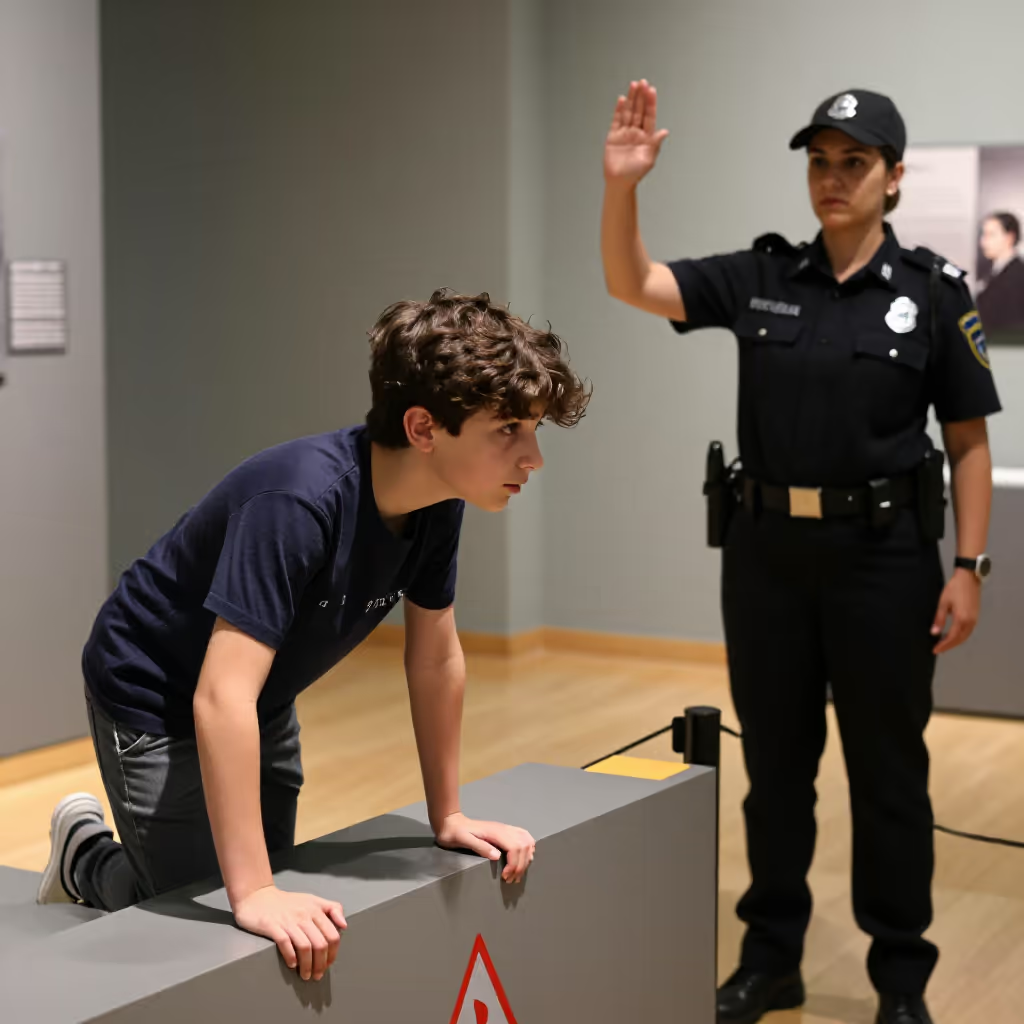
to disregard
To consciously ignore or disregard a rule, an order, or another person's wishes.
Er hat sich einfach über die Anweisungen seines Chefs hinweggesetzt.
He simply disregarded his boss's instructions.

to help through
To support someone in overcoming a difficult time or a painful feeling, such as grief or disappointment.
Gute Freunde haben ihr über die schwere Trennung hinweggeholfen.
Good friends helped her through the difficult breakup.

to overlook
To intentionally not pay attention to or ignore a mistake, a problem, or inappropriate behavior.
Bei einem so kleinen Fehler kann man ausnahmsweise mal hinwegsehen.
With such a small mistake, one can make an exception and overlook it.
The adverb consists of 'hin' (movement away from the speaker) and 'weg' (away). It is often used as a postposition or as part of a separable verb to express overcoming something or distance.
Er schaute über die Menschenmenge hinweg zum Horizont.
He looked over the crowd toward the horizon.
In its spatial or temporal meaning, 'hinweg' often appears as a postposition with 'über' and an accusative object. The structure is: 'über [etwas/jemanden] hinweg' (over/across [something/someone]).
Wir sind über die alte Brücke hinweg gefahren.
We drove over the old bridge.
The expression 'sich über etwas hinwegsetzen' means to consciously ignore a rule or a wish. Pay attention to the reflexive pronoun 'sich' and the accusative after 'über'.
Sie setzte sich über die Bedenken ihrer Eltern hinweg und reiste allein.
She disregarded her parents' concerns and traveled alone.
The expression 'jemandem über etwas hinweghelfen' means to support someone during a difficult time. The person being helped is in the dative, and the difficulty is in the accusative after 'über'.
Seine Familie half ihm über den schweren Verlust hinweg.
His family helped him through the difficult loss.
The expression 'über etwas hinwegsehen' means to intentionally ignore a mistake. What is being ignored is in the accusative after 'über'.
Der Lehrer hat über den kleinen Fehler im Test hinweggesehen.
The teacher overlooked the small mistake in the test.
through
Hinweg is used with „über“ and here describes bridging a distance in space. Hindurch, by contrast, emphasizes movement through the inside of something to the other side. So a train travels over a valley, but through a tunnel.

Der Zug fährt auf einer hohen Brücke über das Tal hinweg.
The train travels across the valley on a high bridge.
Der Zug fährt durch einen langen Tunnel hindurch.
The train travels through a long tunnel.