
A state or place of extreme suffering, pain, or chaos. Often used metaphorically for a very unpleasant situation.
example
Wegen des Staus auf der Autobahn war die Fahrt zur Arbeit die reinste Hölle.
Because of the traffic jam on the highway, the drive to work was pure hell.
Usage tips
Movement and location
The prepositions are important here. Movement to this place is expressed with 'in die Hölle' (to hell; accusative). A state or stay there is described with 'in der Hölle' (in hell; dative).
EXAMPLE
Er wünschte seinen Feind in die Hölle.
He wished his enemy to hell.
Typical collocations
In the figurative sense, 'Hölle' (hell) is often intensified. Common expressions are 'die reinste Hölle' (pure hell) or 'die Hölle auf Erden' (hell on earth), used to describe an extremely unpleasant situation.
EXAMPLE
Das Warten in der Schlange war die reinste Hölle.
Waiting in line was pure hell.
Religious context
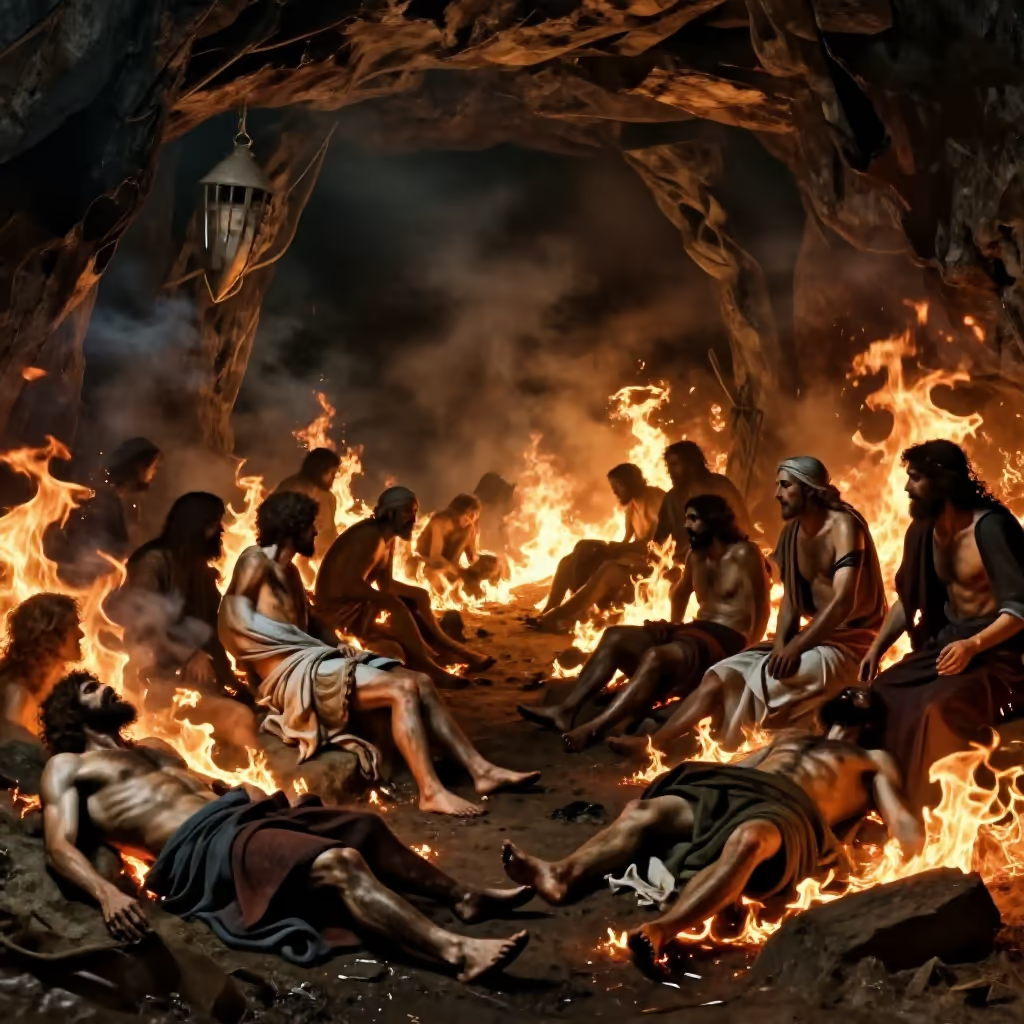
The literal, religious meaning of 'Hölle' (hell) is mostly found in texts about religion, mythology, or, figuratively, morality. Typical words in this context are 'Teufel' (devil), 'Sünde' (sin), or 'ewige Verdammnis' (eternal damnation).
EXAMPLE
In vielen Glaubensvorstellungen ist die Hölle ein Ort der Bestrafung.
In many belief systems, hell is a place of punishment.
Fixed expression
In the idiom 'die Hölle los sein' (all hell to break loose), 'die Hölle' is the subject of the sentence. The structure is fixed and describes a very loud, chaotic, or lively situation.
EXAMPLE
Auf der Party war wirklich die Hölle los.
At the party, all hell really broke loose.
Dative construction
The expression 'jemandem die Hölle heiß machen' (to give someone hell) requires a person in the dative. This person is the one you are causing trouble for or putting under pressure.
EXAMPLE
Der Trainer machte der Mannschaft nach der Niederlage die Hölle heiß.
The coach gave the team hell after the defeat.
Compare with
antonym
Hölle vs Himmel
sky / heaven
'der Himmel' and 'die Hölle' often form a strong contrast. In a religious context, 'der Himmel' stands for the good place with God after death, while 'die Hölle' stands for a place of punishment and suffering. The words are also used as opposites figuratively: 'Himmel' can mean perfect happiness, while 'Hölle' can mean a very bad or chaotic situation. Important: 'Himmel' can also simply mean the space above the earth; in this meaning, 'Hölle' is not a direct opposite.
Hölle
Nach dem Unfall war der Verkehr in der Stadt die Hölle.
After the accident, traffic in the city was hell.
Himmel
Für die Kinder war der Urlaub am Meer wie der Himmel.
For the children, the vacation by the sea was like heaven.